
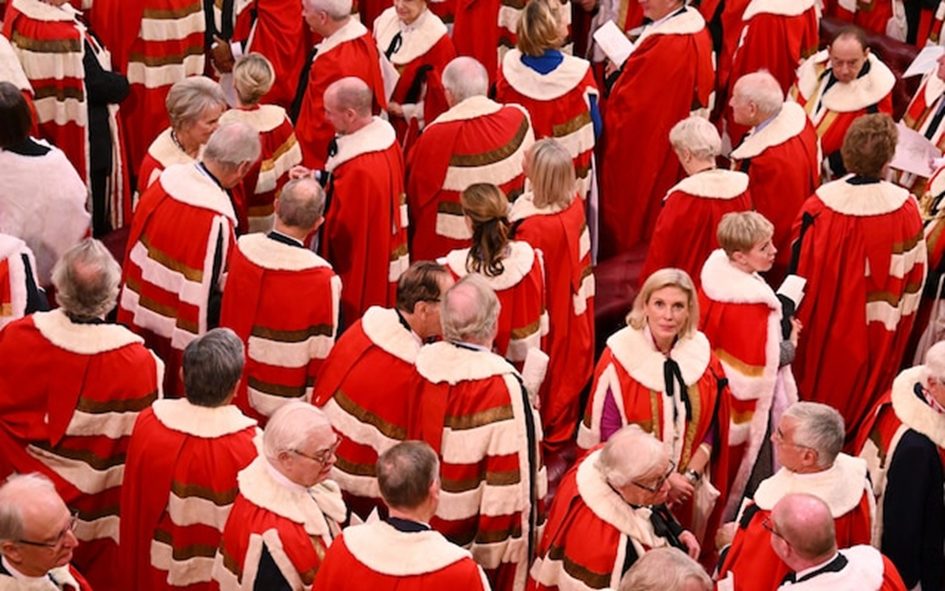
Peerage heirs in the sights of the Labour Party
The promise was contained in Sir Keir Starmer’s Labour manifesto during the 2024 general election campaign. He promised to finish the work begun by Sir Tony Blair in 1999, when he reduced the number of hereditary peers from over 750 to 92, with the primary goal of having a completely «appointed» House of Lords. Only a quarter of a century ago, the House of Lords itself, with the support of the Tories in the House of Commons, resisted and found this compromise, which was meant to be temporary. Before drawing conclusions about the usefulness of these 92 hereditary peers and comparing their role with those of other European high chambers, it is necessary to understand who they were and by what means they were assigned a seat in the Lords.
When in 1999 the upper house was reduced from 750 hereditary members to 92 – two of whom were linked to roles related to the royal protocol, therefore with a quasi-impunity status (sic) – they asked two questions: How to replace these 640 disinherited lords and how to ensure a selection for appointing the 92 hereditary lords?
The first query was found to have a solution that was at least nebulous: the members are appointed for life by the monarch, on the advice of the Prime Minister and with consultation of a Nominations Review Commission in the House of Lords. Translation: The Prime Minister draws up a list that is officially approved by the King, with sometimes some controversy on the part of the Commission.
The second was governed by an unknown, unique, and at least somewhat bizarre system: the 90 hereditary peers not concerned with royal duties were… the only elected members of the chamber! The eligible candidates were listed on a list kept up to date by the Chamber Clerk. Only peers descended from the peers ante-1999 could appear on it. 15 peers were elected by the entire chamber, 42 by the conservative hereditary peers, 2 by the Labour hereditary peers, 3 by the Liberal-Democrats, and 28 by the Cross benches, independent peers who amend and vote according to their conscience.
Almost no allowances
They were overwhelmingly men, the Salic law governing these families, and often elderly, although the difference between the Chamber as a whole and the hereditary peers was only very slight. Notably, these peers were not paid. They did receive daily allowances, but tradition required that, considering the social origin of these Lords, they were not in need of receiving salaries drawn from the taxes of their dependents.
Here then arise the following questions: what was the role of these peers, and what was the advantage of their position? By whom does the Prime Minister intend to be replaced?
The hereditary peers therefore did not come for the salary, not by obligation (they had to show their interest in being elected) and not in the hope of a social advancement.
At the service of the Nation
They worked in the interest of the Nation. Many of them were former military personnel, and the reason why the Conservative Party campaigned for their preservation was not their relative majority within it – the Tories also benefit from this within their appointed peers – but because they considered that these peers possess an advantage that is sorely lacking for politicians both on the other side of the Channel and in the hexagon: disinterest. These peers were educated to have a sense of responsibility not only for their own sphere and their loved ones, but also for their community. By serving – and this is a very relevant point here, of «service» – in the House of Lords, which has only a power of amendment and not of blocking or censure, they had the opportunity to put this noble aspiration to good use. Moreover, their attendance rate was higher than that of their appointed peers, who often tend to be reluctant to attend regularly.
Great freedom of speech
Certainly, the hereditary peers were not strangers to a certain partisan logic, but in no way were they subject to it, due to the inalienability of their status. They could therefore afford a much broader freedom of tone and action. If there is indeed an axis that is highlighted by the Labour government today, it is the conciliatory and cooperative role. Soft power exercised by the monarch, especially during his recent visit to the United States; well, the same was true of the Lords.
A system less shocking than it seems
The argument put forward by the Labour Party was the following: “It is indefensible that on the 21ste In this century, some seats in our legislature are allocated by accident of birth.” Besides the fact that they carefully omit to name the executive, which would not pass the public opinion threshold, the Labour Party hyperbolizes and emphasizes a subject that actually deserves nuance and subtlety.
This relic of the power of the barons may resemble what Marshal Lyautey, then a captain, called the Social Role of the Officer on our side of the Channel in 1891. Indeed, here the officer, in addition to having been in many cases literally a commander, was also a father to his sons, from generation to generation, going back for one of them even to the 13th century.[2]. It was a certain appetite for the timelessness of governance, for non-interference in political games, and for personal self-sacrifice in the service of the greater good. In a nutshell, the House of Lords embodied the aristocratic ideal.
Will the House of Lords become a cemetery for elephants?
The question is not necessarily whether to regret it as such, but to consider what it was replaced with. The House of Lords seems destined to become the golden retirement haven for high-ranking officials, diplomats, and politicians from London. Since they are appointed only with the approval of the Prime Minister, an increased partisan and interest-based coloration is to be expected, not to mention the «professionalization» plans for the chamber advanced by the Labour government, which include proposing to eliminate the allowances in exchange for a salary: a whole symbol.
In the end, The English House of Lords will resemble nothing comparable in the West. No other liberal democracy possesses an organ that derives its legitimacy not from the weight of history, nor from the ballot box, or even from geographic division, as in Canada, but solely from the will of a governing body.
Jacob Rees-Mogg, a famous Conservative politician, recently commented on the issue, arguing that despite the sadness of the removal of the historical and symbolic link that the Chamber represented with British history, it is the fear of its replacement by a Club of retired power-brokers who could simply be a friendly chorus of parliamentary motions that is what terrifies him.
In a nutshell, why remove a working room in favor of a room whose only justification would be the injustice of the first one?
[1] Daniel Hannan, Labour’s cull of the Lords will soon have us clamouring for the return of hereditaries, The Daily Telegraph, 2 May 2026
[2] Lord De Clifford, whose title and charge date back to 1299, is the descendant of Robert de Clifford, who died in the service of the King at the Battle of Bannockburn in 1314, and whose ancestors accompanied William the Conqueror in 1066. This is testament to the historical importance of the institution.

 French
  English
  Chinese
  Arabic