
Let's ask the question directly, without the usual rhetorical precautions: is France still a major European power?
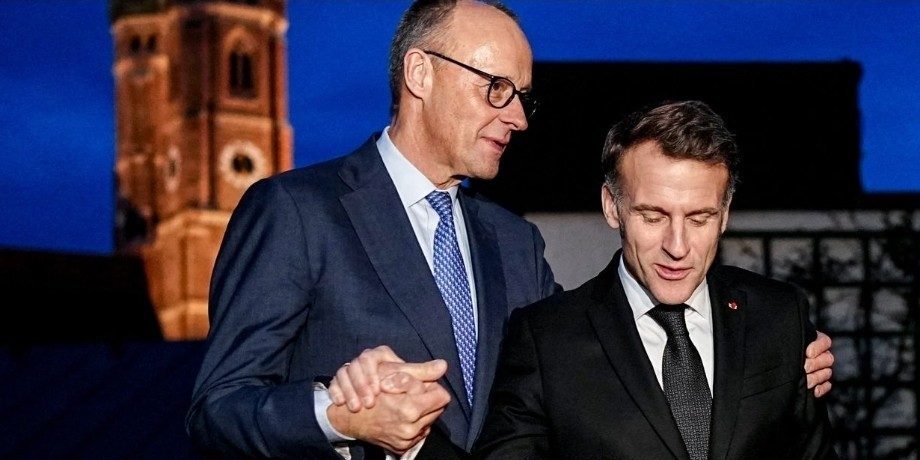
Not in the nominal sense – the seat on the Security Council, the atomic bomb, the rhetoric on sovereignty – but in the operational sense, that is to say the real capacity to impose one’s vision, to influence decisions, to pull one’s allies along. If we look at what has been happening in Berlin since the arrival of Friedrich Merz, the answer is increasingly uncomfortable for Paris: no, not really.
The historic turnaround: Germany wants Europe's most powerful army
Let's start with the defining event of 2026 in Europe: German rearmament. This is not a gradual and discreet build-up. It is a doctrine revolution that is overt, quantified, and deliberately staged. German Defence Minister Boris Pistorius has unveiled a new military strategy. The ambition is clear: to place Germany at the head of the European military procession and take European leadership in conventional deterrence. The plan is structured in three phases up to 2035, with a Bundeswehr on the horizon that is expected to surpass all the continent's armies in volume.
What does this represent for France? A direct threat to its status. France, currently in the lead with 264,000 operational military personnel, plans to recruit 11,000 soldiers while doubling the number of reservists by 2035, according to the updated 2026 military programming law. In other words: while Germany is undertaking a historic quantitative leap, France is achieving marginal growth. The widening asymmetry is not cyclical. It is structural.
French nuclear power: ultimate trump card or new bargaining chip?
This is precisely where Macron’s speech of 2 March 2026 at Île Longue takes on its full analytical significance. This speech by the President of the Republic on nuclear deterrence marks an important strategic shift. Between the persistent Russian threat and uncertainties regarding American security guarantees, France is asserting a reinforced ambition for European defence through the notion of forward deterrence.
What is advanced deterrence, concretely speaking? Macron announced that French strategic air forces could be dispersed across the depths of the European continent, like an archipelago of forces. Eight European countries have agreed to take part: Germany, the United Kingdom, Poland, the Netherlands, Belgium, Greece, Sweden and Denmark. In return, they will contribute to the «strategic backing» of the French nuclear deterrent in the areas of early warning, air defence and deep-strike capabilities.
Two interpretations clash here. The optimistic interpretation: France is transforming its nuclear monopoly into a lever for European leadership. By offering an extended umbrella, it is making itself indispensable to the continent's security and rebuilding its influence on a solid strategic foundation.
The pessimistic and more honest reading: by opening up deterrence, even partially, even in the form of doctrinal dialogue, France is gradually squandering the exclusivity that precisely forms the basis of its strategic singularity. The day deterrence becomes «European» in practice, Paris will have lost its last absolute comparative advantage.
France and Germany have also set up a high-level nuclear steering group. The latter will serve as a bilateral framework for doctrinal dialogue and the coordination of strategic cooperation, notably for consultations regarding the optimal articulation of conventional capabilities, missile defence and French nuclear capabilities. This group exists. The question that arises is: in ten years' time, who will be driving whom?
Forward deterrence is a bold yet potentially counterproductive geopolitical gamble. If Germany massively finances conventional capabilities while simultaneously benefiting from the French nuclear umbrella, Berlin acquires both pillars of military power, mass and deterrence, without paying the full political price for them. What does France get out of it? Financial contributions to its «strategic bolstering» and a promise of solidarity which the history of the Franco-German partnership has not shown to be unconditional.
The FCAS, or the metaphor for everything else
The FCAS (Future Combat Air System) programme is much more than an arms programme. It is the IQ test for a defence-oriented Europe. At the beginning of February 2026, the political nature of the FCAS changes. This programme is now openly called into question in Germany. Industrialists, trade unions and officials close to those in power are arguing in favour of an alternative fighter jet, outside the Franco-German framework. In Paris, this development is interpreted as a new sign of the weakening of a partnership that has been presented for decades as the engine of European integration.
Why is Germany sabotaging a programme it co-signed? The answer can be summed up in a single sentence by Thomas Gomart, director of the IFRI: «Previously, the Germans had time and no money. Today they have money but no time. They don't want to wait for the French.» Berlin has realised that in the race for military power forced upon it by the collapse of the post-1990 security order, Franco-German cooperation is a constraint, a slow, contentious process bogged down in endless industrial negotiations. Germany is even considering increasing its order of American F-35s, bringing the potential total to 50 aircraft. Buying American is quick, operational and politically frictionless with Washington. It is also, incidentally, effectively killing the FCAS before even officially saying so.
If the FCAS collapses, which is now likely in the medium term, the entire philosophy of European strategic autonomy championed by Macron since 2017 collapses with it. European autonomy could be short-lived to the extent that the Trump administration has discovered that American security guarantees constitute a formidable lever over its allies. Dependence on American weaponry is also a political dependence. Germany seems to have chosen to accept it. France refuses to admit it.
The real balance of power: a diminished but irreplaceable France
Here is the central paradox of the Franco-German relationship in 2026: France is objectively losing momentum financially, politically and in military volume, but it remains structurally irreplaceable.
Why irreplaceable? Because Germany, despite its 108 billion defence budget in 2026, suffers from two fundamental handicaps that money cannot buy in the short term.
First disability Germany has to face the difficulty of translating its massive investments into a genuine military doctrine, an unprecedented exercise in which it has neither prior experience nor any guarantee of success. Any military deployment of the German armed forces requires a decision by parliament, often following an intense and lengthy deliberative process. A powerful conventional army without a doctrine of employment or a culture of projection is not a military power. It is a tool without a hand.
Second handicap Berlin is still a long way from being entirely strategically independent. Devoid of nuclear weapons, its unconventional deterrence relies largely on a strong and asymmetrical strategic partnership with the United States within NATO. In periods of tension with Washington, this mechanism highlights a form of structural dependency, sometimes perceived as a strategic constraint.
This is where the real negotiation currently taking place between Paris and Berlin lies, without the two capitals having yet formally stated it. Germany needs France for its nuclear credibility and its doctrine of power. France needs Germany for its financial and industrial capabilities. The problem is that this interdependence is no longer symmetrical. It is leaning more and more towards Berlin.
Outlook: the risk of silent downgrading
In the short term (2026-2027), France is maintaining its role as a driving political power in Europe, particularly on the Ukrainian issue and forward deterrence. Its 2027 presidential election is creating a relative diplomatic vacuum that is further weakening its negotiating capacity with Berlin.
In the medium term (2028-2032), the divergence becomes visible if the Bundeswehr actually ramps up as planned, if the FCAS is abandoned or renationalised, and if France fails to find an answer to the budgetary question. 2026 could mark the entry into a decade where European countries will have to choose between strategic resignation and the active building of a credible defence sovereignty.
The only viable French scenario relies on a gamble: that forward-deployed nuclear deterrence truly becomes the bedrock of a European security architecture of which Paris holds the keys. That Germany, powerful in conventional volume, remains durably dependent on France for its nuclear credibility. And that this dependency is institutionalised within a framework where Paris retains strategic leadership.
That is possible. But that assumes France has the clarity of vision to recognise that the time for rhetoric is over. Europe is no longer debating power. It is building it, weapon by weapon, budget by budget. And in that game, words without the means are worth nothing.

 French
  English
  Chinese
  Arabic