
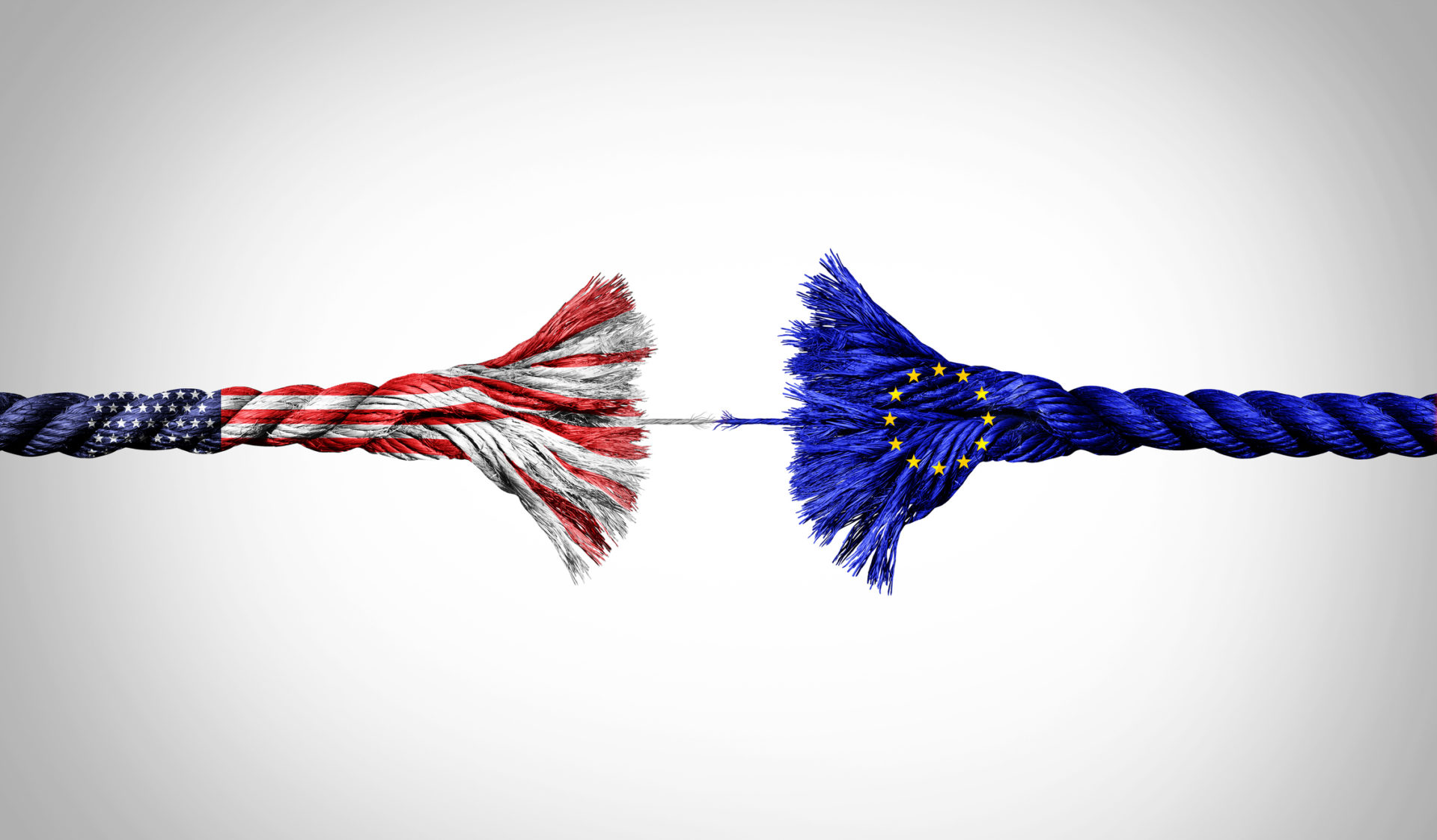
A quarrel, a symbol, an earthquake
This is not an ordinary diplomatic crisis. It is the first time since 1945 that a US president has unilaterally reduced the American military presence in Germany in response directly to the remarks of an allied chancellor. The sequence is unprecedented: a statement from Berlin, a decision by the Pentagon, a seismic shift in the Atlantic architecture.
But the detonator matters less than what it reveals. Behind the Merz-Trump dispute over Iran lies a broader question, long suppressed: has Europe, over the course of seventy-five years of American tutelage, lost the ability—and the reflex—to defend itself alone? The withdrawal from Ramstein may not be the end of an alliance. It is, more surely, the brutal mirror of a dependence that Europe had ceased to see.
Ramstein, or the weight of a symbol
Before measuring what the withdrawal means, it is necessary to measure what is being withdrawn.
Ramstein is not just another base. In 2026, it will be the largest US Air Force installation outside the United States: the headquarters of the USAFE-AFAFRICA, the headquarters of the NATO allied air command, the obligatory stop for every American soldier, every weapon and vehicle deployed from the Gulf War to Kosovo, from Iraq to the withdrawal from Afghanistan, and until the convoys of weapons to Ukraine since 2022. It also houses the satellite links and command centers that remotely control the operations of US drones in the Middle East and Africa. Its strategic footprint extends far beyond the European theater.
This is precisely what makes Trump’s decision analytically paradoxical. Removing troops from Germany is to sanction Berlin — but it is above all to deprive Washington of an irreplaceable tool for global projection. The operational cost for Washington — relocation of logistical chains, loss of responsiveness on the Russian and Iranian flanks, weakening of NATO air command — far exceeds the 2 billion euros per year that the bases generate for the German local economy.
The paradox lies at the heart of the analysis: this punitive act is, objectively, more costly for the one who inflicts it than for the one who suffers it. Is Trump bluffing about an asset he cannot afford to lose? Or is he calculating that Europe, under pressure, will have no choice but to fund its own defense — thereby freeing Washington for its true strategic horizon, the Indo-Pacific?
The long history of a given dependency
To understand the 2026 shock, we must go back to its genesis. The American presence in Germany is not the product of an ordinary treaty: it is the result of three successive shifts, each having consolidated a dependence that we ended up mistaking for a natural order of things.
The first turning point is the Cold War
Between 1949 and 1991, Germany — a semi-sovereign state, a defeated power in the process of rehabilitation — welcomed the American military presence as an implicit condition for its reintegration into the Western order. The treaty called «2+4», signed in September 1990, crystallizes this balance with surgical precision: the two Germanies and the four victorious powers of 1945 — the United States, the Soviet Union, the United Kingdom, and France — jointly regulate the conditions for reunification.
Germany thereby reclaims its full formal sovereignty, renounces the nuclear weapon, and accepts limits on its military forces. In return, the Western allies commit to maintaining their presence on its soil. This is not an ordinary peace treaty — it is the birth certificate of a consented suzerainty: Berlin rules, Washington protects, and Ramstein is the concrete guarantee. In practice, reunified Germany exercises its influence under the umbrella of the American nuclear umbrella — not by coercion, but by rational calculation. Security is externalized; national energy is devoted to reconstruction, then to economic power.
The arrangement is clear, if not explicit: security against strategic vassalage. Ramstein is the physical lock, the concrete and steel manifestation of a granted protectorate.
The second turning point is that of illusion
From 1991 to 2022, the fall of the wall opens a long period of strategic nonchalance. Germany reduces its military spending to 1.2 % % of GDP, relying on the Walking through the trade — the doctrine that trade transforms regimes and dissolves conflicts — and delegates its security to Washington without apparent remorse. The German power becomes economic, commercial, normative. It thrives. And for three decades, this prosperity masks a growing vulnerability, which Putin will expose in February 2022.
The third turning point is that of forced awakening
The invasion of Ukraine breaks the logic of Walking through the trade and forced Chancellor Scholz to proclaim it turning point — the turning point. In 2026, German defense spending will exceed 3 % % of GDP; projects to deploy Tomahawk missiles on German soil are currently under discussion. Berlin is rearming at a pace that post-war Germany had never experienced before.
This is where the most striking contradiction of the current crisis lies: Germany emancipates militarily at the very moment when its historical ally announces its partial withdrawal. Dependence does not disappear — it transforms, under coercion, into something that resembles autonomy. But an accelerated, incomplete, and for the time being fragile autonomy.
Trump’s withdrawal is therefore not the cause of this mutation: it is its brutal accelerator. To understand its real logic, we must dissect its anatomy.
Anatomy of a withdrawal: coercion or recomposition?
The withdrawal of 5,000 American soldiers from Germany resists any one-sided interpretation. This is precisely what makes it the most complex strategic decision of recent years. Four analytical frameworks, not exclusive but complementary, allow us to unfold the logic.
Transactional coercion
Trump has a method. It is simple, consistent, and effective: threatening what the other side holds most dear to obtain what they want. The sequence of the last week of April is the perfect illustration of this. On April 28, Merz publicly declared that the Americans have «apparently no strategy» against Iran and that Tehran is «humiliating» the world’s first power. On April 30, Trump responded on Truth Social that the chancellor «doesn’t know what he’s talking about.» On May 1, the Pentagon announced the withdrawal. Three days, three acts, an implacable logic. This is not impulsiveness; it is punitive mechanics. And Trump then adds a second twist: 25 % % tariffs on European cars and trucks — hitting Berlin where it hurts doubly.
The precedent exists
During his first term, Trump had already threatened to withdraw 9,500 troops to force Berlin to increase its contributions to NATO. The threat had never been executed — but it was enough to obtain real budgetary concessions. This is the whole logic of the Trump deal: the withdrawal is not a project, it is a lever. You don’t pull it to leave — you pull it to make the other side give in. In this reading, the May 1 decision is reversible by nature: Europe has the choice between aligning itself or losing its shield. That’s it. Protection money Overthrown — not America that protects in exchange for loyalty, but America that suspends its protection until loyalty is proven.
The structural reorganization
The Trump-Merz dispute has a cyclical trigger. But it is part of a broader context that goes beyond it, and that existed largely before the statement on Iran.
For a decade, Washington has been methodically shifting the center of gravity of its strategy towards the Indo-Pacific, where the real competition is taking place — with China. In this logic, Europe is not being punished: it is being relegated. The nuance is important. One does not punish an enemy; one gets rid of a burden that has become secondary. The sites in question make it clear: Ramstein, the global logistics hub; EUCOM in Stuttgart, which coordinates all US operations in Europe; Grafenwoehr, the largest US training polygon on the continent. These three infrastructures form the backbone of the American presence in Europe. Seeing them «scaled down» is seeing this presence contract — not out of anger, but out of cold calculation. Beijing, not Moscow, now dictates the tempo.
The self-punishing paradox
It is here that the decision reveals its most disturbing dimension.
Ramstein is not just a base in Germany. It is the hub from which the United States projects its power towards Africa, the Middle East and beyond. Every drone in the Sahel, every convoy to the Levant, every emergency evacuation in the Mediterranean passes, one way or another, through Ramstein. Experts point out that the real concern of the allies is not so much the departure of 5,000 men as the American redeployment of Patriot systems and munitions to the Middle East — a move that, in turn, actually degrades the defensive posture in Europe.
The question then arises with acute clarity: who actually benefits from this withdrawal? Certainly not the Europeans. But neither do the Americans, who are weakening their own responsiveness in theaters unrelated to the German-American dispute. The real beneficiaries are elsewhere: in Moscow, which observes a weakening of NATO coordination without having to lift a finger; in Beijing, which sees a strategic vacuum being created in Europe at the very moment when Washington claims to be focusing on Asia. An act intended to punish an ally that ends up weakening the one who decides: either it is a poorly calibrated bluff, or it is a sign that other, less visible calculations are at work.
The hypothesis of relocation
Sources close to the Pentagon mention a scenario that radically changes the nature of the operation: not a withdrawal, but a relocation. The capabilities of Ramstein would be moved to Romania — a border of Ukraine, a NATO member without the strategic reticence of Berlin. In this reading, the decision is not a disengagement from Europe, but a relocation to its eastern flank: Bucharest and Warsaw rewarded, Berlin sanctioned. The rift is no longer between America and Europe — it is at the very heart of Europe, between an Atlanticist East and an West still searching for its doctrine.
These four readings are not mutually exclusive. They overlap, reinforce each other, and together reveal a Trump less impulsive than he appears to be: coercive in form, restructuring in substance. What is known with certainty is that this decision, whatever its underlying motivation, acted as a brutal revelation—highlighting fractures that Europe preferred to ignore.
The fractures revealed
Trump’s decision did not create the fractures in Europe. It made them visible. Three fault lines, in particular, now openly shape the geopolitical landscape of the continent.
The intra-European East-West divide
In the Eastern capitals, the news is greeted with less alarm than in Paris or Berlin. Warsaw, Tallinn, and Bucharest have long drawn their own conclusions about Germany’s strategic reliability.
The Ramstein format — this coalition of fifty nations formed in April 2022 to coordinate military support for Ukraine — is its revelation. It is Poland and the Baltic countries that have carried out the most consistent effort, while Berlin weighed each shipment of weapons against a doctrine of restraint inherited from the Cold War. For these countries, the American withdrawal from Germany is not a catastrophe — it is a redistribution. The Romanian base at Mihail Kogălniceanu, already in full expansion on the Black Sea, has been waiting for what the military maps have been announcing for two years: the center of gravity of NATO has moved to the East.
The real rift, ultimately, is not between Europe and America. It runs through Europe itself.
The nuclear fracture
It is the deepest and least-talked-about one. The partial withdrawal raises a question that Europe had carefully avoided: if the American umbrella retreats, who will protect the continent? The B61 bombs stationed in Büchel, Germany, as part of NATO’s nuclear sharing arrangement, embody this dependence in its most concrete form. This arrangement is based on a simple principle: American weapons, on European bases, dropped if necessary by allied aircraft. It requires total trust in the American guarantee. This trust is faltering.
French deterrence — 290 warheads, strictly national command, independent employment doctrine — is then the only European nuclear asset available. But transforming national deterrence into a collective guarantee faces two major obstacles: Paris has never accepted sharing the ultimate decision-making power, and Berlin, scarred by the memory of the Second World War, remains culturally resistant to any nuclear logic.
The question is now on the table—no longer as an academic speculation, but as a political emergency. It divides the Union between those who want to build a European substitute for the American guarantee, and those who are still waiting, hoping for Washington’s return.
The doctrinal rift
Iran is only the trigger. The underlying disagreement is older and broader: it concerns the way in which a dangerous world is managed.
Europe believes in negotiations, international institutions, and diplomatic patience. It believes that economic interdependence stabilizes regimes and prevents conflicts. The Trump administration believes the opposite: only power is understood, coercion is more effective than persuasion, and multilateralism is a constraint that the strong do not have to impose. This is not a dispute over temperaments between Trump and Merz. It is a divergence of vision on the world order — deep, lasting, and one that the Iranian crisis has simply made it impossible to evade further.
These three fractures — between Eastern and Western Europe, on nuclear issues, on doctrine — reveal a truth that Ramstein has highlighted: the crisis is not just transatlantic. It is European. Trump provided the revealing evidence. He is not the cause of it.
Three possible futures
May 1, 2026 is a crossroads, not a destination. What follows depends on concrete political choices, which neither the markets nor the military will make on behalf of governments. Three scenarios emerge — not as certainties, but as possible horizons.
The bluff that is taking place
The withdrawal is taking place in half-measures: a few thousand soldiers are returning to the United States; Ramstein has been relieved of its burden but remains operational. Behind the scenes, negotiations are resuming: Berlin agrees to increase its defense budget, Washington eases the pressure on Iran. A discreet agreement, never officially announced, puts things back roughly in place. Europe was afraid — just enough to spend a little more, not enough to really change things. Dependence continues, disguised as a «rebalanced partnership.» This is the most reassuring scenario in the short term, and the most risky in the long term: Europe misses an historic opportunity to take control of its destiny and puts it off until later what it will in any case have to face.
The forced bifurcation
The withdrawals extend to Italy and Spain. The pressure becomes unbearable. France takes over NATO air command in July 2026 — a symbol that becomes a reality. Paris and Berlin, under pressure, decide to accelerate the construction of a European defense worthy of the name: more common means, enhanced military cooperation among Europeans, and, for the first time, an open discussion on the role of French nuclear deterrence in the continent’s collective security. Europe ceases to be a protectorate to become, gradually and imperfectly, a power. This path is possible — but it requires strong agreement between Paris and Berlin, and the ability to attract allies who do not have the same priorities or the same history.
The silent disintegration
It is the least likely scenario today, and the most dangerous in ten years. In the absence of a common agreement, each country deals with it alone: Poland negotiates directly with Washington for the maintenance of American soldiers on its soil, Spain renegotiates its bases, Hungary accommodates an NATO stripped of its substance. The Alliance still exists on paper; the European Union remains a large market, but without shared strategic ambition. Security has become a national matter. Europe is not collapsing — it is festering, slowly, without noise. This is not war. It is organized impotence.
The most likely trajectory combines the first two scenarios: enough sustained American pressure to force real changes in Europe without going as far as a total break. But the final outcome depends on four unknowns that remain open in the spring of 2026: the ability of Paris and Berlin to speak with one voice in the coming months; the outcome of the Iranian conflict, towards escalation or towards the negotiating table; the results of the midterm elections in November, which could weaken or strengthen Trump; and finally the stance of Moscow, which observes the Western disunity with undisguised interest. None of these variables is fixed. All are in motion.
Europe facing itself in the mirror
May 1, 2026 may remain as a turning point date
No, not because the transatlantic alliance has broken down, but because it revealed, for the first time since 1945, its own fragility. America has not abandoned Europe. It simply demonstrated, over the course of three days, that it had the capacity to do so. That is a considerable nuance — and a lesson that the European continent will have to ponder for a long time.
Seventy-five years of American guarantees have generated, in Europe, a form of strategic comfort whose effects are now visible. Security, assured from the outside, has gradually ceased to be perceived as a self-evident responsibility. Military budgets have been compressed. Energy dependence on Russia has been rationalized as a stabilizing lever. These choices, understandable in the context of the post-Cold War era, have over the decades deepened a vulnerability that the invasion of Ukraine in 2022 has begun to reveal, and that the Ramstein crisis now exposes in all its extent.
What this episode highlights goes beyond the bilateral German-American relationship. It sheds light on the state of a continent that is torn by deep divisions.
Between an Eastern Europe that places its trust in the bilateral relationship with Washington, and a Western Europe that is still searching for its doctrine; between member states ready to consider real strategic autonomy, and others who prefer to wait for a return to normalcy; between two visions of the international order that the Iran dispute has made impossible to reconcile this week. These lines of division did not arise from Trump’s decision; they existed before it. He simply gave them new visibility.
Is Europe able to stand on its own two feet? ?
The question that now arises is not so much whether the United States will maintain its commitment to Europe — their strategic interests on the continent remain considerable, and the paradox of a withdrawal from Ramstein being more costly for Washington than for Berlin calls for some reversibility. The question is more fundamental: In an increasingly transactional international order, where security guarantees are negotiated more often than they are given, is Europe able to weigh in on its own—or will it remain beholden to decisions made elsewhere?
Europe is not yet post-NATO. But it can no longer afford to be pre-autonomous.

 French
  English
  Chinese
  Arabic