
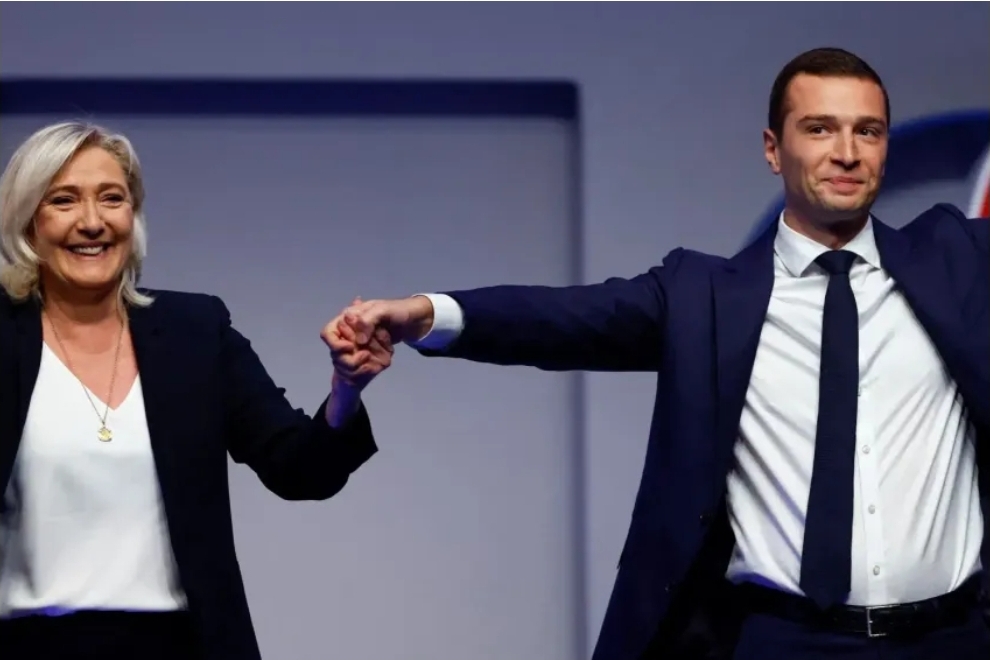
The National Rally at its peak, for the first time in its history
The figures are staggering. Jordan Bardella dominates the popularity polls with 37 % of favourable opinions, followed closely by Marine Le Pen at 34 %. They are well ahead of Édouard Philippe (32 %), Gabriel Attal (28 %) and all the left-wing candidates.
When voting for the first round of the presidential election, Bardella is polling at around 35 % according to an Odoxa poll from April 2026, figures that exceed those recorded by victorious candidates in past elections. Even more telling, a Toluna Harris Interactive poll for M6/RTL published in early May 2026 tested four first-round configurations. Depending on the scenario, Bardella would secure 34 to 35 % of voting intentions, and Marine Le Pen 32 to 33 %. These variations across configurations reveal something essential: for the first time in the history of the movement founded by Jean-Marie Le Pen in 1972, the national-populist candidate is no longer a protest phenomenon to be contained, but a serious contender for the Élysée.
This is no coincidence. Since 2017, Marine Le Pen has pursued a patient, painstaking strategy of detoxification, decried by her own people but ultimately effective. The party has become normalised at the ballot box, in town halls, and in people's minds. Jordan Bardella is the natural heir to this: young, media-savvy, and free from the stigma of the «old RN», he embodies the post-war generation.
The legal sword of Damocles
However, the picture is fractured by a judicial reality that weighs heavily on everything. On 31 March 2025, Marine Le Pen was sentenced to four years in prison, two of which are firm under electronic tag, as well as a 100,000 euro fine and a five-year ban on holding public office with provisional enforcement, a sentence that would prevent her from standing in elections until 2030, including the 2027 presidential election.
The judicial timetable that follows has become the secret arena of all French political life. The appeal trial took place from 13 January to 12 February 2026, and a judgement is scheduled for 7 July 2026. This summer verdict, delivered in the sluggishness of the holidays but with winter political consequences, could uproot everything. For Marine Le Pen, the stakes are crucial: only an acquittal or a sentence of ineligibility not accompanied by provisional enforcement would allow her to maintain her candidacy for the 2027 presidential election.
The stance of the Attorney General's office, expressed during the February hearings, dashed any hopes of leniency: the Advocates General called for the confirmation of the convictions and sentences of ineligibility right from the start of their closing submissions, pointing out that elected office does not constitute a «refuge from the law, but the highest standard of integrity». This phrasing sounded like an anticipatory verdict in the corridors of the RN.
What the appeal court will decide this summer is not just the criminal fate of a politician: it is the shape the French presidential election will take. The confirmation of the sentence of ineligibility would be a severe blow for Marine Le Pen and would mechanically strengthen Jordan Bardella's position. Conversely, an acquittal or the removal of provisional enforcement would free Marine Le Pen for the campaign and put Bardella back in his role as number two, brilliant, but number two.
The double life of a party on the campaign trail
Against this backdrop of twofold judicial and strategic uncertainty, the RN is playing a delicate two-part tune. The strategy is based on a form of balance: officially, Marine Le Pen remains at the centre of the setup; unofficially, Jordan Bardella's presence helps to secure the party's future in the event of an unfavourable scenario.
This situation explains the cautious choice of words. Jordan Bardella does not say «I will be a candidate». He talks about the victory of the national camp, the fight for France, the responsibility of a generation. These expressions allow him to adopt a presidential tone without crossing the threshold of a personal announcement, occupying the ground while respecting the internal hierarchy.
It is a calculated strategy of ambiguity, which speaks volumes about the political maturity of a 30-year-old. Bardella is not trying to usurp Le Pen’s position; he is aiming to be visible enough so that, if she falls, no internal rival can seriously challenge him. The risk for the RN would be falling foul of the judicial timetable. A presidential campaign is prepared long in advance: travel, image, manifesto, team, financing, media strategy. If the party were to change candidate at a late stage, it would need a face already established in the public eye. It is precisely this role that Jordan Bardella is playing.
This dual preparation is also visible behind the programmatic scenes. According to internal sources cited by several media outlets, thematic working groups—territorial reform, energy, education, environment—have been preparing the manifesto in secret for several months, coordinated by Le Pen’s chief of staff. «On the manifesto, the essentials will be decided before the summer, by the two of them,» indicates one of the participants. A tandem mechanism—public for rallies, discreet for doctrine—which reproduces the complementarity of roles rather than revealing fractures.
The economic pivot: towards the unashamed right
The big surprise of this preparatory cycle for 2027 is ideological. The RN is no longer the party of the national welfare state that it was under the leadership of Jean-Marie Le Pen, nor even the hybrid formation of the Le Pen-daughter years which combined protectionism, defence of the public service and distrust of big business. It is currently making a liberal turn whose scale is striking.
According to a Cevipof study published in March 2026, the average point of the economic measures proposed by the RN is now clearly on the right of the economic axis, reflecting a significant break with the 2012–2022 decade. Liberal measures now account for 62 % of all the party's proposals, compared with 42 % in June 2024 and barely 21 % in the 2022 presidential election.
This movement is reflected concretely in the strategy to woo economic elites. In April 2026, while Bardella was meeting the Medef leadership, he and Le Pen addressed a letter to the heads of major French companies, promising to identify and lift the regulatory barriers that are holding back economic development. An unprecedented lunch with the employers' executive board, a few weeks after Marine Le Pen had dined privately with several CAC 40 corporate leaders, are all gestures that would have seemed unthinkable under Jean-Marie Le Pen, and even under the Marine Le Pen of the 2010s.
On a programmatic level, Bardella insists on a «major simplification ordinances project» that could be published within the first days of a potential mandate, with the stated objective of «freeing businesses from an unbearable tax and regulatory straitjacket». The vocabulary is that of unashamed liberalism. The RN also proposes scrapping property tax for first-time buyers for five years and intends to finance part of its promises by reducing immigration-related spending and by tackling tax fraud.
This shift towards economic right-wing politics is a double-edged sword. On the one hand, it allows the RN to attract a middle-class and small-business electorate that was still hesitating; on the other hand, it risks alienating the working-class and lower-class factions loyal to the movement's historical social programme. For the moment, polls seem to prove the strategy right: the electoral base remains solid, and the new profiles captured during the 2024 European elections do not appear to be put off by this shift.
Two styles, one line
What strikes you about the tandem is the complementarity of their profiles. Marine Le Pen, 57, is the heiress who transformed everything: she defascised the movement, showed her father the door, took the blow of two second-round defeats in 2017 against Macron and in 2022 in an even tighter duel, and stayed the course. She is respected, feared, and divisive.
Jordan Bardella, for his part, embodies a new political generation, with more direct communication and a strategy geared towards broadening the electorate. At the head of the party, he is gradually making his mark, multiplying his stances and strategic adjustments. His personal trajectory—the son of an Italian immigrant mother, raised in a working-class neighbourhood in the north of Paris, without a university degree—gives him a working-class authenticity that the bourgeois right-wing classes cannot fake. He appeals to both the traditional RN electorate and new profiles, particularly among young people and abstainers.
The complementarity is also generational in its form. Where Marine Le Pen prefers large rally venues and direct exchanges with journalists, Bardella masters the codes of social media with disconcerting fluency: TikTok, Instagram, short-form content. He is the first French political leader to have built a substantial part of his popularity rating on these platforms even before having held high governmental office. This mastery is not trivial: in a presidential election, the ability to saturate the media space matters just as much as the solidity of the manifesto.
The spectre of a runoff alternation
The figures from the run-off are perhaps the most instructive and unsettling for the parties of government. In the available simulations, Bardella is beaten in the second round only by Édouard Philippe (by a margin of 52-48), but wins against Glucksmann (58-42) and by a wide margin against Mélenchon (71-29). These figures mean one specific thing: the only credible barrier against an RN victory at the Élysée is the candidacy of the former Prime Minister from Le Havre, and even then, only narrowly.
This scenario, a near-victory for the RN in the second run-off, narrowly defeated by Édouard Philippe, is precisely the one that left-wing and centre strategists have been dreading for months. It assumes that the left-wing electorates (Mélenchon, Glucksmann, Tondelier, Ruffin) transfer their votes massively and in a disciplined manner to Philippe, that Macronist centrists do the same, and that a portion of the republican right overcomes its reservations. That is a lot to ask. And recent French history regarding the republican front shows that these defensive coalitions erode with every electoral cycle.
For the RN, the second round is therefore no longer a guarantee of defeat, it is now a probability of victory with a sufficiently weakened candidate facing them. This transformation of the balance of power is perhaps the most structural shift in French politics since the 2002 election.
2027: now or never
The window of opportunity is unique. On the left, the division persists between Mélenchon, Ruffin and Glucksmann, three credible candidates, with none dominant. In the centre, Macron stands at 20 % in the polls and cannot constitutionally run again, leaving a leaderless Macronist bloc desperately seeking an heir. On the traditional right, Édouard Philippe is dropping in the polls, worn down by his time managing Matignon under Macron and unable to find the right tone when facing a radical right that is stealing his vocabulary.
All these factors point to the same conclusion: never since its foundation has the National Rally been so close to supreme power. «Jordan is the only one apart from Marine who can bring us victory, we're all aware of that,» believes an RN MP in his inner circle. «2027 is now or never.»
This now-or-never moment sums up the mindset of a party which, for the first time in its history, feels capable not merely of having a say, but of winning. Yet it also reveals the fragility of a trajectory hanging on a court ruling. For if the appeal court upholds Marine Le Pen's ineligibility this summer, it will fall to Jordan Bardella, at the age of 30, to carry single-handedly the most anticipated candidacy of the Fifth Republic. A dizzying prospect for a man who has never held ministerial office, never managed a state crisis, and never been subjected to the grueling toll of a solo presidential campaign.
It remains to be seen which of the two will carry the standard. And whether justice, by ruling in the summer of 2026 on the fate of Marine Le Pen, will not be the true arbiter of the French presidential election, even before the French people vote.

 French
  English