
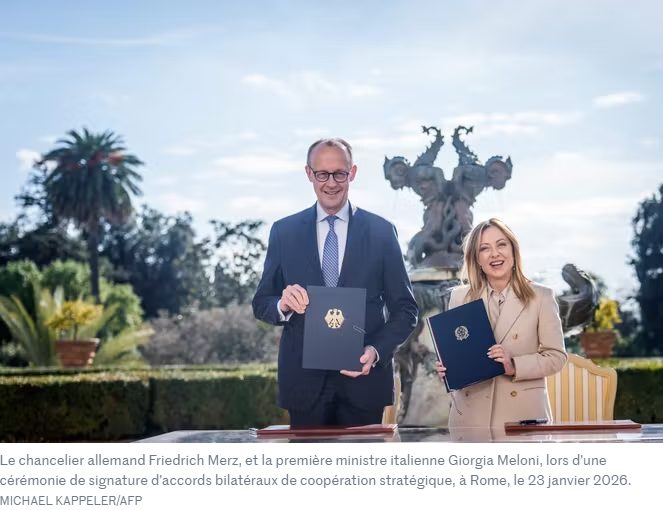
This agreement relies heavily on the 2024 Draghi report, which has become Brussels' compass. Reviving competitiveness, financing the energy transition and consolidating the defence industry are the priorities. Without shaking up the institutions, it reveals a profound shift in the balance of power within the Union.
For the countries of the southern Mediterranean, this reorganisation is no minor detail. It marks Italy’s return to the heart of the European game. It places the Mediterranean, with its migratory flows, energy resources and regional fragilities, back among the strategic priorities of the Union.
Does this tandem herald the end of the Paris–Berlin leadership? Or simply the advent of a more fragmented, more pragmatic Europe, governed more by power dynamics than by shared visions?
A still heavy European heritage
To understand this recomposition, we must go back to the eurozone crisis.
Between 2010 and 2012, Merkel and Sarkozy imposed crisis governance: rapid bilateral meetings, compromises negotiated behind closed doors, and the creation of the European Stability Mechanism. This method probably prevented the collapse of the single currency. It also left lasting scars — distrust between North and South, a feeling of budgetary discipline dictated by Berlin, and persistent disagreements over Libya, taxation and monetary policy.
In reality, the Franco-German couple has never been a joint political project.
It acted as a firewall — effective in times of acute crisis, poorly suited to fundamental shifts. Fifteen years later, this model is reaching its structural limits. The Union of 2026 is no longer facing a localised financial emergency, but an accumulation of simultaneous crises: war in Ukraine, economic slowdown, migratory pressures, industrial competition, geopolitical fragmentation. In this context, automatic reflexes are no longer enough.
Why Berlin and Rome are getting closer
This rapprochement does not result from any spectacular upheaval
It stems from a silent convergence of national interests, accelerated by the relative weakening of Paris.
Since 2024, France has seen its room for manoeuvre in Brussels shrink under the weight of its deficits. It remains influential on defence and strategic autonomy — areas where its credibility stays intact. But its budgetary fragility erodes its capacity to rally other capitals on economic dossiers, precisely where the crux of European decision-making lies today.
Friedrich Merz has drawn the consequences. At the head of a CDU refocused on fiscal discipline, he is not seeking to impose German hegemony. He is trying to stabilise a European system that is threatening to seize up. Berlin wants predictable rules, commitments kept, and solidarity conditional on real reforms.
It is precisely on this ground that Meloni has rebuilt her European credibility. Without disowning her convictions, she has swapped the nationalist tone of her beginnings for the posture of a reliable partner — within both NATO and the institutions of the Union. On migration and industrial policy, she has not given an inch. But she has understood one simple thing: Italy has more clout by playing the European game than by contesting it.
Despite considerable public debt, the Italian economy is displaying unexpected resilience. Rome is recovering a strategic influence that the Berlusconi years and then the 2011 crisis had seriously undermined.
For the countries of the Maghreb, this return is deeply significant
Italy is not a Mediterranean partner by ideology or diplomatic tradition: it is one out of geographical necessity and direct national interest. Its energy supplies depend on North African pipelines. Its coasts are on the frontline of migratory flows. Its domestic stability is linked, more than that of any other major European country, to what happens on the southern shore. It is this convergence of interests — and not superficial solidarity — that makes Rome a structurally different interlocutor from Berlin or Paris for the capitals of the Maghreb.
The Draghi report provides the operational common ground: less bureaucracy, more industrial investment, support for defence, and priority given to results over grand visions. It is not about steering Europe as a pair — but about unlocking it ahead of summits, to prevent institutional gridlock from paralysing decisions that have become urgent.
The convergences... and the limits of the tandem
Behind the image of a united front in Brussels, the Berlin-Rome understanding remains above all pragmatic
It relies less on ideological proximity than on temporarily converging geopolitical interests. The tandem works when national priorities coincide; its fragilities reappear as soon as budgetary or energy issues become sensitive.
Fundamentally, the two capitals share several orientations. They wish to ease certain European budgetary rules to facilitate strategic investment, and support an industrial revival focused on defence, semiconductors and the securing of supplies.
On migration, their convergence is perhaps the most significant for the southern neighbourhood. The goal is no longer just to control European borders, but to shift part of migration management to partner countries in North Africa and the Sahel — which mechanically reinforces the strategic weight of these states in their negotiations with Brussels.
On Ukraine, Berlin and Rome are adopting a more measured line than the Eastern European countries: financial, energy and industrial support for Kyiv, without engaging in a logic of open military escalation.
This method gives flexibility to the Union. It does not give it a vision.
Because the differences are real. Italian debt remains a source of structural tension with German budgetary rigor. On energy, Berlin is banking on liquefied natural gas and renewables; Rome is defending nuclear power and seeking to strengthen Mediterranean energy connections. On monetary policy, Germany remains attached to the fight against inflation, while Italy is pushing the ECB towards a posture more favorable to growth.
Above all, their geopolitical horizons do not overlap. Berlin looks to the East — Russia, the Balkans, Central Europe. Rome looks to the South — North Africa, energy routes, the Sahel, the wider Mediterranean. Seen from the Maghreb, this asymmetry is decisive: it explains why Italy aims for a bridging role between Europe and its southern neighbourhood, whereas Germany remains anchored in continental balances.
This alliance therefore remains flexible and reversible. It is not based on any treaty, nor does it carry any federal vision. Its strength depends on internal political balances, future economic turbulence, and migration crises. Berlin and Rome do not lead Europe — they manage its emergencies, and attempt to maintain minimal cohesion within a structurally more fragmented Union.
What this reshuffle reveals is more profound: the major stable axes are giving way to coalitions built file by file. Power in Brussels is becoming less vertical, more transactional, more fluid.
The European Union in the face of this new steering
Unlike the Franco-German couple, the Merz-Meloni tandem does not constitute a European steering committee
The Union's institutions continue to limit the influence of national capitals: the Commission retains the legislative initiative, the Eurogroup arbitrates finances, and the European Council seeks compromises between diverging interests. In this system, Berlin and Rome do not dictate the rules — they create the conditions for the rules to be acceptable.
France remains the benchmark military power in Europe — on defence and strategic autonomy, no one can do without it. But its public deficits and political instability have eroded its influence on economic dossiers. Paris no longer dictates the tempo. Berlin and Rome are not sidelining it — they are moving forward without waiting for it, and coming back to fetch it when the final agreement requires it. France is still at the table. It is no longer at the head of the table.
The rest of the Union is adjusting according to its interests. The northern countries are following German budgetary restraint. Central Europe is protecting its margins of sovereignty. The southern countries are negotiating funding and flexibility. Everyone is playing their own tune. There is no longer a conductor — there are coalitions forming, unravelling and reforming depending on the issue. This Europe is less legible and less ambitious. It is perhaps more robust, precisely because it no longer requires everyone to move at the same pace.
A new European equilibrium
The Merz-Meloni tandem does not change Europe — it reveals what it has become.
A Union which has given up governing itself through grand ambitions and is learning to govern itself through everyday management.
The Franco-German couple still carried, even clumsily, a political project for the continent. Berlin and Rome are setting themselves more modest goals: managing finances, defending industry, containing migration, and supporting Ukraine without losing themselves in the process. This is an Europe that manages what it has, rather than building what it wants.
The real question is therefore no longer who is running Europe. It is a question of where it is heading: towards an economic power capable of making its weight felt in global competition? Towards a genuine strategic autonomy, with its own defence capabilities? Or towards a permanent and defensive management of crises, condemned to undergo events rather than shape them?
The European Council of June 2026 will be a first indicator
The reform of the budgetary rules and defence financing will determine whether Berlin and Rome can turn their tactical complicity into collective momentum. But a deadline does not sketch out a horizon.
Because this reshaping goes beyond Brussels. Italy's return to the heart of the European game puts the Mediterranean back where it should always have been: at the centre of the Union's strategic priorities. Energy, migration, maritime security, trade routes, Sahel stability — the Mediterranean South ceases to be a periphery managed from afar and becomes once again a space that is closely calculated.
For the Maghreb capitals, this reconfiguration is a double-edged sword
It opens up real prospects — economic, energetic, diplomatic. But it carries a risk of structural asymmetry: seeing the southern shore reduced to a buffer zone — useful for outsourcing migration management and securing the Union's borders, without ever attaining the status of a fully-fledged partner.
The final trajectory will not be decided in Brussels. It will depend on the ability of the Maghreb countries to pit a concerted regional doctrine against the Union’s strategies of bilateralisation — which divide in order to negotiate better. The challenge is to stop appearing as a reservoir of problems to be managed, in order to assert themselves as a set of regional powers indispensable to Europe’s security, its energy transition, and its long-term stability.
Europe is now moving without a fixed course — through provisional coalitions, unstable balances, and constantly renegotiated power dynamics. This flexibility may make it more resilient. It may also prevent it from answering the question that, sooner or later, will impose itself upon it:
What power does she still want to be in the world that is building itself without her?

 French
  English
  Chinese
  Arabic