
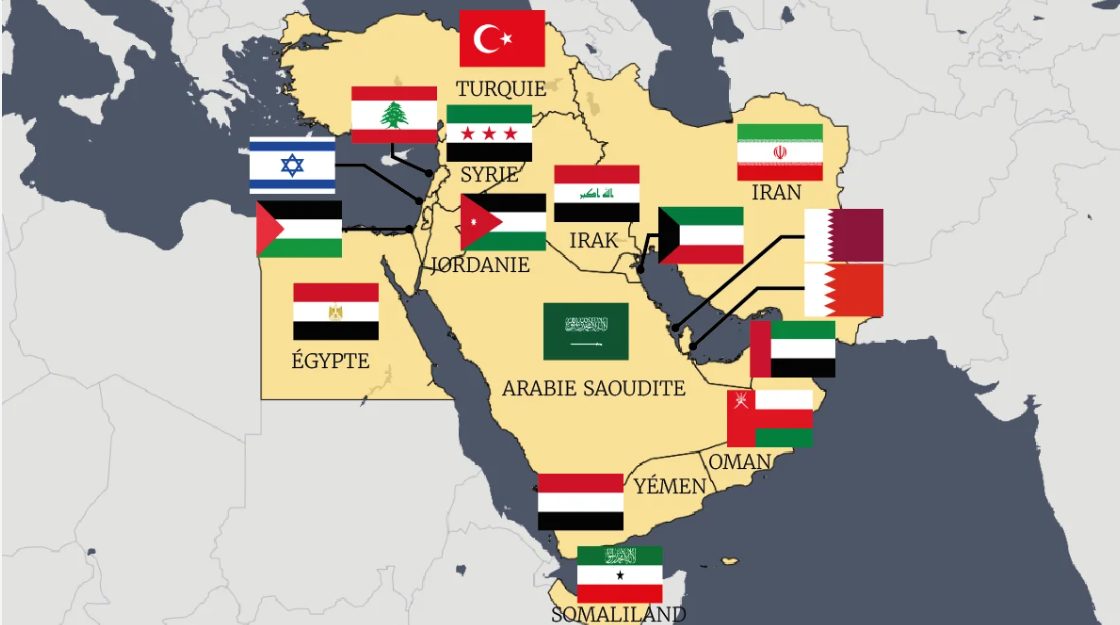
Iran: The power born of constraint
The contrast with Iran is striking.
Since the 1979 Revolution, the Islamic Republic has undergone what few contemporary states would have been able to endure for such a long period: sanctions, a military embargo, diplomatic isolation, economic pressure and, from 1980 onwards, a devastating war waged by Saddam Hussein's Iraq, supported to varying degrees by Western powers and several Arab states.
While these constraints were aimed primarily at depriving Iran of the military and technological resources to which its neighbours had access, they gradually produced an unexpected effect: they forced the country to develop its own capabilities. Missiles, drones, a military industry, ballistic capabilities and defence systems were developed over time, until the necessity for autonomy became a genuine strategic doctrine.
It is obviously not a question of absolute self-sufficiency. But the essential result lies elsewhere: Iran has acquired a military and technological autonomy that decades of sanctions were precisely intended to prevent.
This confirms that power cannot simply be decreed, but that it can also arise from a constraint that its adversaries had not anticipated.
However, this capacity for resistance cannot be understood through the Islamic Republic alone. It is rooted in a much older history.
Iran is not a creation of 1979.
Before Islam, there is Persia and a civilisational memory whose Shahnameh, Ferdowsi's Book of Kings, constitutes one of the most powerful expressions.
The Islamisation of Persia did not mean the erasure of the heritages that preceded it.
It profoundly transformed Iranian society, but without making traditions, memories, languages or earlier religious communities disappear. Zoroastrianism, the religion of pre-Islamic Iran, is thus still present in Iran. The Iranian Jewish community also has a very ancient history, dating back to the Achaemenid era, notably to the period of Cyrus the Great.
Shia Islam then became a defining feature of Persia’s political identity, particularly under the Safavids.
To this national history was added a religious memory of exceptional power: Karbala. In Shia memory, Karbala is not just an episode from the past. It embodies sacrifice, loyalty to a principle, the refusal to submit and the possibility of moral victory despite material defeat.
The Shahnameh and Karbala belong to different universes, but their gradual encounter in the history of Persia has contributed to forming a particular continuity: that of a civilisation that conceives of itself over time, that preserves the memory of its trials and that readily associates identity, resistance and loyalty.
The Islamic Revolution therefore does not arise in a historical vacuum. It gives contemporary political form to several of these legacies. The Islamic Republic of Iran intends to make Islam a guiding principle for the organisation of society and the state, in accordance with its own interpretation of the teachings of the Qur’an and Shia tradition.
This is where Iran is profoundly different Gulf monarchies.
GCC countries have followed a different trajectory: they have built their modernisation and power in a strategic environment largely guaranteed by external powers, while progressively adapting their societies to the transformations of globalisation.
Iran, for his part, made autonomy and the rejection of external dependence the central tenets of his political and strategic model. Since then, this consistency has been striking. The political independence proclaimed by the revolution was accompanied by a determination to control over its military capabilities. The rejection of foreign domination has resulted in the pursuit of autonomous capabilities. The religious conception of resistance has been extended into a regional policy based on strategic depth and the building of allied networks.
So Iran has not simply spoken of sovereignty: he organised his strategy around it.
He did not simply proclaim his refusal to depend on foreign powers: he bore the considerable costs associated with developing his own means.
He didn't simply invoke resistance: he made it a lasting principle of his regional policy. It is this consistency between theory and practice which makes it possible to understand her resilience.
This political orientation towards self-determination has however come at a cost. For decades, a section of Iranian society has paid the price for Western sanctions. They have weighed heavily on the economy, restricted trade and fostered in some Iranians a legitimate desire for openness, prosperity and a rapprochement with European societies, reflecting a model of success.
By targeting Iranian exports and restricting the country’s access to foreign currency, the international financial system and imports, the sanctions have put considerable pressure on the rial. Its depreciation has led to high inflation, resulting in a sharp decline in the population’s purchasing power.
This imposed economic deterioration has had political consequences. It does not remain an abstract reality of international relations: it is directly inscribed in the daily lives of citizens. It has thus contributed to fuelling growing discontent with the Iranian government and, at certain times, to fuelling protest movements.
Sanctions are a double-edged sword: designed to coerce the Iranian regime, they largely place the considerable cost of this pressure policy on the people.
But one day, the mirage of an idealised model ends up dissipating.
That day was 7 October 2023. The massacres that followed in Gaza served as a further wake-up call for a section of Iranian society. Western discourse on human rights and the international order was confronted with a reality that was becoming increasingly difficult to ignore: the way in which events were handled politically and in the media within liberal democracies, as well as the support given to Israel, profoundly shook perceptions of the political and international model that had hitherto been held up as a benchmark.
What was presented as an order founded on universal principles now appeared, in the eyes of some, to be subject to much more traditional geopolitical considerations.
Then comes the real turning point.
Two years later, a new threshold is crossed when the United States and Israel strike Iran directly, and an immediate strategic question arises:
Can an attack on the Iranian regime truly be dissociated from an attack on the country itself?
This is where the fundamental error appears.
Disagreed with one's government does not necessarily mean wishing that a foreign power strike one's own country.
It is possible to challenge the powers that be or to desire political change without accepting brutal aggression. Faced with an attack on the national territory, the issue can then cease to be primarily one concerning the leaders and become instead one of defending the country.
And this distinction was soon to be confirmed during a further assault.
28 February 2026, two strikes hit the Shajareh Tayyebeh primary school in Minab, in southern Iran, during school hours. According to UNICEF, 168 young girls were killed.
The majority of the victims were aged between 7 and 12 years old.
The reflection of Gaza was then becoming difficult to ignore.
What could be presented as a war against a power was becoming, in the eyes of a population, a war that was also striking its children.
The attack then revealed the extent of the lie: the attackers made no distinction between the «regime» and the people.
The funeral of Ayatollah Ali Khamenei provided a spectacular image of this. Huge crowds gathered across Iran, while delegations from several countries in the region and beyond came to show their solidarity in Tehran, giving the event a dimension that extended far beyond the country's borders. Ansarullah, from Yemen, was notably represented there.
The figures put forward by the Iranian authorities exceeded forty million cumulative participants, giving these funerals an unprecedented dimension in the country's recent history. This event was widely observed by the Western media, which themselves reported on the scale of the turnout.
What was meant to reveal Iran's vulnerability thus contributed, on the contrary, to strengthening national cohesion: a renewed pride in the autonomous capabilities the country had managed to develop after decades of sanctions, isolation and war.
Because Iran cannot be reduced neither to its leaders nor to its institutions. Yet, 1979 appears to be precisely the date that the United States and its Western allies chose to fix their gaze, as if the Islamic Republic constituted the starting point of its history. But they also underestimated the very nature of the political Islam that had just asserted itself, driven in particular by the thought of Imam Khomeini and that of Ali Shariati.
You can challenge the Islamic Republic, its political system, its religious power or its support for the axis of resistance. But you then have to answer a simple question: what other major state in the region has resisted such external pressure for decades without giving up its political independence? Iran has retained its autonomy despite sanctions, maintained its strategic choices despite pressures and preserved a singular continuity between its history, its ideological convictions and its institutions. It is this continuity that explains its capacity for resistance. Therein lies its true strength.
You can decapitate a government. You do not decapitate a civilisation.
The Gulf monarchies have followed a radically different trajectory: from Ottoman domination to British tutelage, and then to American protection, they have built their modern power within a security system largely guaranteed by the West. Their anxiety regarding Iran is not solely due to the sectarian divide, however: it also stems from the political threat represented, for powers based on family and hereditary succession, by a Republic born of a revolution that overthrew a monarchy.
The understanding of Islam in Western capitals was largely shaped by the image reflected by the strict monarchies of the Gulf, notably Saudi Arabia and its Wahhabi-Salafist model, as well as by their complacent attitude towards the West.
This representation, often reduced to a conservative and retrograde Islam, made it almost unthinkable that Islam could become the driving force of a revolution, the organising principle of a state and the foundation of a policy of independence.
Israel: the graft that failed to take in the regional environment
Power without victory
But there remains another regional actor whose contradictions now deserve to be examined: Israel.
A considerable military power.
A technologically advanced society.
An ideology of which Revisionist Zionism now constitutes the dominant mainstream in power, carrying a territorial and religious vision.
A major strategic dependence on the United States.
And above all, a question that remains unresolved after nearly eighty years:
Why did the transplant never take in its regional environment?
The most obvious answer may lie in this: the Palestinian wound has never healed.
Because, instead of seeking lasting political conditions to close it, successive Israeli governments have often favoured the balance of power, territorial expansion and progressively reinforced the definition of Israel as a «Jewish State».
Following the Oslo Accords, at a time when Yasser Arafat's PLO had recognised Israel's right to exist and accepted the principle of a negotiated settlement, the rejection came this time from the graft itself: it manifested itself at the very heart of Israeli society.
On 4 November 1995, Yitzhak Rabin was assassinated by Yigal Amir, a Jewish extremist opposed to the Israeli-Palestinian accords. And among those who, at the time, denounced Rabin and the Oslo Accords was Benjamin Netanyahu, then leader of Likud and a leading figure in the opposition to the peace agreements. A few months later, the elections of May 1996 brought the latter to power against Shimon Peres, the other major figure of the Oslo Accords.
Then Leah Rabin will say: «It's as though my husband had been murdered a second time.»
The episode highlights a contradiction that would continually run through the Israeli project: how to successfully establish a regional presence whilst refusing the political concessions necessary for its acceptance?
However, a transplant cannot take without anti-rejection treatment.
In Israel's case, this treatment could only be political: it required concessions allowing the Palestinians to have a viable political future and making lasting coexistence possible, as well as the acceptance of this idea by the Israeli opposition.
Yet it is precisely this treatment that has never truly been administered.
To understand why, we must go back to how this graft was carried out.
For Israel was not born in a geopolitical vacuum. Its project developed in a space profoundly disrupted by the disappearance of the Ottoman Empire, that «sick man» which the European powers had long set out to carve up even before its demise became a reality. Palestine then came under British mandate, and London arrogated to itself the right to determine its political future, before the Zionist movement gradually gave itself the means to realise its own project.
Israel subsequently became progressively a pillar of American power in the Middle East.
An outside power can install, protect and arm a country; it cannot, on its own, forge for it a regional identity.
She can guarantee a territory.
It can guarantee military superiority.
It can even guarantee, for a time, a form of strategic security.
But she cannot guarantee acceptance by the environment.
Israel blew out its 78th birthday candle, and the finding becomes hard to bypass.
Opponents follow one another without disappearing.
Hamas has not been defeated either politically or militarily.
Hezbollah, for its part, has not been eliminated either.
And, just like in 2006, after its defeat in Lebanon, Israel is discovering that overwhelming military superiority — in the air and on the ground — against an armed militia is not enough to turn a military campaign into a victory and can even lead to defeat.
The multiplication of fronts cannot logically bring any more security to Israel.
On the contrary, it has broadened the scope of its adversaries. Israel has also extended its military presence in southern Syria following the fall of Assad, even as the new authorities in Damascus, led by Ahmed al-Sharaa, are themselves seeking to establish a security agreement with Israel.
Therefore, the disappearance of Assad has not solved the problem: it shows that the problem was not linked to Assad.
The same paradox appears in Lebanon. The hegemony of the Israeli regime blinds it to the point of demanding the disarmament of Hezbollah regardless, even though the continuation of its military actions provides Hezbollah with the very argument for its necessity.
While the Lebanese government still seems to believe that disarmament can guarantee the country's security, a significant part of the population considers, on the contrary, that the continuation of Israeli actions precisely demonstrates the need for Hezbollah.
The problem then becomes the one we have encountered throughout this reflection: the difference between the power one possesses and the power one is capable of converting into a political outcome.
It can destroy infrastructure.
He can hit his opponents.
But destroy is not to conquer.
Hit is not to achieve a political result.
The Israeli regime is now facing a deeper difficulty: incapable of achieving a decisive military victory or of agreeing to a political settlement, it is left with only one deadly strategy: regional escalation, in anticipation of an illusory victory.
The ultimate addiction
Long before 7 October 2023, Israel had already demonstrated that it was a formidable military power, particularly from the air. The devastation of civilian infrastructure does not, however, constitute a victory.
However, Israel does not produce on its own everything it needs to indefinitely sustain a high-intensity war.
And when Washington is itself engaged in a confrontation that mobilises a growing share of its resources, this dependency ceases to be an absolute guarantee.
It is becoming a vulnerability.
Israel's problem is therefore no longer whether it has an ally, but how long that ally will be able, or willing, to continue paying the price of its commitment.
This support relies today more than ever on Donald Trump and his administration.
America is experiencing its own economic, military and political difficulties.
And public opinion there has shifted profoundly in the face of the ongoing horrors in Gaza, the occupied Palestinian territories and Lebanon.
This does not mean that US support for Israel has disappeared.
This means that what previously seemed politically certain is now much less so.
The question then becomes that of any dependent power:
what happens when the one upon whom your safety depends is starting to reach his own limits?
That is where the shift becomes palpable.
The Gulf monarchies have long believed they could buy their security.
Israel long believed it could ensure its security through its military superiority.
Western democracies long believed they could preserve their model through their superiority economic, institutional and military.
Iran, for its part, has made a different choice: not to make its security a dependency.
The war against Iran has produced the opposite effect to that expected by its opponents: far from fracturing Iranian society, it has sparked a reflex of national cohesion around the defence of the country.
The duration of the confrontation then reveals another asymmetry: Iranian capabilities allow it to view war and sanctions as lasting constraints of its external environment. In a prolonged conflict, time therefore plays in its favour, especially since Iran now exercises jurisdiction over the Strait of Hormuz and controls access to it — whatever the mainstream media may say.
Desperation
To understand this headlong rush, let us return to its starting point.
What happens when a power, blinded by its own superiority, refuses to turn back?
Each new conflict makes returning to the previous balance more difficult.
Every new military operation fuels new resistance.
Each occupied territory adds a constraint.
Every destruction makes a political settlement more difficult.
And when the previous fronts fail to produce the expected victory, Israel opens a new one: on 28 February 2026, the United States and Israel launched a new war against Iran.
Desperate running forward then becomes an endless strategy.
The paradox is striking.
Israel retains considerable military power, but its adversaries have learned to confront it differently. Resistance has adapted, developed its own methods and gradually reduced the advantage provided by Israeli conventional superiority.
This superiority no longer produces the victory it was supposed to guarantee.
The question is now whether Israel can continue to wage a multi-front war, sustain its economy, preserve its social cohesion and retain the political and military support of the United States over the long term.
On the American side, the situation is hardly any better. The United States is weakened politically, economically and militarily, notably due to the pressure on its ammunition stocks. They are left with only three instruments: printing dollars, engaging in media hype and maintaining the mystification of information.
The fourteen-point memorandum of understanding signed by Trump with Iran, which was supposed to pave the way for a resolution to the conflict, is stillborn.
There is nothing left except headlong flight or the acknowledgement of defeat.
For Donald Trump, acknowledging the failure of this war could come at a considerable political cost and permanently compromise his future. Moreover, suspicions of conflicts of interest and suspicious stock transactions carried out before certain war-related announcements have already led US lawmakers to demand investigations.
But the problem goes beyond Trump. Acknowledging defeat would mean exposing the fragilities of the American power system, where public affairs, the economy, finance and military might are closely intertwined.
The dollar is not just the currency of the United States it constitutes one of the foundations of their international power. Military power helps to preserve this position, while financial dominance enables Washington to turn its currency into an instrument of coercion.
This intertwining of military, financial and monetary power finds a particular institutional expression in the United States within the Federal Reserve: its governors are appointed by the president and confirmed by the Senate, but their fourteen-year term, which is non-renewable and staggered relative to the electoral cycle, deliberately places them at a distance from political alternation.
This architecture protects monetary management from immediate electoral pressures, but it also embeds the conduct of monetary policy in a timeframe that extends well beyond that of the government.
Yet this power now contains its own paradox: the more Washington uses the dollar as a weapon of sanctions, the more it encourages its adversaries to free themselves from it.
In particular, the BRICS nations are developing trade in local currencies and their own payment infrastructures. The very instrument that enables the United States to assert its power is gradually helping to undermine the centrality of the dollar upon which that power rests.
The United States is like the Titanic, but with one essential difference: the iceberg is anything and everything except unpredictable and, yet, the ship is steaming ahead at full speed.
Power eventually ends up turning against itself: it no longer serves merely the interests of the State, but also those of the political, financial and monetary system that it protects. And when this system in turn becomes dependent on military force to preserve its equilibrium, the headlong rush ceases to be a choice and becomes a necessity.
But when this power can no longer back down without jeopardising the order it protects, escalation may become the only apparent way out. In this stalemate, the nuclear threat becomes the ultimate risk.
The net is closing.
The United States and Israel are heading towards a strategic defeat.
A true power must be capable of winning the war or winning the peace.
Since its creation, Israel has seemed incapable of either.
War, because technological superiority is no longer enough in the face of a courageous and determined resistance, especially since the latter is deeply rooted in the territory and it is impossible to defeat it by military force alone.
Peace, because the revisionist Zionist ideology espoused by the regime's ministers portrays their enemies as subhumans to be eliminated, making political compromise impossible.
This is also what explains the fragility of the ceasefires: the Israeli regime does not view them as a step towards a political settlement, but as a mere pause in the war.
super-segment
Let us remember the words of the peace-maker, Benjamin Netanyahu, who called for the Nobel Peace Prize — not for himself, but for Donald Trump.
He stated in September 2025, when Israel had already been engaged for nearly two years in the genocide in Gaza, that Israel must become a «super-Sparta».
Netanyahu was then launching this phrase in a context of growing international isolation, asserting the need, according to him, to strengthen the country's economic and military autonomy.
The phrasing was meant to be heroic: «we will stand alone if we have to».
On 14 October 2025, I was already summarising this paradox in an article entitled «700: Super-Sparta is Gaza».
Despite unconditional US support, Israel has failed to defeat either Hamas or Hezbollah. What would have happened without this support?
Not that Israel is Sparta. But since Netanyahu invokes Sparta, we must also look at what the history of Sparta teaches us.
Because Sparta didn’t vanish for lack of courage.
She did not lack soldiers.
She did not lack discipline.
She didn't lack willpower.
But the men of Leonidas were fighting to defend their land.
Israel, for its part, is fighting a resistance born of occupation and dispossession.
And perhaps that is, ultimately, the lesson of this whole story.
Religions can lose their spirit.
Ideologies can lose their purpose.
Democracies can retain their procedures while forgetting their promises.
Monarchies can accumulate wealth without building autonomy.
States can become extraordinarily powerful without managing to become masters of their own destiny.
But History does not only ask:
Who is the strongest?
She asks instead:
Who is able to last?

 French
  English