
When form forgets spirit
Civilisations do not only die of their defeats. They can also begin to decline when they gradually substitute their institutions for the purpose that gave birth to them.
A religion can survive the spirit that animated it. An ideology can keep its words while the realities it claimed to transform slip away from it. A democracy can keep its elections while progressively distancing the citizen from real decision-making. A monarchy can preserve its dynasty while discovering that the historical conditions that founded its legitimacy have changed.
In each of these cases, the form remains.
But the mind may have changed.
It is this tension between form and spirit that forms the guiding thread of this reflection.
For History does not make civilisations disappear abruptly. It transforms them from within first. Institutions continue to function, symbols remain present, ceremonies carry on, speeches endure. But what gave them their initial justification can gradually fade away.
Therefore, the danger is not always the disappearance of the form.
It can be deeper: Form can survive its own raison d'être.
This question first appears in the religious sphere.
Every religion carries within it a purpose that goes beyond itself. It is reduced neither to the accumulation of knowledge, nor to the defence of an institution, nor to the affirmation of a collective identity. It claims to transform humankind in its relationship with God, with others, and with itself.
It should therefore lead to humility, justice, responsibility, self-control and compassion.
When religion becomes primarily a set of technical debates, doctrinal squabbles, external signs and identity assertions, a paradox appears: Man can end up defending the form of his religion with more ardour than he seeks to live what it asks of him.
The question of God then becomes a question of doctrine.
Loyalty becomes conformity.
Knowledge becomes accumulation.
And religion risks becoming an end when it was supposed to be a path.
The divine oneness and the limits of man
This question is particularly important in Islam.
The assertion of Tawhid, divine unity, does not merely mean that God is one as opposed to several divinities. It affirms a radical difference between the Creator and creation. God cannot be confined within human categories, nor reduced to the representations that man constructs of Him.
This distinction should impose a form of humility on all religious thought.
Man can speak of God, seek to know Him, interpret texts and reflect upon His attributes. But his words, his concepts and his institutions remain human.
The danger begins when man progressively confuses what he says about God with God Himself.
He may then come to defend his interpretation as if it were divine reality itself.
This mechanism is ancient. It does not concern Islam alone, but all the major religious traditions: what was intended to lead towards the sacred can become an autonomous system of representations, rules, authorities and identity boundaries.
This is how a «religion within religion» may appear.
Religious knowledge becomes a power.
The institution becomes an objective.
Belonging becomes proof of truth.
And the defence of religion can end up taking precedence over the inner transformation it was supposed to produce.
The problem is obviously not the existence of doctrines, rules or institutions. A tradition cannot survive without transmission, knowledge and structures.
The problem occurs when the means forgets it is a means.
From this moment on, a reversal takes place.
What was meant to serve man is beginning to serve itself.
When religion becomes power
This inversion becomes particularly important when the religious intersects with the political.
It would be absurd to consider every relationship between religion and politics as a manipulation. The two have always maintained complex relations. But an essential boundary appears when political power uses religious authority to protect itself.
Religion therefore possesses a power that other forms of legitimacy do not always possess: she speaks to the conscience.
If a regime succeeds in presenting its own interests as inseparable from those of religion, challenging the regime can progressively be presented as a challenge to the religious order itself.
The mechanism can work in reverse: a religious institution can also seek political power to preserve its influence.
In both cases, confusion arises.
Religion no longer serves solely to remind the ruler of their duties; it can become an instrument enabling the ruler to justify their authority.
Yet, religion ought precisely to impose a higher demand upon power: that of justice.
Power that claims to be from God should not be exempt from accountability in God's name.
On the contrary, he should be held more accountable for what he claims to embody.
The real question is therefore not whether a regime is religious, secular, democratic or monarchical.
It is simpler and more difficult:
what is it for?
This question makes it possible to move beyond the purely religious domain.
Because the same mechanism can appear elsewhere.
An institution created to serve a purpose can gradually make its own preservation its priority.
And when she succeeds, the form remains, but the spirit has shifted.
The same logic in modern ideologies
Modern ideologies were also born from promises.
Reduce inequalities.
Free man.
Restore sovereignty.
Create prosperity.
Protecting the most vulnerable.
Returning to a nation the mastery of its own destiny.
But what happens when the promise becomes harder to keep than the speech that carries it?
A possibility emerges: shifting the battleground.
When economic and social structures become difficult to transform, norms, representations and societal issues offer an immediately visible field of action.
The phenomenon is not limited to any particular political movement. In France, as in much of Europe, societal debates have gradually taken on a considerable role in political life, even while economic, industrial, social and demographic difficulties persist.
In the United States, the Biden years have been marked by intense polarisation surrounding issues of gender, transgender identity and what is commonly referred to as «wokeism». At the same time, the country's structural difficulties — inequality, housing, deindustrialisation, debt — had obviously not disappeared.
Then Trump came back with a different promise: reindustrialisation, jobs, economic sovereignty, protection of the American market, restoration of national power.
But one question remains.
Can the economic and social structures of a continental power be transformed in four years?
This is where historical time conflicts with electoral time.
Deep transformation often takes decades.
An election requires results before the next deadline.
Democratic power is thus confronted with a contradiction that is not necessarily attributable to a party: History works slowly, whilst politics must persuade quickly.
Consequently, those in power are tempted to produce what is immediately visible.
A symbolic reform.
A cultural battle.
A spectacular announcement.
A sales pitch.
Customs duties.
Threats.
And, when the result is delayed, the balance of power can itself become a demonstration of strength.
Foreign policy thus sometimes becomes the extension of a domestic policy that seeks to show that the government is taking action.
This obviously does not mean that a democracy would be incapable of carrying out historical transformations. The United States itself has accomplished considerable ones.
But this raises a more general question:
how can a democratic regime lead a historical transformation when its political horizon never quite extends beyond the next election?
Liberal democracies readily present themselves as the spearhead of progress and development. This claim implies an obligation of result.
If they are truly the model of development, where are the results?
In this regard, Vladimir Putin's Russia and Xi Jinping's China offer another example of a relationship with time. Their regimes are authoritarian, with an ability to anchor a policy over the long term. UA state can therefore plan its action over a timespan longer than the electoral calendar.
However, we quite often forget that an authoritarian regime also has a duty to deliver results.
It may seem self-evident, but it is worth recalling how convenient the democratic system is, as it allows the failures of a policy to be blamed on the record of the previous government.
This forces us to look differently at the debate between democracy and authoritarianism.
For there is a paradox that we often prefer not to see.
Some diets described as «dictatorships» have, over several decades, built infrastructure, developed their economies, improved access to housing, education and healthcare, and increased life expectancy.
Liberal democracies, they can preserve their institutions while experiencing an increase in homelessness, inequality, precariousness or a feeling of decline.
The first of human rights isn't it also that of living with dignity: having a roof over one's head, being able to work, getting healthcare, educating one's children and hoping for a better life?
Therefore, what gives a regime its legitimacy when it is no longer capable of producing the results it promises?
And this question leads us directly to American democracy.
Being a candidate for the US presidency requires having colossal financial resources, political networks, media connections and a considerable national organisation.
The ordinary citizen obviously does not have access to these resources.
Great fortunes, major economic networks and organisations with considerable resources, on the other hand, possess them.
They do not vote in place of citizens. But they contribute powerfully to determining which candidates can reach the national level, finance a campaign, organise a network and be heard.
Then come the ballot boxes.
The vote is entirely real.
Yet the political offer itself has already passed through several filters: party, financial, media and institutional.
The people therefore choose — but within a field of possibilities that is not entirely their own.
That is where the democratic paradox lies.
The procedure remains.
The form remains.
But what about the mind?
A democracy designed to give the people control over their destiny can end up becoming a mechanism enabling the people to choose between possibilities whose conditions of existence have been largely predetermined upstream.
The phenomenon strangely recalls the one we had observed in religious matters.
A democracy intended to give power to the people can end up defending above all the procedure that defines it.
The form continues to function, but the purpose may have shifted.
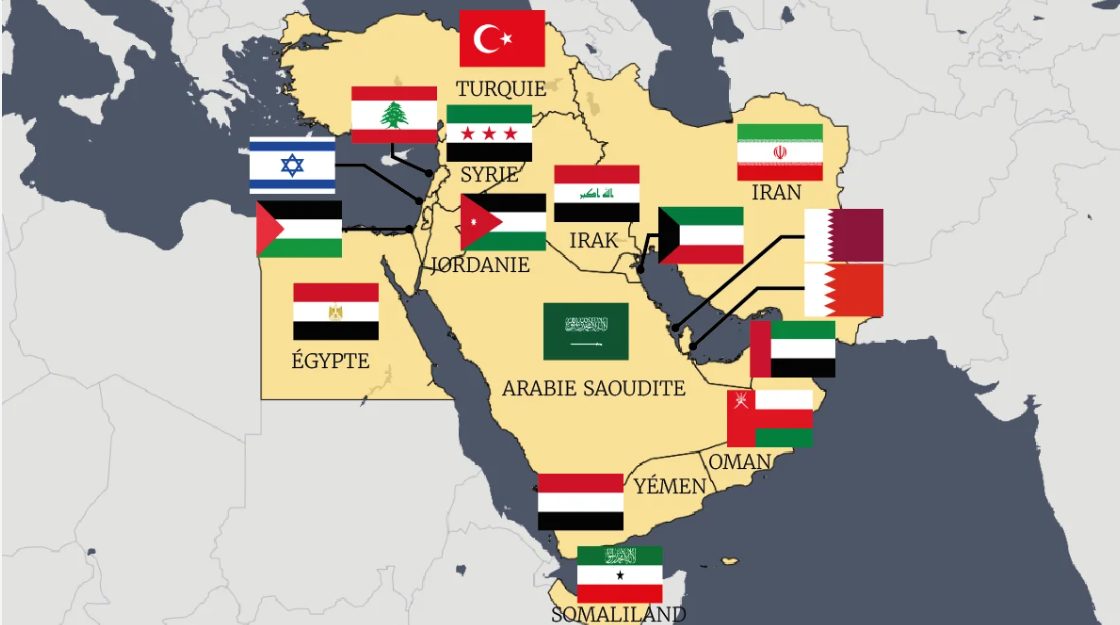
It is precisely this question that now makes it possible to understand the Gulf monarchies.
The Gulf monarchies: legitimacy put to the test of time
The Gulf monarchies are based on a different political contract.
They do not rely on universal suffrage, but on dynastic tradition, stability, security and, for decades, prosperity.
As long as this contract works, the democratic question can remain a secondary concern for a portion of the population.
Legitimacy therefore does not come solely from a political theory.
Again, it comes from the results.
But every historic contract eventually runs out of time.
The world that enabled the Gulf monarchies to build their stability is no longer the one of today.
Oil has created immense wealth, but it has also created an economy largely dependent on a rentier model.
Globalisation has opened up considerable possibilities, but it has also placed these States within an international financial system whose rules they do not fully control.
Their population is younger, better educated, more connected and more exposed to the outside world than previous generations.
And above all, a new generation of leaders has come to power.
Mohammed bin Salman in Saudi Arabia.
Mohammed bin Zayed in the United Arab Emirates.
Their project is clear: to prepare their countries for a world in which oil can no longer constitute a historical strategy on its own. They have therefore embarked, at a forced pace, on bringing ambitious projects to fruition:
Economic diversification.
Infrastructures.
Technologies.
Tourism.
Foreign capital.
International appeal.
Social modernisation.
So they are not seeking to preserve the old system.
They are looking to reinvent the conditions for its survival.
It is a considerable transformation.
But every transformation of this scale has a price.
By changing the economy, we change society.
By changing society, we change expectations.
And by changing expectations, we necessarily change the foundations of legitimacy.
Those in power must now legitimise their actions not only through tradition and stability, but through their ability to lead their societies towards the future.
The problem is that, in this race towards the new world, it is possible to lose something of the old.
And it is here that the Palestinian question takes on its full significance.
The Palestinian baby
In their desire to turn the page on the old regional order, the Gulf monarchies have progressively favoured their economic and strategic interests: investments, normalisation with Israel under the Abraham Accords, new alliances and integration into the global economy.
But they also threw the Palestinian baby out with the bathwater.
Because Palestine has not disappeared with the new diplomacies.
Palestine is not merely a diplomatic issue. It is a historical, human and memorial reality that transcends religious affiliations: it concerns Muslim, Christian and Jewish Palestinians.
Leaders can change their priorities.
Societies, on the other hand, do not always change at the same pace.
This is where modernisation meets its first contradiction.
Alliances can be changed faster than memories.
And this contradiction does not only concern Palestine.
It touches more broadly on the way the Gulf monarchies have approached the old regional order.
Syria: the bolt that was no longer seen
For the new ruling elites of the Gulf, Bashar al-Assad's Syria represented an old world: Arab nationalism, a state-controlled economy, closeness to Iran and a refusal to fully integrate into the new regional order.
Unlike Egypt and Jordan, Syria had not concluded a peace treaty with Israel. The issue of the Syrian Golan, occupied since 1967, remained unresolved. While the Gulf monarchies were accelerating their rapprochement with Israel within the framework of the Abraham Accords and seeking to turn the page on the old regional order, Syria continued to face some of the very issues that this new order intended to move beyond.
Two temporalities thus found themselves face to face.
To varying degrees depending on the state and the period, the GCC states therefore supported the forces seeking to overthrow Assad.
But behind this political calculation lay a deeper reality.
Syria was not merely a regime. It was also a strategic space.
Its alliance with Iran, its geographical position and above all its military apparatus constituted an element of the system of constraints that organised the regional balance.
By trying to make a regime disappear that they considered an obstacle, GCC states may have underestimated the role that this balance played in their own security.
Assad's fall in 2024 therefore produced an upheaval that went far beyond the fate of the Syrian president.
Much of the Syrian military apparatus was destroyed. Air defenses disappeared. A new strategic space emerged.
And the consequences of this disappearance could not be measured solely by the yardstick of Syria.
In trying to make an old order disappear, one can also make disappear the constraints that prevented certain actors from going further.
This is where the vulnerability of the Gulf monarchies is shown in a new light.
Doha: the end of illusions
The Israeli strike on Doha on 9 September 2025 was, in this regard, a dramatic warning.
The Israeli regime was striking at the heart of a Gulf state that harboured a significant American military presence.
So the question was no longer just whether the monarchies could buy enough weapons.
She was becoming:
how much are security guarantees actually worth?
The United States has major military bases in the region.
But the ability of this presence to protect them was abruptly called into question.
GCC states realised that they could be struck despite their agreements and the American presence.
The United States, whether informed of this attack or not, was discredited.
By striking Qatar, Israel appeared as a perfidious and disloyal partner.
Even more revealing, the attack proved those who had refused to believe that normalisation could guarantee their security right. Once the surprise had passed, a revelation became clear: these bases were not there to protect the Gulf monarchies, but first and foremost Israel.
The threat simply wasn't supposed to come from there.
That is perhaps where they discovered the limit of their strategic contract.
They had accumulated wealth.
They had bought the most modern military equipment.
They had developed their cities at a spectacular speed.
But they had also taken part in the conflicts tearing their neighbours apart, without measuring the consequences they could have for their own security.
They had never been worried about their lack of strategic depth.
And, to top it all off with a supreme lack of care, they had outsourced the bulk of their security.
They had become wealthy, modern, influential. But can they remain so without autonomy?
This question takes us back to history.
The Mirror of Byzantium
This is where the history of Byzantium becomes troubling.
Byzantium had a millennium of history behind it. It was rich, cultured, powerfully organised and had developed, over the centuries, a remarkably sophisticated diplomacy. It had survived crises that many states would not have pulled through.
And yet, she ends up disappearing.
If a state endowed with so many assets and qualities has not escaped this law, what can be said of monarchies whose power relies to a large extent on exceptional financial capacity and external guarantees?
Moreover, this power needs to be put into perspective: their main instrument remains the cheque book. But this wealth, largely invested in Western financial systems, remains exposed to the decisions of those who control them. The Russian experience has shown that a major political rupture can be enough to render a considerable portion of a state's assets inaccessible.
They can certainly buy weapons, attract partners, finance projects and exert considerable influence, but this influence remains, all things considered, relative.
Buying power does not necessarily mean possessing the historical, military and strategic levers required to keep it.
Perhaps this is where the mirror of Byzantium becomes truly unsettling.
What can be bought can disappear much faster than what has been built over centuries.
They have sometimes regarded certain former balances as obstacles to the new order they wanted to build. But some of these obstacles were perhaps also protections. By making them disappear, they are discovering today the price of their disappearance.
And now recent events seem to call for a new response.
On 7 August 2026, in Mecca, Saudi Arabia, Turkey and Pakistan have signed a mutual defence agreement. An attack on any of the three must be considered an attack on all three, even if the practical modalities of an intervention remain to be defined.
It is not yet a Middle Eastern NATO.
Moreover, the structure seems fragile: these three states have neither the same interests, nor the same alliances, nor the same relations with Iran. Egypt could also be called upon to join them.
It is therefore difficult to see it already as a true military alliance. But its logic may lie elsewhere: offering the Gulf monarchies an additional protective capacity without forcing them to break with their existing alliances.
Turkey remains a member of NATO. Pakistan maintains relations with Washington as well as with Beijing and Tehran. Saudi Arabia also keeps its ties with the United States. The new arrangement does not necessarily replace the old one: it seeks to reduce dependence on it.
Yet the symbol remains considerable: the monarchies and their partners no longer seem willing to rely solely on an external guarantee.
The «American king» might be leaving the region.
But this search for autonomy is not new in the region.
Yet two Muslim states took radically different paths.
One has built its stability around the monarchy, prosperity and external protection; ;
the other one has made sovereignty, independence and resistance to foreign interference the foundations of its political project.
They both claim Islam, but have clearly not drawn the same conception of power, sovereignty and independence from it.
Since 1979, Iran has made this autonomy a necessity.
He accepted the isolation.
He suffered the sanctions.
He lived under an embargo.
He was deprived of a large part of Western weaponry.
He fought an eight-year war against Saddam Hussein's Iraq, at a time when Baghdad was receiving considerable outside support.
And, rather than abandoning its strategic ambitions, it turned its constraints into indigenous capabilities.
Missiles.
Drones.
Defence industry.
Regional networks.
Autonomie stratégique.
Indéniablement, la République islamique d’Iran a depuis longtemps compris que la puissance ne se décrète pas.
Elle se construit, ou elle se subit.

 French
  English
  Chinese
  Arabic