
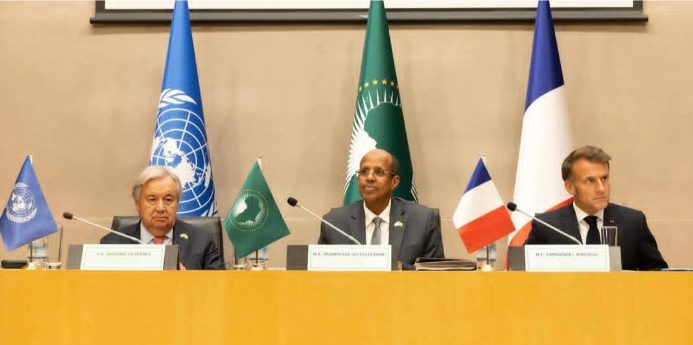
For the first time since coming to power, Emmanuel Macron has spoken at the headquarters of the African Union in Addis Ababa. A highly political symbol at a time when France is seeking to redefine its place on the African continent following several years of diplomatic and military setbacks.
Alongside Mahamoud Ali Youssouf and UN Secretary-General António Guterres, the French President demonstrated strong support for the African Union Peace Fund, which is now presented as a central pillar of continental security.
But behind the official announcements, this visit reveals above all a profound transformation of French doctrine in Africa: Paris is now trying to move from a logic of direct intervention to a strategy of indirect influence backed by African institutions.
Paris calls time on the post-colonial security model
Macron's speech in Addis Ababa marks a break with several decades of French African policy.
Following forced military withdrawals from the Sahel, rising anti-French sentiment and growing competition from new actors such as China, Russia, Turkey or the United Arab Emirates, Paris is now seeking to rebuild its legitimacy through African multilateralism.
« African problems must above all be resolved and coordinated by Africa », insisted Emmanuel Macron.
This sentence constitutes a clear strategic signal: France now recognises that its direct influence on African crises has considerably diminished. Support for the AU Peace Fund thus becomes a means for Paris to:
- maintain an indirect security role; ;
- preserve one's diplomatic access ;
- maintain a continental capacity for influence; ;
- avoid geopolitical marginalisation in the face of competing powers.
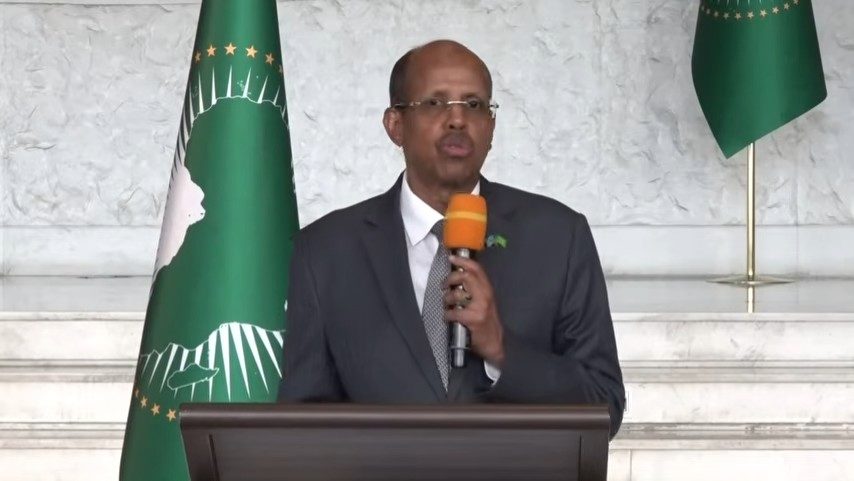
The Peace Fund: a new lever for strategic influence
At the heart of the announcements is the upcoming organisation in Paris of an international conference aimed at mobilising new funding for the African Union Peace Fund.
Established in 1993 but paralysed for a long time, this mechanism has become central since the adoption of United Nations Security Council Resolution 2719 in 2023, paving the way for more structured funding of African peace-keeping operations.
Nearly 400 million dollars have already been raised, but the target set by the African Union is approaching one billion. For Paris, supporting this fund serves several geopolitical objectives:
- strengthen African crisis management capacities; ;
- limit direct Western military interventions; ;
- stabilise strategic African regions; ;
- protect European interests in the face of migration and security crises.
France is also seeking to establish itself as one of the main architects of the future African collective security system.
African crises and global competition
This visit comes against a particularly tense continental backdrop. Discussions in Addis Ababa focused on:
- the east of the Democratic Republic of the Congo; ;
- regional security tensions ;
- the global consequences of the Strait of Hormuz crisis; ;
- African economic vulnerabilities.
Moreover, Emmanuel Macron acknowledged that tensions in the Middle East risked having major effects on African economies, notably through: energy prices; fertilisers; supply chains; logistics costs.
Paris thus wishes to launch an initiative to support the African countries most exposed to the consequences of the Hormuz crisis.
Nairobi–Addis Ababa: the new French economic offensive
Emmanuel Macron’s visit to Ethiopia is part of a broader African tour that began in Egypt and continued in Kenya during the «Africa Forward» summit. This sequence confirms a new French priority: the economy.
In Nairobi, Emmanuel Macron had already acknowledged that Africa now had more need of « than of public aid »This repositioning reflects several realities:
- Western budgetary constraints; ;
- the rise of Chinese competition; ;
- the rise of African economies; ;
- the African drive for partnership diversification.
Faced with China, Macron has furthermore hardened his rhetoric, accusing Beijing of developing a« predatory logic »based on industrial and mining dependencies.
The African Union at the centre of the new diplomatic game
In reality, this visit illustrates a deeper shift: the African Union is gradually becoming a key diplomatic player. French support for:
- a permanent African seat on the Security Council; ;
- the integration of the AU into the G20 ;
- the financing of African peace operations; translates the recognition of an ongoing geopolitical shift.
Africa no longer wants to be merely a theatre of external intervention. It is now seeking to become an autonomous centre of strategic decision-making. However, this ambition still faces several limitations:
- external financial dependency; ;
- continental political fragmentation ;
- limited integrated military capabilities; ;
- competition from foreign powers.
An institutional battle for influence from now on
Behind the rhetoric of peace and cooperation, a broader reality is emerging: the global competition for influence in Africa is changing in nature. The battle is no longer being fought solely:
- on the military bases; ;
- on mining contracts; ;
- on infrastructure.
It is now also played:
- in African institutions; ;
- in the funding mechanisms; ;
- in security architectures; ;
- in the ability to influence continental standards.
By supporting the African Union Peace Fund from Addis Ababa, Emmanuel Macron is thus attempting to reposition France within the new African geopolitical landscape. An Africa where external powers can no longer impose their agendas alone.
And where institutional sovereignty is gradually becoming a new instrument of power.

 French
  English
  Chinese
  Arabic