
Glucksmann: the social-democratic gamble and its limits
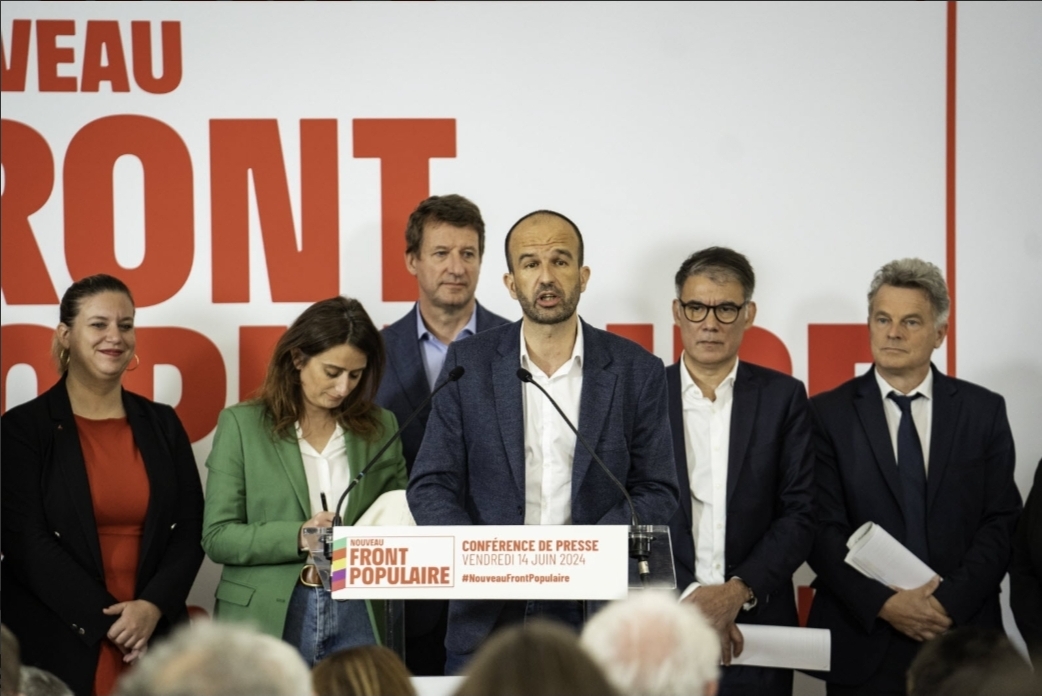
The momentum of the New Popular Front, born from the urgency of the June 2024 dissolution, produced a significant score in the snap legislative elections. However, it has never resolved the fundamental contradictions that have run through the French left since the rupture of the 1990s. The PS and the Greens are part of a social-democratic tradition, whereas LFI advocates a citizen-led revolution and a complete overhaul of the institutions. Jean-Luc Mélenchon's movement rejects the social-liberalism adopted by the PS in recent decades and accuses it of compromise with neoliberalism.
One year after the New Popular Front, the left is once again scattered to the four winds, while the next presidential election is fast approaching. The creation of the «Popular Front 2027» collective, agreed in Tours in January 2026, does little to hide the fault lines for long. This process is being led by the Front Populaire 2027 collective, made up of figures such as François Ruffin, Clémentine Autain, Marine Tondelier, Olivier Faure and Lucie Castets. Jean-Luc Mélenchon and Raphaël Glucksmann, meanwhile, are refusing to take part.
Two absences that are not anecdotal: they mean that the primary scheduled for October 2026 will take place without the two leading figures in the polls on the left. This structural paradox alone sums up the impasse in which the progressive camp finds itself.
The Mélenchon question: first-round asset, second-round poison
Jean-Luc Mélenchon has embodied the major contradiction of the French radical left for well over a decade now. An excellent first-round candidate, capable of mobilising abstentionist working-class voters and working-class neighbourhoods around a message of rupture, he is a structurally negative candidate in the second round, incapable of broadening his appeal beyond his activist base.
While Jean-Luc Mélenchon makes a strong first-round presidential candidate, that is less true for a run-off; according to estimates in a hypothetical duel with Bardella, polling projections give him only 26 %, a historic rout that would turn the second round into a landslide for the RN.
Yet, he is preparing for a fourth presidential run. Within LFI, the possibility of a fourth candidacy by Jean-Luc Mélenchon is welcomed by 78 % of radical left supporters, compared with only 17 % of the French people polled. His refusal of the primary is not a tactical posture; it is a strategic conviction. He considers that his legitimacy comes directly from the people, rather than from a vote by activists who oppose him.
The exclusion of the LFI «rebels» – Alexis Corbière, Raquel Garrido, Frédéric Mathieu, Hendrik Davi and Danielle Simonnet – while re-investing Adrien Quatennens, was thus aimed at consolidating Jean-Luc Mélenchon's leadership and preparing the ground for a new candidacy in 2027. The LFI machine is locked down around its founder. Internal dissent, though real, has not produced an alternative figure capable of replacing him.
Faced with Mélenchon, Raphaël Glucksmann embodies a radically different strategy: building a clean, readable, pro-European, humanist platform capable of gathering together the traditional socialist electorate, part of the Greens, and voters from the central bloc disillusioned with Macronism without having shifted to the right.
Glucksmann surged to 24 % of favourable opinions in November 2025 and became the most popular figure among left-wing sympathisers, where he reached 50 % approval, ahead of François Hollande and Fabien Roussel. He wishes to embody «a social, European, humanistic, ecologist and feminist left».
Glucksmann condemns a primary project that refuses to choose between two existing poles on the left: on the one hand, a populist current led by Mélenchon, and on the other, a reformist, pro-European left ready to govern. Rather than taking part in the primary, he is calling for a common platform with the Socialists in order to create a more structured electoral dynamic.
His strategy, however, relies on a difficult condition to fulfil: that the PS rallies massively behind him against internal resistance. The MEP must rely on the PS while bypassing its national secretary Olivier Faure, perceived by some Socialist elected officials as the «gravedigger of the left» or as being «under the total influence» of Jean-Luc Mélenchon. The First Secretary of the PS Olivier Faure, who faces strong internal opposition, only garners 37 % of favourable opinions for a 2027 candidacy among PS voters.
The 2027 FP primary: solution or division machine?
The primary election scheduled for 11 October 2026 is presented by its promoters as the only mechanism to prevent the dispersion of candidacies. The reality is more ambiguous.
Supporters of the primary see it as a way to decide between several candidates without an all-out war of egos. Opponents, meanwhile, fear the opposite: a machine that stirs up divisions, legitimises camps that are already separated and manufactures a winner without a solid base. Raphaël Glucksmann has already closed the door on such a procedure, as has Jean-Luc Mélenchon.
Polling data, however, is favourable to union in a specific configuration. According to a recent study, 48 % of French people say they are in favour of an alliance and a single candidate between certain left-wing parties—the Socialist Party, the Greens and the Communist Party—without La France insoumise. Support climbs sharply among Nouveau Front populaire sympathisers, to 73 %. And it is even more marked among Socialist Party voters: 92 % of them say they are in favour of this type of alliance excluding LFI.
The same poll tests the reverse hypothesis: an alliance with LFI. Only 27 % of French people are in favour of it. Among NFP voters, the idea remains a majority at 68 %. But among Socialist voters, it is massively rejected.
The equation is therefore set out with mathematical clarity: a union without Mélenchon is popular among the public; with him, it is a turn-off for the moderate electorate essential for victory in the second round. But Mélenchon will not take part in a primary that would de facto exclude him.
Ruffin, Castets: the elusive third ways
François Ruffin and Lucie Castets each embody, in their own way, the search for a third way between Glucksmann's discreet Hollande-style politics and Mélenchon's disruptive brand of politics. Two interesting trajectories, two probable dead ends.
Ruffin has achieved a remarkable political makeover. Wishing to present himself as an independent candidate, he has managed to break away from the orbit of La France Insoumise, no longer hesitating to display his «profound moral and electoral disagreement» with Jean-Luc Mélenchon. He embodies a grassroots left, popular in the primary sense of the term, anchored in the concrete concerns of the middle and working classes. But he lacks structure.
Castets, independent of any party, is trying to embody a possibility outside the traditional party apparatuses. She is not alone in this attempt, but she seems, much like Ruffin, to be losing momentum, failing to embody a third way between "Hollande-ism" and "Mélenchon-ism". Without a militant apparatus, structured funding, or a local party network, a presidential candidacy remains an almost impossible endeavour within the French system.
The 2026 local elections as an indicator of the balance of power
The municipal elections of March 2026 constitute a strategic laboratory of paramount importance for reading the 2027 balances. CEVIPOF points out that this ballot comes just before 2027 and serves as an indicator of the real balance of power between parties, local elected officials and voters. It will provide mayors, networks, activist resources and territorial markers.
With less than a week to go before the 2026 municipal elections, the ballot is shaping up to be marked by a strong incumbency advantage and a largely local dynamic. However, in the major cities, where the competition is more politicised and more open, these elections could serve as a strategic laboratory for national parties, and notably for La France Insoumise's new local establishment strategy.
The results confirm a major trend: a locally united left can resist, a fragmented left collapses. However, the First Secretary of the PS, Olivier Faure, is facing strong internal opposition following a series of PS-LFI alliances in the municipal elections. These unnatural alliances in certain towns are fuelling internal socialist tensions and further undermining the prospect of a united PS behind a single presidential candidate.
Scenarios for 2027: from hope to catastrophe
Black scenario (most likely): Three maintained candidacies, Mélenchon around 12 %, Glucksmann around 12 %, and a candidate from the 2027 PF around 8 %, total a left wing at 32 % but without anyone qualifying. The ghost of Jospin being eliminated in the first round in 2002 with 16.2 % takes another form: no longer the fragmentation on the far left, but the tripartition between three left wings equally incapable of merging. The RN and Philippe find themselves face-to-face.
Median scenario (possible): The October 2026 primary produces a Ruffin or Castets candidate whom Glucksmann eventually rallies behind under pressure from the socialists. Mélenchon stays in the race. The left fields two candidates on 18 % and 12 %, one of whom narrowly qualifies for the second round against Philippe. The outcome of the second round then depends on the left-wing candidate's ability to convince beyond their natural electorate, a historically difficult task for the French left since 2012.
Optimistic scenario (unlikely): Glucksmann embodies a broad social-democratic candidacy, clearly pro-European, capable of bringing together the PS, Greens and a section of disillusioned Macron supporters. LFI rallies at the last minute or disperses. The reformist left reaches 20-22 % in the first round, qualifies clearly, and builds a republican coalition in the second round broad enough to beat the RN. This scenario assumes a level of collective discipline that the French left has not demonstrated since François Mitterrand in 1981.
The left facing its destiny
For at least thirty years, the French left has tried tirelessly to unite. And every time, divisions resurface, even more stubborn than before. The 2027 presidential election is no exception to this iron rule. The players change, Glucksmann has replaced Hollande, Ruffin has taken Montebourg's place, Castets embodies a new generation, but the machinery of failure remains identical. The French left suffers from a deep-seated ailment that primaries and collectives will not cure: the absence of a shared narrative on what kind of France it wants to build. Between Mélenchon's radical break and Glucksmann's cautious reformism, no synthesis is possible, only a lame compromise that would satisfy party apparatuses without convincing voters.
Hope exists, albeit tenuously. The probability of a united, disciplined and victorious left in 2027 remains historically low. The October 2026 rendezvous, the 2027 FP primary, will tell whether the left has finally learned the lesson of its defeats. Everything suggests not.

 French
  English
  Chinese
  Arabic