
Episode 2: first defeat of a right wing that has become populist against... François Hollande
A wild strawberry, that is how Laurent Fabius described François Hollande in 2011. The latter doesn't have the slightest governmental experience. A blessing for the political animal that is Nicolas Sarkozy?
Indeed, the elimination of Dominique Strauss-Kahn from the presidential race and the nomination of François Hollande ought to have allowed for the re-election of Nicolas Sarkozy. Nevertheless, the 2012 campaign was atypical, to say the least, in the worst possible sense.
Departure from the Élysée for the UMP
I did not experience it from the Élysée, having left in the summer of 2011 to become diplomatic adviser to Jean-François Copé. An atypical career path, usually it is the other way round: people tend to go from the party to the Presidency. But I am doing it without any qualms. Having arrived at the Élysée via Jean-Pierre Raffarin (then Personal Representative of the President for La Francophonie), I am not a Sarkozyste. I feel I am making the right choice, as Copé was for a long time a «Chirac baby» who often showed his distrust or independence towards Nicolas Sarkozy. Furthermore, his political career is «flawless», all my colleagues tell me I have made the right choice: «Copé never makes a mistake», «he is the best». Indeed, Copé is already virtually a candidate for the next presidential election, that of 2017. My job interview was love at first sight. I had not even left the UMP premises, then in Rue de la Boétie, when Jérôme Lavrilleux called me to say «when can you start?». Proud of myself, I replied «at the start of the new term, we have organised ourselves in the diplomatic cell for this summer». He then replied «no, next week at the latest». I therefore immediately joined the UMP as a «diplomatic adviser» to the man who was then Secretary General. This allowed me to broaden my horizons, which until then had been essentially focused on the Arab world at the DGSE..
Nevertheless, on the 1ster Jean-François Copé's trip took place ten days later to Algeria. An extremely sentimental trip for him, a first, given that his mother is originally from Algiers. During this trip, President Bouteflika, at the height of his power, received him for three hours and told him, «you are arriving a little late». Indeed, It was with Jacques Chirac that Abdelaziz Bouteflika wanted to move forward to get past the past. However, the ill-fated Vanneste amendment on «the positive role of colonisation, in February 2005, would block everything. The Algerian President sees Jean-François Copé as a possible successor. In a later article, I will bear witness that Alain Juppé subsequently carried this hope.
A late-starting campaign and surprising choices.
I therefore lived through this presidential campaign within the ruling party without taking an active part in it. Indeed, international affairs are rarely the heart of a presidential campaign (things could change in the future) and I do not feel aligned with the tone and political positioning. The Cross of Lorraine seems to me to be totally relegated, forgotten.
Jean-François Copé's role is a thankless one. The leader of the ruling party has the task of relentlessly and sometimes immoderately attacking the opposition, to fully and totally support an executive even when it is not in harmony and to come to the rescue of failing ministers. He accomplishes this with the immense talent that is his. But its image will suffer long-term damage. He will fully and very loyally support the candidate. He was completely and wrongly associated with Sarkozyism and regarded as a somewhat sectarian ideologue.
Nicolas Sarkozy decides to enter the campaign late, at the end of February for rather incomprehensible reasons. Opting for the 1988 Mitterrand model, Nicolas Sarkozy nevertheless lacks any of the assets that would justify it. Indeed, in 1988, all the polls gave François Mitterrand as the winner and he appeared as a unifier. Nicolas Sarkozy has neither of these two assets.
A rather surprising second choice, that of his campaign managers : Guillaume Lambert and Jérôme Lavrilleux (deputy director). Unprecedented… Usually the campaign manager is someone close to the candidate, experienced, who can speak to them frankly and directly, almost as an equal. Chirac would choose Pasqua in 1988, Stefanini in 1995, Antoine Rufenacht in 2002.
By choosing two young public figures who have absolutely no opportunity to speak their mind to him, let alone contradict him, Nicolas Sarkozy is making a mistake. Not that Guillaume Lambert isn’t talented… As for Jérôme Lavrilleux, he’s a political animal and will throw himself totally into this campaign, to the point that some amused themselves by classifying him as a «Sarkozyst» rather than a «Copéist» to describe this metamorphosis. A quip. The fact remains that they are not in a position to contradict, or truly make themselves heard by, the candidate. The consequences will be dramatic.
A sense of déjà vu
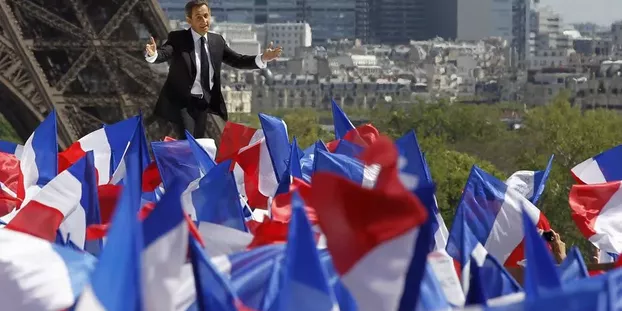
For the rest, the heavyweights of the campaign are the same as in 2007, just like the themes, which are barely recycled. The big spectacular rallies where the Rock Star goes back on stage have the air of a farewell tour. They only fool the party activists.
Nevertheless, Nicolas Sarkozy knows how to campaign and a momentum builds. To the point that within the UMP, despite the polls, confidence reigns as to the outcome of the ballot. Nicolas Sarkozy is clawing back his deficit. Everyone will have noticed, two weeks of campaign were missing to significantly and decisively reduce the gap. Whose fault is it that the candidate entered the campaign too late?
A candidate caught in a squeeze between the far right and the centre
Nicolas Sarkozy achieved a very strong result for an incumbent president (over 27%) in the first round.er tower, but he is ahead by a point and a half while his voice reservoir for the second is limited. Siphoning off FN votes no longer works After five years in power, Sarkozy can no longer be seen as a break with the past or anti-establishment. Jean-Marie Le Pen secures nearly 18% of the vote in his final presidential election. As for François Bayrou, backed by his 9%, he unconditionally endorses François Hollande. This is a historic break in the alliance between the right and the centre, which can be explained by the animosity between the two men, but also by a drift to the right on substantive issues. To this day, eleven years later, the right has still learned no lessons from this and is continuing its frantic race, no longer in pole position, but far, far behind the FN, which has become the RN. The split with the centre is complete. As for the manifesto, it is an endless recycling of the 2007 campaign, with the same direction coupled with implausible verbal escalation. Would a severe drubbing in the European elections finally provide a much-needed wake-up call?»[1]
The run-off debate is a complete flop. During François Hollande's famous «Me, as President» tirade which goes on for so long, everyone is waiting for Nicolas Sarkozy's necessarily killer retort. It never comes. While his opponent is a complete novice on international issues, Nicolas Sarkozy will never go onto that terrain.
During this failed campaign, only Jean-François Copé managed to put François Hollande in difficulty during the debate on 16 March 2012.
To top it all, Le 1er May, François Fillon, Prime Minister to Nicolas Sarkozy for five years, couldn't find a better way to stand out and criticise the President on the issue of relations with trade unions. A way of distancing oneself from the president-candidate, and to already show a swollen head and a rather measured sense of teamwork.
A dignified end to the campaign and a defeat that seems like a mere accident
Nicolas Sarkozy knows he is going to lose. The eve of the 2n'd tour, he invites his colleagues to his campaign HQ to greet them. Although not suspected of unbridled Sarkozysm, I am nevertheless impressed by the strength that emanates from him, an unshakable solidity while a major defeat is underway.
Nicolas Sarkozy pulled off an extraordinary feat between the two rounds: without receiving the backing of a single candidate from the first, he managed to gain 21 points. But defeat was inevitable. His speech is moving and presidential he is leaving active political life and will serve France in another way. We know that, alas, this will not be the case and that the idea of a return has never left him.
The right wing is therefore defeated, it is not the 1era times under the Fifth Republic. But it has lost its Gaullist soul and its Gaullian tone. Will it ever find it again?
The UMP is then a fully functioning machine, perfectly «bossed» by Jean-François Copé. Hopes for revenge and a return to power in 2017 are real despite the defeat in the legislative elections. François Hollande, who does not have the slightest executive experience, chooses a Prime Minister who is equally a novice in the person of Jean-Marc Ayrault. From the beginning of the five-year term, there is no surprise. Hollande is not up to the job. For my part, I am taking a risk and resigning from the civil service on 18 June 2012 because I have the political bug, I believe in Copé and have no wish whatsoever to serve Hollande, even from afar.
[1] The Republicans: towards a salutary rout? | Geopolitics.fr

 French
  English
  Chinese
  Arabic