
Russia vetoed a UN Security Council draft resolution on Monday calling for a ceasefire in Sudan. Tens of thousands of people have already died in this war. Nearly 60 % of South Sudan's population will face acute food insecurity in 2025, various United Nations agencies stated on Monday, noting that returnees fleeing the war in neighbouring Sudan and young children are facing some of the highest levels of hunger and malnutrition, as economic pressures, climate extremes and the effects of the war in Sudan worsen hunger.
It is more than likely that around 7.69 million people will find themselves in a crisis food situation (Phase 3 of the Integrated Food Security Phase Classification, IPC) or worse. This figure includes 2.53 million people likely to be in Phase 4 (emergency food insecurity) and 63,000 people likely to be in Phase 5 (catastrophe), if an easing or at the very least a cessation of fighting does not occur rapidly.
This alarming new data, agreed upon by all organisations alike, shows that acute food insecurity and malnutrition are deteriorating due to the economic crisis, repeated climate shocks – mainly widespread flooding – the direct consequences of conflict and ongoing insecurity.
The influx of returnees and refugees fleeing the conflict in Sudan is exacerbating the situation and increasing the pressure on an already devastated country.
Catastrophic famine threatens returnees fleeing Sudan
According to the latest data from the Integrated Food Security Phase Classification (IPC), more than 85 % of returnees fleeing Sudan will experience acute food insecurity during the upcoming monitoring period, starting in April 2025. Regardless of where they seek exile, they will also account for nearly half of all people facing catastrophic hunger globally.
« Year after year, we see that hunger is reaching some of the highest levels we have ever known in South Sudan and, when we look at the areas where food insecurity levels are highest, it is clear that a cocktail of despair – conflict and the climate crisis – is the main driver », said Mary-Ellen McGroarty, the World Food Programme (WFP) Representative in the country, to the Security Council, to no avail.
Between September and November 2024, the UN estimates that 6.3 million people (47 % of the analysed population) are classified in IPC Phase 3 or above (Crisis or worse). Of this total, 1.71 million people are facing critical levels of acute food insecurity – classified in IPC Phase 4 (Emergency) – and a further 41,000 people are facing catastrophic levels of acute food insecurity, or IPC Phase 5 (Catastrophe).
Relentless figures: nearly 2.1 million children at risk of malnutrition
The population in Phase 5 (catastrophe) includes 10,000 people in Malakal County (Upper Nile State) and around 31,000 South Sudanese returnees who fled Sudan because of the ongoing conflict. Compared to the same period last year, this indicates an increase of roughly 500,000 people in Phase 3 or higher.
Furthermore, nearly 2.1 million children are threatened with malnutrition, compared to 1.65 million previously. Children, the primary victims, take refuge in nutrition centres several times a year as they continue to suffer from inadequate access to safe drinking water and sanitation.
Illness is a major factor in malnutrition, and nearly half of the children included in the collected data had been ill in the preceding two weeks.
« Malnutrition is the end result of a series of crises, the most notable of which for South Sudan are a lack of sanitation and the prevalence of water-borne diseases, alongside severe food insecurity. », said Hamida Lasseko, UNICEF Representative in this East African country.
UNICEF has said it is deeply concerned that the number of children and mothers at risk of malnutrition will continue to rise inevitably if a ceasefire is not reached allowing the expansion of international humanitarian aid. It is thus a question of tackling these root causes, alongside « the provision of immediate nutritional support to treat malnutrition in children at greatest risk of dying ».
Numerous abuses: in some camps, young women are no longer to be seen
« Some parents were killed while trying to protect their daughters from rape », says Sara*, a counsellor in Al Jazirah State in eastern Sudan, and one of many health workers who have recounted shocking accounts of sexual violence in recent weeks.
Since 20 October, the escalation of the conflict in Al Jazirah State has resulted in the deaths of more than 100 people, including local health professionals, forcing over 135,000 people to flee their homes in search of illusory refuge in neighbouring states.
With at least six healthcare facilities attacked in recent months, primary emergency care has been severely disrupted and patients transferred to other health centres, although only one in four is currently operational in Al Jazirah.
Reports from the state Ministry of Health indicate a surge in serious human rights violations committed during rebel attacks, with women and girls aged 6 to 60 having been victims of rape and sexual assault.
Women throw themselves into the river to avoid being abused
« In some camps, young women are no longer seen », reports a health worker to UNFPA, the United Nations agency for sexual and reproductive health.
« Some girls who arrived in Gedaref said that their friends had been abandoned ».
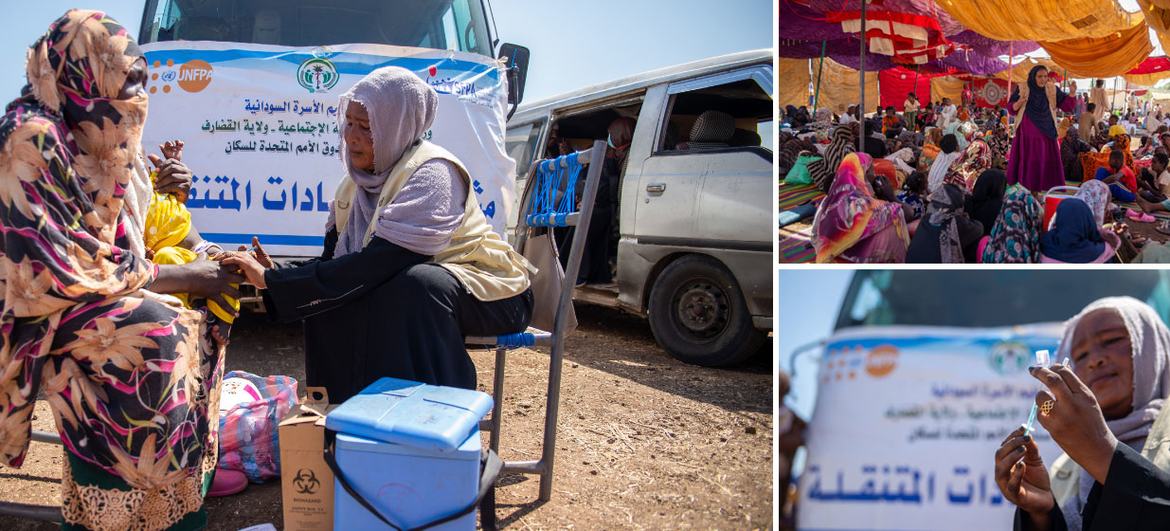
UNFPA personnel in Gedaref have the mission of caring for women and young girls who recently had to flee Al Jazirah, in shelters funded for this purpose, with an almost unimaginable first mission: « preventing women from throwing themselves into the river to avoid being abused by armed men »In another displaced persons camp in Kassala, some tell of the painful warnings from their family before they left: « If we see armed fighters coming to the village and trying to rape you, we will kill you to protect you before it happens ».
A human tragedy exacerbated by the stigmatisation of sexual violence
The stigmatisation of rape victims – and their loved ones – is such that many of them turn to devastating and radical measures to cope.
« Survivors of sexual violence flee and hide because their families threaten to end their lives to wash away the dishonour », explains an adviser from Gedaref, who wishes to remain anonymous for security reasons.
A number of girls stated that their brothers, fathers and uncles had provided them with knives and asked them to «end their lives if they were threatened with rape».
« We cannot access most [survivors] because, firstly, they are in denial about the reality or are afraid of being accused or targeted. Secondly, they fear losing their lives if they reveal what they have experienced ». She continues.
Uprooted lives, yet numerous testimonies, a proven genocidal framework
The UN agency also shared alarming reports before this Security Council. Looting, widespread attacks on shelters in camps, causing ceaseless mass displacement.
Aliya’s* family was attacked in Al Jazirah, forcing her to flee on foot. « They took everything from us, we left with nothing. They beat us like dogs », she testifies in the NGO report. Their journey was no less arduous and dangerous: « We walked for seven days in the sun without eating anything. Some women died along the way – there was no water to drink, they died of thirst ».
Like countless other women caught up in this spiral of violence, Aliya is now the only one looking after and providing for her uprooted family.« Our men stayed in the village. I don't know where my husband is… They may have killed him. I swear I don't know what has become of him. I have six children. We need clothes, shoes, food, soap – we have nothing left ».
Mariam* fled to Kassala after her husband was murdered for no reason.
« They came to our house, threatened us and tried to take my daughters. I told them my daughters were married. They then demanded gold and money, but I told them I didn't have any. They then took my eldest daughter and me away, and beat us. One of my daughters is immunocompromised and I fear she will die of malnutrition », she continues. « I'm using my own clothes to cover my newborn, who is only four months old ».
A humanitarian response, but funding is deficient
Since the escalation of violence in Al Jazirah, UNFPA has provided more than five mobile health teams deployed in Gedaref State, funded by the governments of Canada, the Republic of Korea, Sweden, the United Kingdom, and the United States.
The UN has planned to send an additional health team to Al Butana, as well as a mobile health and psychosocial support unit to Elfao hospital, which UNFPA has already equipped with clinical supplies directly related to the physical repair of sexual assault.
The hospitals of New Halfa and Khashm El Girba in Kassala have also received this essential medical equipment.
UNFPA currently supports 49 safe spaces for women and girls across Sudan, providing essential prevention and response services for gender-based violence. However, in the face of escalating violence and growing insecurity, much more must be done to guarantee safe and rapid access to life-saving support for all women and girls who urgently need it.
Moscow's veto at the Security Council on Sudan puts millions of civilians in danger
Out of sight, out of mind. Such could be the sad adage of this armed conflict which has pitted the Sudanese Armed Forces (SAF) against the Sudanese Security Forces (RSF) in Sudan for nearly two years now, the latter having broken out in April 2023. The UN Security Council draft resolution of 18 November expresses, among other things, its concern and condemns violations of human rights and international humanitarian law. Furthermore, it urges « all parties to the conflict to protect civilian infrastructure necessary for the delivery of humanitarian aid and to allow and facilitate access for such aid, whilst encouraging international partners to increase it ». This is, in summary, the purpose of the text, which appears to be disturbing to the Kremlin.
Many NGOs, some of which also operate in the Caucasus close to Russia, have already reacted to Moscow's stance. In particular, Amnesty International expressed its deep disappointment at this shameful veto. « Once again, politics is blocking the protection of civilians and the United Nations Security Council has failed to fulfil its mandate », said Tigere Chagutah, Amnesty International’s Regional Director for East and Southern Africa.
« Sudan is experiencing the world's largest displaced persons crisis. Facilitating the delivery of humanitarian aid, as provided for in the draft resolution, would have temporarily relieved millions of internally displaced people in urgent need of assistance. All countries fuelling the conflict must immediately cease direct and indirect deliveries of arms and ammunition to both parties and respect and enforce the UN Security Council arms embargo on Darfur. The Security Council must prioritise the protection of the civilian population by extending the current arms embargo to the rest of Sudan.. », he hastened to add.
This Russian veto at the UN serves as a reminder of just how much international rivalries and real or alleged interference further complicate matters in this conflict, which has already left tens of thousands dead and displaced: more than 11 million people, including 3.1 million outside the country, according to the UN.
If Russia had abstained during previous resolutions on this war, this veto confirms an increasingly clear alignment with General Burhan’s camp, according to the experts interviewed by geopolitics.fr
Beyond these figures, which speak volumes about the scale of the humanitarian crisis in Sudan, both sides are simultaneously committing large-scale war crimes, ranging from the bombardment of residential areas and the looting of humanitarian aid to the systemic use of rape against Sudanese women.
*Names have been changed for reasons of confidentiality and protection.

 French
  English
  Chinese
  Arabic