
A report from the European Court of Auditors rarely excites the media, let alone the public. The one that was published in recent weeks and which seems to warn of the use of the Trust Fund for Africa, whose resources are theoretically earmarked for combating the major causes of migration, is no exception.
Who benefits from the trust fund for Africa?
Established in 2015 in response to the migrant explosion, this mechanism, whose technocracy is at the cutting edge of art, is particularly intended for the Sahel region, the Horn of Africa, and North Africa.. In total, this fund has received more than 5 billion euros in contributions, financed by the EU budget, the European Development Fund and the additional contributions from the Member States. In this report, the Court of Auditors thus vilifies the Commission in the following terms:« Human rights risks are not properly managed« . But further on, in the rather unpleasant reading of the report, an even more striking accusation emerges. For the first time, a European control institution recognizes that EU money through this fund ends up funding human rights violations and, in some cases, benefiting mafia organizations through «migrant trips.». Paradoxically, these same traffickers that Ursula von der Leyen and other leaders promised, with great fanfare, to combat.
The Commission is under fire
In its press release, not to mention its bad mood, the Court of Auditors does not mince its words. Thus, it states that the The Commission turned a blind eye to the abuses committed against migrants in a number of beneficiary African countries, in order not to have to interrupt the flow of the Trust Fund.. « No mechanism exists to determine whether these cases (of human rights violations) were duly examined and taken into account when deciding on the continuation or suspension of European support. », declares the high authority on accounts. And this despite several warnings issued by EU auditors in the past. And to bid that « The previous reports have not led to any «major changes" »The Court of Auditors notes that, more generally, the Commission is accused of overstating (not to say «exaggerating») the results of the projects funded by the Trust Fund for Africa. Even worse: the effectiveness of the mechanism is seriously called into question.« The European Commission still does not know which approaches are the most effective for reducing irregular migration and forced displacement in Africa« , the CCE insists.
A non-activated suspension clause
Regarding human rights, the high court emphasizes in its report that « The general conditions of all funding agreements stipulate that the action must be suspended if the EU formally detects a violation of human rights.«But this clause has not been activated in practice. The contract for a project scrutinized by the Court of Auditors, « included a clause that conditioned the delivery of the equipment on compliance with the principle of non-aggression and human rights ». However, « This clause, added during the project’s implementation, did not apply to equipment that had already been delivered. ». The Court of Auditors also analyzed that this clause, curiously enough, « was not systematically applied to all projects, particularly those related to security, border management or other sensitive activities ».
The Libyan case and the possible diversion of funds
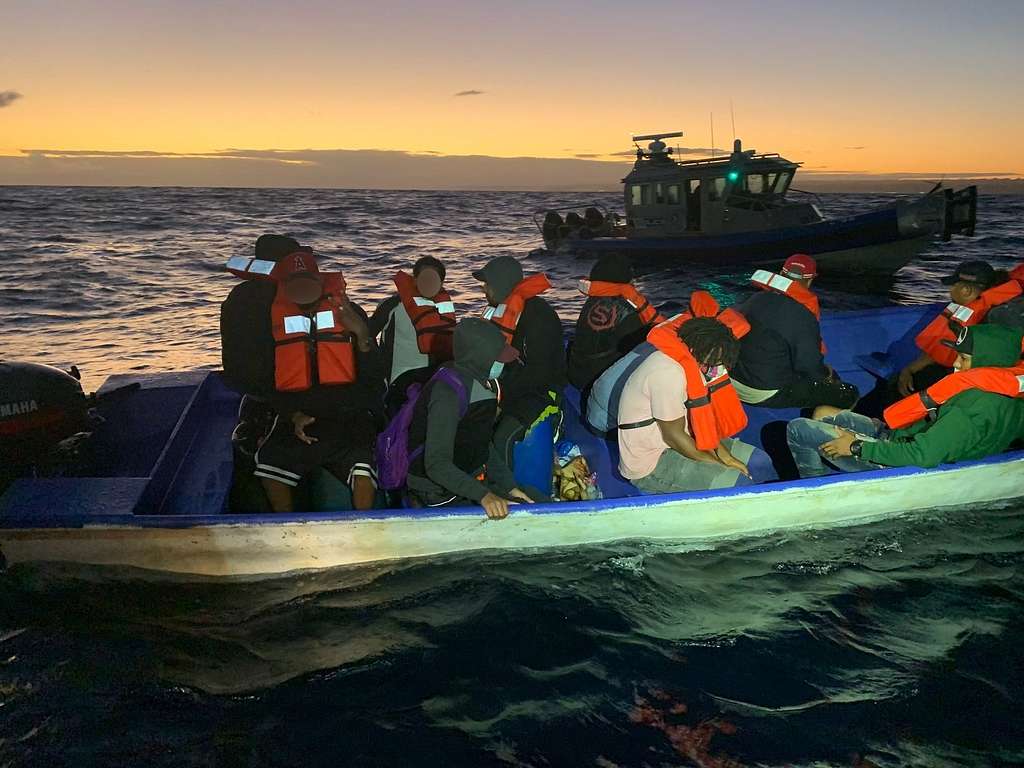
What exactly must be understood? In a diagram included in the report, the Court of Auditors summarizes what it calls the « Potential risks to human rights posed by the implementation of various activities » financed by the Trust Fund for Africa in Libya. Example: the boats and equipment provided to the so-called «Libyan coastguards» can be used to carry out « Other actors » that the beneficiaries. Like the landing points for migrants rescued at sea used by « Other actors »That the coastguards. In the absence of a credible investigation, the financial police officer is cautious and does not specifically name the «pimps of misery». But there is no doubt that behind his linguistic skill, the Court clearly points the finger at perfectly organized militias, pimps and traffickers, well established in the Libyan security apparatus. According to the Court of Accounts, the transport means financed with EU funds and paid to the Libyan authorities are used to transfer migrants to the calamitous detention centers, which worsens the living conditions of those held there. The detention centers can be« under the control of actors involved in migrant trafficking », the report indicates. Equipment paid for with European funds can sometimes be resold. The system can benefit « criminal organizations ».
In Libya, the criticism of Brussels is hardly new. Several investigations by observers and fellow journalists shed light on how EU programs favored human rights violations by ending up in the hands of the mafia. In 2023, it was the United Nations that was already pointing the finger at the EU and its member states, seeing in them an encouragement during the interception of migrants at sea, thereby favoring human traffickers. The EU and its member states thus provided « Directly or indirectly financial and technical support and equipment, such as vessels, to the Libyan coastguard and the Directorate for the Fight against Illegal Migration, which were used in the context of the interception and detention of migrants », the report of the UN Independent Fact-Finding Mission in Libya states without equivocation. That same report states very explicitly that « strong reasons to believe that high-ranking Libyan coast guard officials were complicit with traffickers and smugglers, allegedly linked to militias, in the interception and detention of migrants »That's the end of that.
Confusion about the objectives
At that moment, the Brussels authorities had issued a terse communiqué stating that the Commission was not directly paying any funds to the Libyan government. This is not entirely untrue, since part of the resources of the Trust Fund for Africa destined for Libya first pass through the Italian coffers. Arguing that in 2023, in order to extend support to the Libyan coastguard, the priority was to save the lives of thousands of migrants at sea. That is, to put it bluntly, the same argument was made to the European Court of Auditors, and the same conclusion was reached:« The Commission has not suspended any of the FFU’s activities in Libya to date, believing that aid must be maintained to save lives and alleviate the suffering of migrants. »The High Court’s report again supports this,« the report continues. In essence, the maneuver consists in obstructing migrants attempting to reach European shores while allowing Libyan authorities to intercept them in their territorial waters. As a matter of fact, the term »intercept" never appears in the official, or at least public, communications of European institutions. And for a good reason: an assimilation to a practice of refouling asylum seekers would be highly contrary both to international law and to the very rules of the European principle of welcome and movement.
We will have to wait until June 25th, when Ursula von der Leyen will send a letter to the leaders of the EU member states, whose objective is to «take stock of the work done regarding the external dimension of the migration policy». As excerpted: « While cooperation with Libya remains a challenge, the resumption of dialogue with the Libyan authorities has enabled the strengthening of (…) interception capabilities in the Central Mediterranean. »That is what I have done," boasts the President of the Commission. On this 25th of June, and for those who know how to read between the lines, Ursula von der Leyen admits half-heartedly that the real goal is indeed to save lives at sea, but also to intercept them and return them to the coast of North Africa, with the consequences described here.
A likely inertia
Will the report of the European Court of Auditors change anything?« Everything will continue as before », reports a source close to the committees of the Commission.« The political will is to continue ».The policy of funding regimes that violate fundamental human rights and international law seems perfectly accepted. Is the very powerful President of the European Commission following the winds of the big capitals? Germany has reintroduced Schengen border controls. France has a new Interior Minister, Bruno Retailleau, whose roadmap is clearly outlined. Has Giorgia Meloni’s policy become a model for subcontracting migration policies?”
Fifteen other member states pressed Ursula von der Leyen for «innovative solutions». What orders do they contain?

 French
  English
  Chinese
  Arabic