
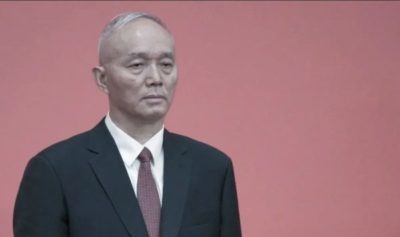
Decoding a discreet power
The quiet rise of a pillar of the regime
At international summits as well as behind-closed-doors conclaves, it is towards him that knowing eyes turn: Cai Qi, 70, whose influence — less publicised than that of his peers, but no less real — rivals that of the regime’s most prominent figures. Officially the fifth member of the Politburo Standing Committee, he is, in practice, its number two: the man whom, in the event of a sudden vacancy of power, observers unanimously designate as best placed to take the reins of the Chinese Communist Party, guarantor of smooth continuity in a system where stability takes precedence over all other considerations.
The fate of Cai Qi is inextricably linked to that of Xi Jinping. Born in 1955 in Fujian — the coastal province where Xi himself experienced the years of exile during the Cultural Revolution — Cai belongs to that sacrificed generation of the «sent-down youth». It was in this shared crucible that a relationship, initially professional and later deeply personal, was forged in the 1980s. In 1985, when Xi was appointed Vice-Mayor of Xiamen, Cai was still only a local official.
This would be followed by fifteen years of close collaboration, first in Fujian and then in neighbouring Zhejiang — far from the factional struggles of Beijing. This provincial partnership, forged away from the intrigues of the capital, forged an unwavering and unambiguous loyalty between them.
The rise of Cai Qi closely mirrors that of Xi Jinping. In 2014, the latter recalled him to Beijing to join the National Security Commission, a strategic body created to centralise the management of domestic and foreign crises. Three years later, in a rare move in the Party's annals, Cai gained access to the Politburo – that circle of the twenty-five most influential leaders of the CCP – without even having previously served on the enlarged Central Committee.
Appointed as early as 2017 to head the General Office of the CPC – a first since the days of Mao and his trusted confidant Wang Dongxing, architect of the fall of the «Gang of Four» – Cai simultaneously established himself as mayor of Beijing and then Party secretary in the capital. In this capacity, he revealed an uncompromising governance style: the forced removal of informal migrants in 2017, a resolute offensive against air pollution, and the strict enforcement of health protocols during the Covid-19 pandemic. Absolute loyalty to Xi, implemented with methodical rigour: such is his guiding principle.
In October 2022, at the 20th CPC Congress, he was appointed to the Politburo Standing Committee, the highest decision-making body. The General Office, which he had already been heading for five years, made him Xi Jinping’s de facto chief of staff: he sets the agenda, filters information, controls access and accompanies the president on all his travels. Far more than a mere executor, Cai Qi is the discreet architect of an extremely centralised system of power.
The power of Cai Qi, between domestic control and external influence
Cai Qi is not merely the president’s diary manager. He occupies a pivotal position within the Party apparatus, at the crossroads of administrative, security and, increasingly, diplomatic responsibilities. As head of the CCP Central Secretariat, he oversees the day-to-day running of the institution and ensures that the policies set out by Xi Jinping are faithfully translated into concrete decisions.
He also presides over the Central Guard Bureau, a civilian entity responsible for the physical protection of leaders — a portfolio which, although seemingly protocol-driven, in reality confers permanent and exclusive access to the heart of power.
In addition to these responsibilities, he is closely involved with the National Security Commission, established in 2013 to centralise the handling of the most sensitive issues, whether they relate to internal security or regional and international strategic balances. It is here that decisions are taken, with the utmost secrecy, on matters relating to Xinjiang, Taiwan, the South China Sea and tensions with Washington.
A comparison with Li Qiang, the Premier and the regime’s second-in-command in terms of protocol, is illuminating. Also hailing from Xi’s Zhejiang network, Li Qiang embodies the visible face of Chinese power: that of the economic manager and the point of contact for foreign foreign ministries and business circles. Cai Qi, for his part, operates on a different level — that of internal control mechanisms, ideological cohesion and the neutralisation of factional tendencies. Xi Jinping is thus said to have established a subtle division of labour between them: one takes centre stage, the other holds the system together. Together, they exemplify Xi’s method of governance: concentrating real authority within a very small circle of loyalists, at the expense of the Party’s traditional collegial bodies.
This power structure has found an unexpected extension into the diplomatic sphere, traditionally reserved for members of the government or career diplomats. Cai Qi now accompanies Xi Jinping on his overseas trips, including during summit meetings with the major powers. Even more significantly, outside official channels, he holds one-to-one talks with Indian, Egyptian and Turkish leaders, as well as with leading figures in the US financial sector. These parallel channels serve a specific geopolitical purpose: to enable Beijing to gauge the intentions of its adversaries, test different approaches, or initiate discreet negotiations, without formally committing the president’s word. ‘Shadow diplomacy’, in other words, as a natural extension of domestic control.
The fact that the Trump administration sent him a request for a one-on-one meeting — which went unheeded — speaks volumes about how Western foreign ministries perceive his actual role.
A key player in a system undergoing restructuring
At the age of 70, Cai Qi is approaching the 21st CPC Congress, scheduled for 2027, in a position that is both strong and uncertain. Solid, because his grip on the workings of the Party is unrivalled amongst his peers on the Standing Committee. Uncertain, because the CCP’s unwritten norms stipulate, at this age, an orderly retirement — norms that Xi Jinping himself deliberately flouted in 2022 by granting himself a third term, thereby paving the way for similar concessions for his close associates.
The recent upheavals within the People’s Liberation Army — a spate of dismissals in the strategic missile force and reshuffles within the Central Military Commission — serve as a reminder that the Xi era is not immune to internal crises, and that loyalty, however overt it may be, is no absolute guarantee. In this context, Cai Qi’s political longevity will depend less on his titles than on his ability to remain indispensable: a silent arbiter of internal balances, a discreet liaison with the outside world, and the guardian of an institutional memory that no one else possesses to the same degree.
Potential successors are emerging — Ding Xuexiang, Chen Miner — but none of them, at this stage, has the network of relationships or the grasp of the inner workings that Cai Qi has patiently built up over four decades working alongside Xi.
A reflection of shifts in global power
Cai Qi is not so much a reflection of the system as the key to understanding it. What his rise to power reveals is not an anomaly, but a consistency: that of a system of governance which has made trust a guiding principle and discretion a form of efficiency.
In an international environment characterised by the fragmentation of the multilateral order, Sino-American rivalry, and the geopolitical realignments taking place in both Eurasia and the Middle East, the figure of Cai Qi takes on a significance that extends beyond his individual career path. For foreign diplomats and analysts, understanding him means understanding how power in Beijing really works — not through official statements, but through silences, appearances and the channels that remain out of sight.
In Zhongnanhai, the most faithful shadow is often the one that speaks volumes.

 French
  English
  Chinese
  Arabic