
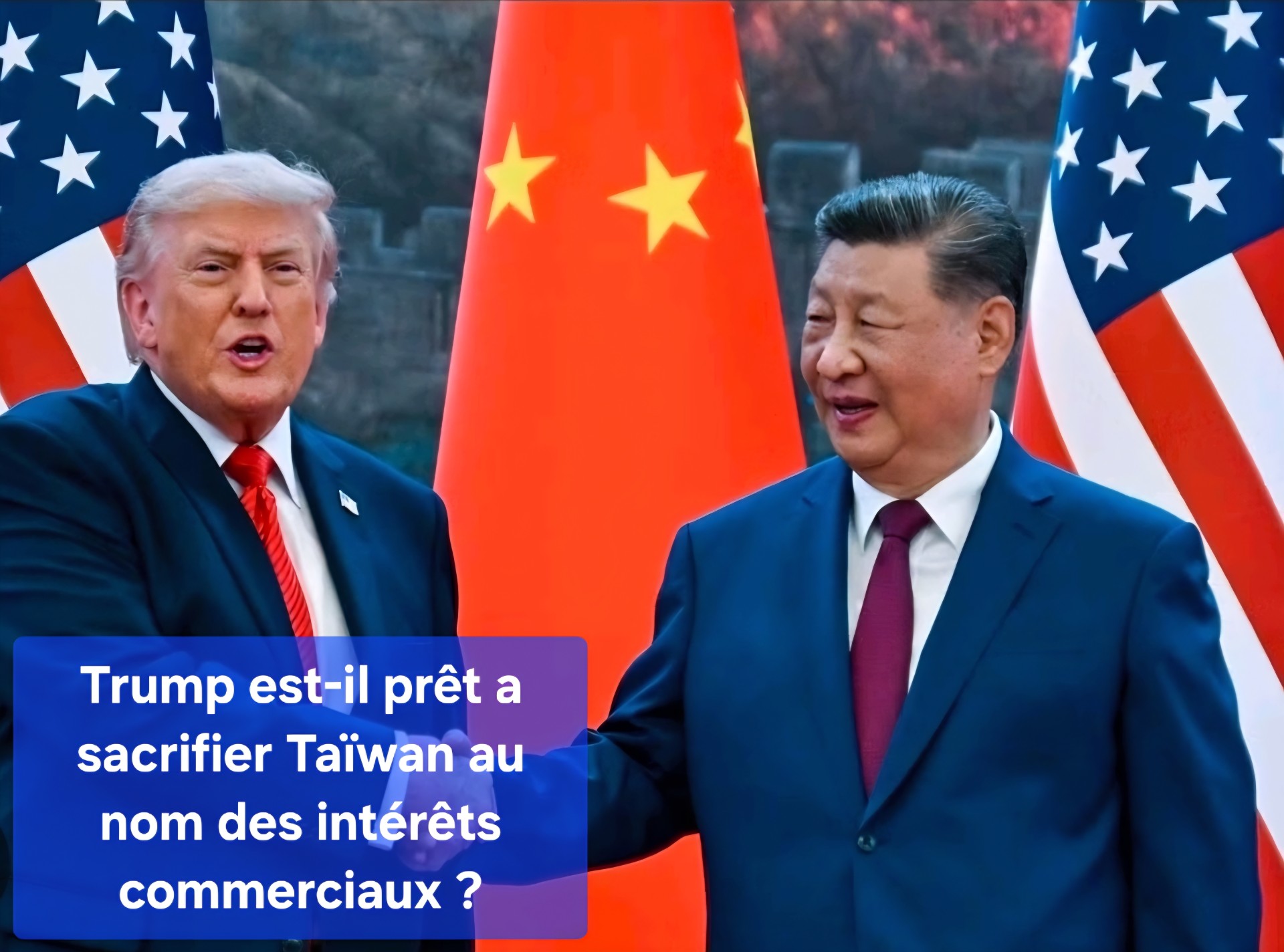
The Great Hall of the People radiated with gold plating this Thursday morning as Donald Trump, welcomed with great pomp, shook hands with Xi Jinping in front of the world's cameras. «Relations between China and the United States are going to be better than ever,» proclaimed the US president, praising his host as «a leader of extraordinary distinction.» Behind the protocol and the conventional formulas, however, one of the most consequential diplomatic meetings in decades was playing out.
The visit marks the return of a US president to Chinese soil for the first time since 2017. Already under Trump, already in this atmosphere of lavish banquets and superficial smiles. It takes place against a tense backdrop: a trade war in a half-truce, a conflict in the Middle East lingering in the background, and above all, an issue whose shadow hangs over every handshake. That of Taiwan.
The deal of the century, Trump style
First, one must understand how Trump views this trip. His travelling companions are not seasoned diplomats, but captains of industry. Indeed, these are the bosses of Tesla, Apple, Nvidia, and Boeing. The signal is unambiguous: this summit is as much a commercial negotiation as a state meeting. Trump said so himself before taking off: he wants to persuade Xi to open up China so that these «brilliant people can work their magic».
At the heart of the negotiations are customs duties. The two countries have observed a tariff truce since last autumn, agreed upon during a previous summit in South Korea. The objective in Beijing is to consolidate this fragile calm, to extract American purchasing promises and perhaps to unblock access to Chinese rare earths, a master card that Beijing is playing with calculated patience. China possesses the majority of the world's reserves of these minerals, which are essential to American industry. Their potential blockage would put a large part of Washington's industrial apparatus in difficulty.
The unthinkable: Trump consults Beijing on Taiwan
Yet it is another subject that has sent a shudder through capitals around the world. Even before his departure from Washington, Donald Trump stated that he would discuss US arms sales to Taiwan with Xi Jinping. A seemingly innocuous sentence. In reality, a major break.
For decades, the US position has been based on a subtly constructed and patiently built balance: military support for the island, without formal diplomatic recognition, but a categorical refusal to consult Beijing regarding this support. This tacit red line underpinned the credibility of the US commitment. By publicly announcing that he would discuss it with Xi—«He would prefer that we didn't do it,» he added with a disconcerting smile—Trump broke this silent doctrine that had held firm for fifty years. The Taiwan issue is the most important one in Sino-American relations. If it is mishandled, the two countries will clash, or even go to conflict. Xi Jinping, for his part, chose his words with the care of a strategist. Invoking Thucydides and the trap represented by rivalry between powers, he warned that Taiwan would remain «the most important subject» between the two countries. His warning was not veiled: if the issue is mismanaged, it could lead to an open confrontation. The Chinese term used does not necessarily mean a military conflict, but the ambiguity was likely deliberate.
A personal relationship as a security guarantee?
Faced with these warning signs, Trump’s response was disconcerting to say the least. Asked about the risk of a Chinese invasion of the island, he brushed the question aside: «I think everything will be fine. I have a very good relationship with President Xi. He knows that I don't want that to happen.» In other words, Taiwan's security guarantee would now rest, according to the American president, on the quality of a personal relationship between two strongmen.
This transactional logic applied to security alliances is precisely what is alarming American partners in Asia. Taiwanese diplomacy reacted with a sobriety tinged with nervousness, reaffirming its desire to strengthen cooperation with Washington and to develop effective deterrence capabilities. Diplomatic translation of a very real anxiety: what happens if the personal relationship cools down? What happens if Trump gets what he wants on trade and no longer needs Taiwan as a lever?
Beijing grows in confidence, Taipei in anxiety
For China, the mere fact that Trump is coming to Beijing and not the other way round constitutes a symbolic victory of the highest order. Beijing carefully orchestrated the welcome, rolling out the red carpet where Trump is most sensitive: pageantry, prestige and imperial pomp. Xi understands well that flattering this particular interlocutor is the shortest route to strategic concessions.
Beijing is also closely learning lessons from the Russia-Ukraine conflict. The immediate objective is not a frontal invasion of Taiwan, which is deemed too costly and too risky. The strategy is more subtle: wear down the morale of the Taiwanese, isolate the island diplomatically, and obtain American concessions on weapons deliveries. If Trump were to agree to reduce, even symbolically, his military support for Taipei, Beijing would have achieved a decisive strategic victory without firing a single shot.
Allies on high alert
Trump's trip is being followed with nervous attention by Tokyo, Seoul, Canberra and Manila, all linked to Washington by defence treaties. All exposed to a potential rise in tensions in the strait. Because any weakening of American support for Taiwan would not only produce a Taiwanese crisis. It would shake the entire Indo-Pacific security architecture, risking the triggering of a regional arms race and pushing certain allies to reconsider their own defence strategy.
The Treasury Secretary attempted to calm concerns, stating that Trump would speak more about Taiwan in the coming days. The White House described the meeting as «good». Such vague phrasing does little to reassure Asian capitals, which are used to deciphering every presidential word to read the future of their own security.
A summit between deal-maker and strategist
At heart, the gulf between the two men in Beijing is also a gulf between two worldviews and two concepts of time. Xi Jinping is playing a fifty-move game of chess, armed with the patience of a regime that does not have to answer to voters and measures its horizon in decades. Trump, meanwhile, seeks the visible deal, the resounding announcement, the triumphant photo to wave about on his return.
This asymmetry structurally benefits Beijing. As long as Trump needs to return to Washington with a tangible victory, a trade deal, a promise of investments, warm photos with Xi, China will have a powerful lever to obtain concessions on issues where it plays the long game. Taiwan is the most sensitive of them.
The question therefore remains open: is Trump prepared to sacrifice Taiwan? Not head-on, not officially, and no doubt not consciously. But by treating the island's security as a variable in a trade negotiation, by breaking the unwritten rule that excluded Beijing from discussions on Taiwanese armaments, he has opened a breach. And Beijing, with its characteristic patience, will know how to widen it.

 French
  English
  Chinese
  Arabic