
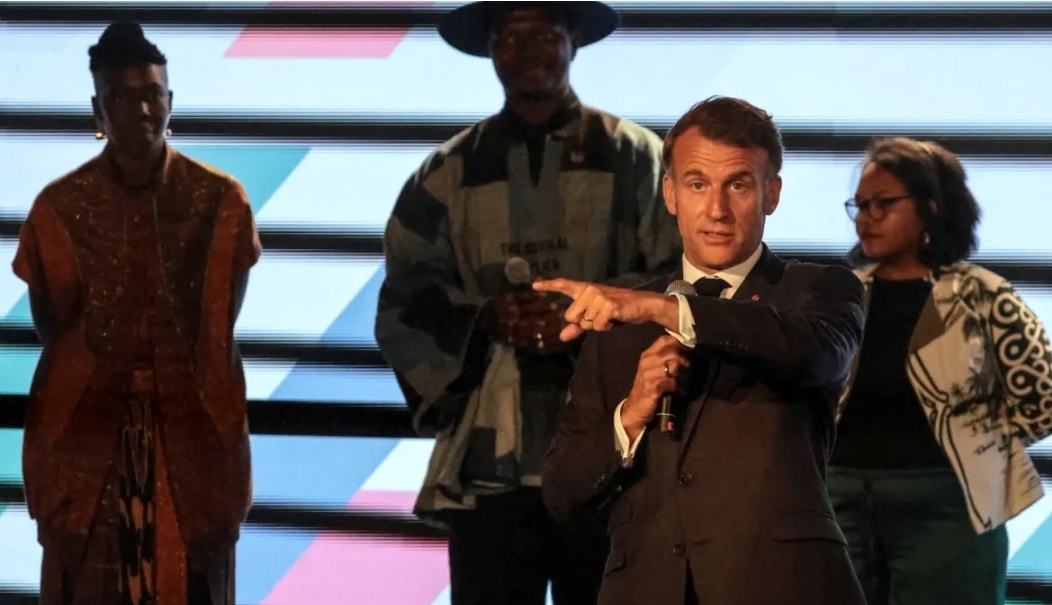
The sun is setting over Nairobi as Emmanuel Macron announces, from the Kenyan university, twenty-three billion euros of investment for Africa. The figure is spectacular. The context, however, is even more so. Indeed, a few months after abandoning its last military base in Chad, France is attempting, via the economic route, to regain a foothold on a continent where it has never seemed so much of a stranger.
The summit, named «Africa Forward», marks several breaks with previous formats.
For the first time, such a Franco-African summit is being held in an anglophone country, Kenya, and is being co-chaired with an African head of state. The symbolism is crystal clear. Paris now intends to move beyond francophone Africa alone, long considered its reserved domain, to open up to a vaster, more diverse, and above all more demanding continent.
Of the twenty-three billion announced, fourteen come from French players, both public and private combined. The targeted sectors reflect current ambitions:
- the energy transition has attracted more than four billion,
- digital technology and artificial intelligence near four others,
- the blue economy, ports, fishing, maritime trade, some three billion.
A civil nuclear cooperation agreement between Paris and Nairobi was also initialled, signalling a relationship that intends to be built for the long term.
«Africa is succeeding. It needs investment to be more sovereign, and as it happens, we no longer entirely have the means for public aid either.»
This single statement sums up the rhetorical shift made by the French president. Public development aid, long presented as the hallmark of a generous relationship between France and its former colonies, is now accepted as inadequate and, fundamentally, outdated. In 2025, it fell by nearly 11%, against a backdrop of widespread budget cuts. The era of unilateral charity is over. The era of commercial partnership is opening at least, that is the stated ambition.
An unprecedented military setback
To understand the urgency of this pivot, we must measure the scale of French defeats since 2020. Mali first, then Burkina Faso, Niger, and then Chad. Four countries where Paris had heavily invested in men, equipment, and credibility have successively demanded the departure of French soldiers. Operation Barkhane, the pillar of the strategy in the Sahel since 2014, officially ended in 2022. The last French base in Chad was handed back in January 2025. Indeed, the Chadian government unilaterally terminated the historic defence agreement that had bound the two countries for decades.
The consequences go beyond the security sphere alone. Nigerien uranium, which supplied up to twenty percent of French nuclear power plants, has become inaccessible since the military takeover in Niamey. In Kenya itself, a one-and-a-half-billion-dollar motorway project, initially awarded to a consortium led by the French company Vinci, was ultimately reassigned to Chinese operators. France is losing ground in people's minds as much as on the map.
China and Russia, the new masters of the game
France does not fight in a vacuum. Its retreat coincides with a coordinated, albeit unconcerted, offensive by China and Russia to occupy the ground left vacant. Beijing has been Africa’s primary trading partner for fifteen years. Its exports to the continent reached 225 billion dollars in 2025. The Belt and Road Initiative has woven a network of port infrastructure from Djibouti to Lomé, creating lasting dependencies that Europe is struggling to challenge. From this May 2026, China is abolishing its customs duties on fifty-three African countries, an additional manoeuvre to lock in its commercial leadership.
Moscow is playing a different tune, less economic but just as formidable. Via Africa Corps, Wagner's successor, Russia now occupies Sahelian bases that were once French. There, it deploys a narrative of regained sovereignty, anti-Western and effective in societies where colonial memory remains painful. Its concrete investments are limited; its disinformation campaigns, however, are not.
Faced with this dual pressure, Macron chose to turn the argument around. «The paradox is that Europeans are not the predators of this century,» he declared in Nairobi, pointing to the logic of Sino-American confrontation. Europe, according to him, defends the rule of law, multilateralism and open trade. All of these are values that could, in the long run, appeal to African partners weary of Beijing's conditions and Russian unpredictability.
Kenya, symbol of a new geography
The choice of Nairobi as the host city is no coincidence. The Kenyan capital has become one of the most dynamic technological hubs on the continent. Its president, William Ruto, has democratic legitimacy and a liberal economic vision that aligns with the new French discourse on private investment. On the eve of the summit, the two countries signed eleven cooperation agreements covering transport, infrastructure and maritime affairs, worth over a billion dollars. A civil nuclear cooperation agreement completed the package.
The two presidents announced that they would meet at the G7 in Evian next June to jointly advocate a reform of the international financial architecture. The aim is to attract more private capital to Africa, in a world where public aid is collapsing on all sides, particularly that of the United States. The dismantling of USAID has left a considerable strategic vacuum.
Macron explicitly links African development and European migration issues
«If you fail, we have no chance. Your youth will leave your countries and we'll have loads of migratory tensions.» This phrase, spoken in front of an amphitheatre of young Kenyans, reveals the dual nature of the French approach. Philanthropic in form, it is deeply strategic at its core. France is investing in Africa because it needs to: for its supplies of critical resources, to contain migratory flows and to maintain a credible voice in global affairs.
The twenty-three billion euros announced call for a number of qualifications
They aggregate very heterogeneous instruments – direct investments, equity stakes, loans, guarantees, grants – whose actual impacts and time horizons differ considerably. Part of this sum covers African commitments that Paris does not control. The share actually disbursed over the next three years will be the key indicator to watch.
The real challenge lies in execution. The French market share in Africa fell from 8 to 4% over twenty years, despite a stock of direct investments exceeding fifty billion euros. French companies are often considered competitive on quality, but slow on decision-making times. Particularly when facing Chinese competitors capable of offering turnkey solutions in a matter of weeks. Economic trust, much like political trust, cannot be decreed from a podium.
Anti-French sentiment, fuelled by decades of Françafrique and exploited by Russian disinformation campaigns, remains a reality in several countries. Even in those that appear in favour of a rapprochement, distrust surfaces. Macron himself half-admitted this: «France, for the past twenty-five years, has been shaken up in Africa. And that's normal and it's a very good thing!», he stated, acknowledging that this pressure is forcing Paris to reinvent itself.
An uncertain legacy
With less than a year to go until the end of his second term, Macron appears to want to cement this African turning point as part of his legacy. His Nairobi speech echoes that of Ouagadougou in 2017, where he solemnly promised an end to France's Africa policy. Nine years later, the record is ambivalent: the Sahelian coups have contradicted promises of stabilisation, but the pivot towards an uninhibited economic relationship perhaps represents, at last, a real break with the old Françafrique.
Perhaps the real innovation lies here: accepting that France is no longer the natural partner of francophone Africa, but rather the chosen partner, among others, of a more diverse, more anglophone Africa, and one much more demanding regarding the conditions of its cooperation. It is no longer an empire negotiating with its peripheries. It is a middle power appealing to a booming continent. The balance of power has shifted. France is slowly beginning to accept this.

 French
  English
  Chinese
  Arabic