
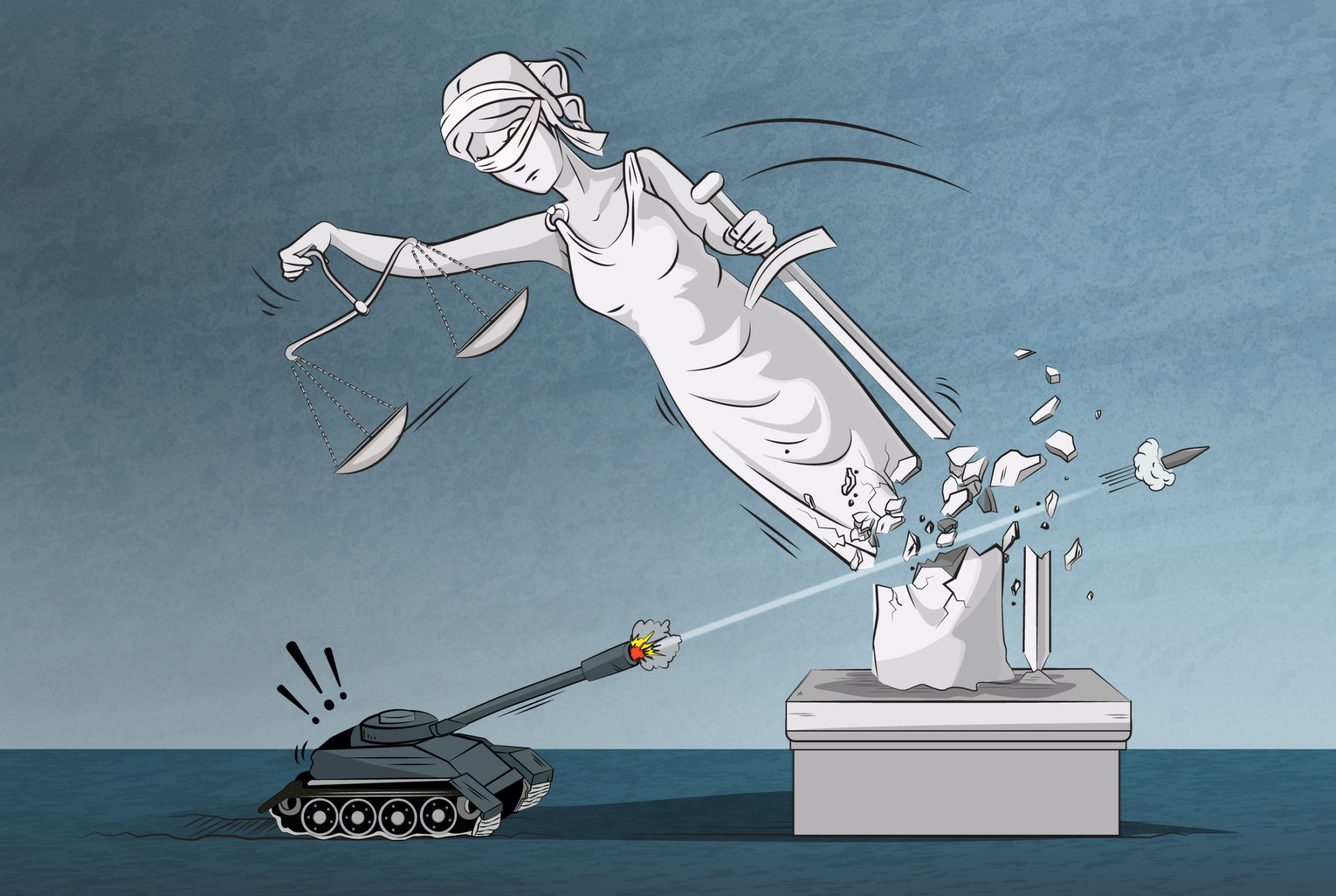
The ICC is going through a multidimensional crisis. Attacked from the outside by major powers, weakened from the inside by its own institutional tensions, it is operating in an increasingly hostile budgetary, technological and political environment.
Universal justice under pressure
The International Criminal Court (ICC) was intended to embody the culmination of a longstanding project. Putting an end to impunity for the most serious crimes – genocide, crimes against humanity, war crimes, the crime of aggression – when national jurisdictions are failing. Conceived as a permanent instrument of international criminal justice, it has long been presented as the guardian of an international order based on law rather than sheer power.
This universalist ambition contrasts today with the reality of an institution facing unprecedented geopolitical pressures. The ICC finds itself at the heart of mounting geopolitical tensions, with major powers vying to limit its scope or neutralise it. The arrest warrants issued in November 2024 against Benjamin Netanyahu and Yoav Gallant, the US sanctions imposed on judges in The Hague in 2025, Russian pressure on the judges handling the Ukraine dossier, the dismissal of Prosecutor Karim Khan in July 2026, as well as the budget tensions of 2026, paint a mixed picture. A Court whose legitimacy is challenged from all sides.
The ICC is no longer just an international criminal court. It has become an arena of confrontation between logics of power, where national sovereignty and international responsibility, strategic interests and the principle of justice clash.
The US offensive: sanctions and deterrence
The offensive led by the United States against the ICC marks a turning point in the history of international criminal justice. In February 2025, the US administration signed an executive order imposing sanctions against Prosecutor Karim Khan and several officials of the Court. It is a retaliation against investigations targeting American and Israeli nationals. This measure was followed, in June 2025, by the extension of sanctions to four ICC judges, and then by new waves of restrictions targeting other judges and deputy prosecutors over the course of the year.
The effects of these sanctions are tangible and immediate. The magistrates concerned have faced banking restrictions, bans on entering US territory, and administrative disruption affecting their ability to work. These measures are not only intended to challenge a specific judicial decision. They can be interpreted as aiming to set a deterrent precedent.
The paradox is all the more striking given that the United States, which is not a party to the Rome Statute and does not contribute to the Court's regular budget, nevertheless has nationals present at several levels of the institution. This presence, which in no way calls into question the integrity of the individuals concerned, cautiously raises a question of institutional balance. How can the autonomy of an international jurisdiction be guaranteed when a non-party power has a form of continuous presence within it?
These measures can be interpreted as aimed at discouraging any legal action that might harm US or Israeli interests, whilst retaining a degree of influence within the institution itself. This strategy transforms the ICC into a forum where international justice clashes head-on with the logic of power.
Israel and strategic alignment with Washington
This procedure targeting the highest authorities of the Hebrew state marked a turning point in relations between the ICC and Israel. The Israeli reaction was immediate and vigorous, denouncing a decision described as an abuse of power and the politicisation of international justice. This challenge quickly translated into a strategic alignment with Washington. The United States imposed sanctions against the judges, presenting them as a legitimate response to investigations deemed biased.
This convergence is forging a united front against the ICC. It is intended to send a message that any prosecution targeting their leaders or military personnel would come at a political and diplomatic cost. As soon as the Court takes action against Western allies, it is accused of politicisation. This criticism fuels the perception of a two-tier justice system and undermines the Court’s legitimacy in the eyes of part of the international community.
Russia: a legal counter-offensive and intimidation
Russia’s response to the ICC follows a similar line of reasoning, but with its own specific approach. The arrest warrant issued against Vladimir Putin in March 2023, for the illegal deportation and transfer of Ukrainian children, provoked an immediate reaction from Moscow. Russia denounced the decision as politicised, illegitimate and without legal validity, before initiating proceedings against Prosecutor Karim Khan and several judges of the Court. Arrest warrants have been issued against ICC judges, and threats have been made against anyone who might attempt to enforce the decisions from The Hague.
This strategy aims to target individuals, not just decisions. By intimidating judges and prosecutors, Moscow seeks to deter judicial cooperation with the Court on the Ukrainian case. And to demonstrate that the ICC cannot act with impunity against major powers. This approach transforms legal challenge into a personal power struggle, in which international justice comes up against the desire for power of a state possessing nuclear weapons.
The ICC as a geopolitical battleground
The convergence of American, Israeli and Russian reactions reveals a broader dynamic. This is a shared rejection of judicial constraint by powers that oppose one another on many other fronts. This marriage of convenience turns the ICC into a geopolitical battlefield, where national sovereignty and international accountability, and strategic interests and the principle of justice, clash.
China, whilst more cautious in its actions, supports this trend through its rhetoric. Beijing regularly denounces the double standards of international justice and calls for greater respect for state sovereignty. It thus echoes Russian and American criticism of the ICC, which is perceived as being manipulated by the West. This position forms part of a broader strategy to promote a multipolar international order in which supranational institutions must accommodate the primacy of states.
The tension between universal justice and the logic of power has thus reached a critical point. The ICC finds itself faced with a double bind: on the one hand, the major powers that reject its jurisdiction; on the other, the weaker states that expect it to fulfil its mission of combating impunity. This situation transforms the Court into a symbolic arena, where the very future of legal multilateralism is at stake.
The internal crisis: the Karim Khan affair
The ICC is also facing an internal crisis which is exacerbating external pressures. In June 2026, Prosecutor Karim Khan was suspended as a precautionary measure following allegations of serious misconduct. This suspension was followed, on 24 July 2026, by his permanent removal from office by the Assembly of States Parties. Karim Khan is therefore no longer the Prosecutor in office, and this decision marks a turning point in the Court’s history.
Karim Khan’s suspension in June 2026, followed by his dismissal on 24 July following disciplinary proceedings, triggered a particularly sensitive governance crisis. This decision, in itself, does not call into question the validity of the proceedings conducted during his tenure. Nevertheless, it inevitably affects public perception of the Court and the trust placed in its leadership. The prosecutor’s dismissal undermines the institution’s moral and political authority and makes it more difficult for it to defend itself against accusations of politicisation. The external crisis is thus exacerbated by an internal governance crisis, reinforcing the perception of an institution facing a crisis of direction.
Technological vulnerability
The ICC also faces technological challenges that reveal another dimension of its vulnerability. Following sanctions and political pressure, the Court has faced digital vulnerabilities, particularly following cyber-attacks targeting its infrastructure. In response, in 2025 it began migrating to OpenDesk, a German open-source suite, to reduce its reliance on traditional digital tools.
This development shows that judicial sovereignty now presupposes technological sovereignty. The ICC depends on external infrastructure, networks and service providers over which it does not have total control. This dependence turns technological vulnerability into an issue of judicial security. It serves as a reminder that international justice no longer relies solely on the law, but also on technical tools.
Legitimacy, Africa and the perception of selectivity
The ICC must also contend with a long-standing crisis of legitimacy, fuelled by criticism of its focus on Africa. Since its establishment, the Court has been accused of prioritising the African continent. This has resulted in enduring mistrust towards it within several African states. Some have even considered or carried out symbolic withdrawals from the Rome Statute.
Although the European Union formally supports the ICC, it is adopting a cautious stance. It is avoiding any concrete measures that might exacerbate tensions with Washington. This attitude reflects an internal division between advocates of international justice and those who favour a pragmatic approach. The ICC is thus still perceived as asymmetrical by some in the Global South, reinforcing the notion of a two-tier justice system.
This historic crisis of legitimacy is being exacerbated by the current attacks from the major powers. The Court thus appears caught in a symmetrical vice: too weak in the face of the powerful, too intrusive in the eyes of the countries of the South. This situation undermines its political legitimacy and hampers its ability to fulfil its mission of combating impunity.
Outlook for future developments
Three possible scenarios can be envisaged for the future of the ICC.
Scenario 1: marginalisation
The ICC survives but loses its ability to take action against the powerful. It continues to take action against weak or cooperative states, but finds itself marginalised in the face of the major powers that reject its jurisdiction.
Scenario 2: fragmentation
The proliferation of competing judicial mechanisms, such as ad hoc tribunals or regional initiatives. This trend erodes the universal model and leads to a multi-tiered justice system.
Scenario 3: reform and resilience
Political, budgetary and institutional strengthening of the ICC. Collective defence of the Rome Statute by States Parties, modernisation of the Court and improvement of its governance. This scenario presupposes strong political will on the part of the international community.
The future of the ICC will depend largely on the ability of states to overcome geopolitical rivalries in order to preserve the international criminal justice system. The current crisis may prove to be a moment of strategic clarification, or, conversely, it may accelerate the fragmentation of legal multilateralism.
An international order at a crossroads
The crisis facing the International Criminal Court extends far beyond the institutional framework. It reflects the deep divisions running through the international order itself. The ICC is not merely the subject of criticism regarding its decisions or methods; it faces a more fundamental challenge to the very idea that the most serious crimes must be prosecuted regardless of the political clout of the alleged perpetrators. Sanctions against its magistrates, threats against its judges, budgetary and technological pressures, as well as internal governance crises, paint a picture of an institution caught in a vice between the universalist mission on which it was founded and the power dynamics that threaten it today.
The future of the ICC does not depend solely on its capacity to reform its internal functioning. Above all, it depends on the political will of States to accept a simple yet revolutionary principle. That according to which no power should be above the law. If the international community fails to preserve this principle, the ICC risks becoming the symbol of a declining multilateralism. Justice would apply only to the weak whilst the powerful continue to escape all accountability.
The crucial question, therefore, is not merely whether the Court will weather the current storm. It is whether the international community still has the will to uphold a fundamental principle: that no power, no state and no leader can claim, in the long term, to be above the law.

 French
  English
  Chinese
  Arabic