
Migration, Euro-Maghrebi sovereignty and interdependence
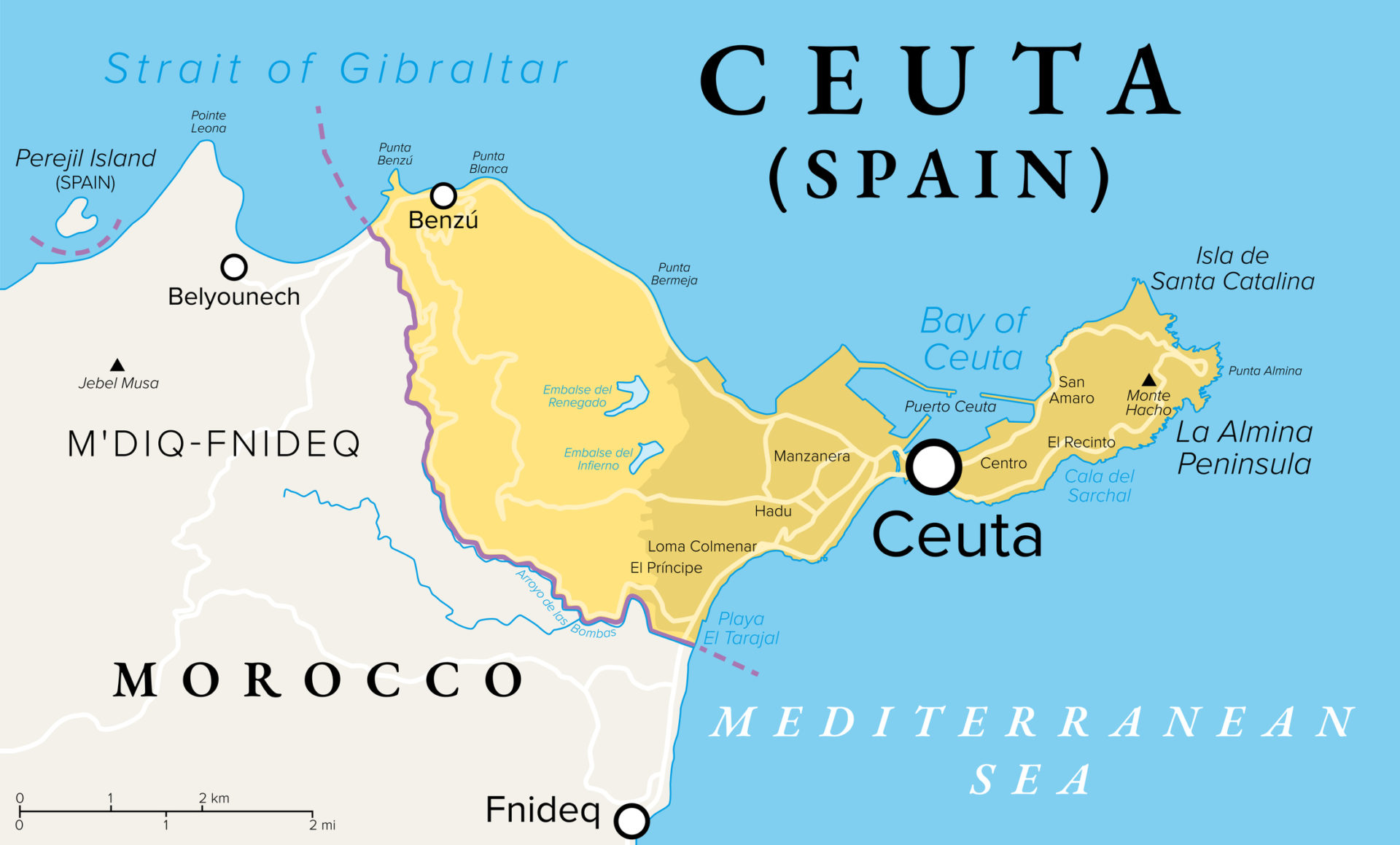
What does this episode reveal? In particular, how migration, sovereignty and interdependence are now articulated between the European Union and its Maghrebi neighbours? The question is all the more relevant as the new European Pact on Migration and Asylum came into effect in June 2026. At the same time, a comprehensive partnership between the EU and Morocco is being negotiated. Ceuta is thus becoming an initial test of the European mechanism, and an indicator of the balances that now structure relations between the two shores of the Mediterranean.
Anatomy of an exceptional crisis
In the afternoon of 30 July 2026, the first footage of swimmers attempting to reach Ceuta from the Moroccan coast quickly gave way to a movement of unprecedented scale. Within a few hours, thousands of people crossed the border by land and sea, turning the Spanish enclave into the theatre of an unprecedented migratory crisis. Between 50,000 and 60,000 entries in two days according to local, Spanish and media sources. This volume is much higher than that of May 2021, when 8,000 to 10,000 people crossed the border in 48 hours.
Faced with the influx, the Spanish authorities deployed significant security resources. The Guardia Civil, reinforced by divers, drones and helicopters, secured the crossing areas and contained the arrivals. The Head of Government, Pedro Sánchez, visited the site and described the episode as a «violation of Spain's territorial integrity».
Over the following days, Moroccan-Spanish cooperation enabled rapid stabilisation. On the Moroccan side, controls were stepped up and return operations organised. According to Madrid, nearly 48,000 people had left Ceuta voluntarily by 31 July. The human toll remains very heavy, however—more than 50 deaths according to the Spanish authorities, with subsequent estimates suggesting over 70 fatalities. The crisis was therefore contained within a few days, without dispelling the central question that remains: why did an influx of such magnitude occur at that precise moment?
Why now? A multi-level causality
Why a crisis of this magnitude, and why now? Two types of factors are combining. Structural factors—income disparities between the Maghreb and Europe, a lack of prospects for some of the youth, persistent instability in certain regions—fuel migration continuously. These are what explain the underlying pressure—not the triggering of a specific episode.
Short-term factors better explain this surge. When a country tightens controls on one route, flows often shift to other itineraries. This is what happened in the western Mediterranean. Departures from Tunisia have dropped drastically since the 2023 EU-Tunisia agreement, and some of the migration pressure has shifted towards Morocco. Arrivals in Ceuta rose sharply in 2025. Smuggling networks, for their part, adapt quickly to these changes and know how to seize new opportunities.
This reveals a simple paradox: strengthening one route does not make migratory pressure disappear; it displaces it elsewhere. Since 2022, Spain and Morocco have normalised their relations and strengthened their security cooperation. Some migrants may have seen this as a temporary window of crossing — a plausible hypothesis, but difficult to prove. It does not on its own explain the scale of the crisis.
One final point deserves to be handled with caution. Indeed, the peak in arrivals coincided with the Throne Festival, celebrated on July 30th in Morocco. Some observers see this as a possible sign of the Moroccan authorities' ability to influence migratory flows depending on the political context. However, going from coincidence to intention is a step that no evidence allows one to take. No official statement has established a link between the two events, and Rabat has denied any involvement.
The fact is established; its interpretation remains open. Distinguishing between observation, hypothesis, and causality is essential for dealing with such a sensitive subject without prejudging the actors' intentions.
2021-2026: continuity and rupture
In May 2021, some 8,000 to 10,000 people crossed the border between Morocco and Spain within 48 hours, against a backdrop of intense diplomatic tension between Madrid and Rabat. Indeed, the crisis came after Spain hosted Brahim Ghali, leader of the Polisario Front, for medical reasons. This decision was fiercely contested by the Moroccan authorities. Spanish intelligence services subsequently deemed the influx «deliberate», fuelling the hypothesis that migratory flows were being used as a means of pressure.
Five years later, the context has changed. Since 2022, Madrid has moved closer to Rabat and reoriented its position on Western Sahara by supporting the Moroccan autonomy plan. This has allowed for closer security and migration cooperation, via bilateral mechanisms established since 2023. The real question is therefore no longer to compare the two episodes, but to understand how a crisis of this magnitude could have occurred when relations between the two countries are, in principle, stronger than in 2021.
The contrast shows both continuity and a break. Continuity: migration remains a central issue, intertwined with the rest of the bilateral relationship. The break: the degree of institutionalisation of the cooperation. The channels between Madrid and Rabat, consolidated over the years, made it possible to manage and resolve the crisis quickly. In 2021, the crisis had revealed a fragile relationship that was breaking down. By 2026, it rather demonstrates a denser partnership, capable of regulating itself — without, however, being immune to the upheavals of regional geopolitics.
Interdependence as a power dynamic
The relationship between Morocco and Spain—and, beyond that, the one between the Maghreb and the European Union—cannot be reduced to the migration issue. Trade, investment, energy, security, counter-terrorism, police cooperation and mobility form a tightly interwoven whole. Migration is less an isolated file than one element of a relationship built on common interests, mutual dependencies and strategic divergences.
This interdependence remains asymmetric, however. The European Union possesses considerable economic weight, the attractiveness of its market, significant financial capacities and regulatory power whose effects extend beyond the realm of migration alone. Morocco, for its part, takes advantage of its geographical position. This grants it a role in the management of certain migratory routes and an importance for Spain's security. Morocco is diversifying its partnerships — the Gulf, sub-Saharan Africa, China, other emerging actors. But this does not remove its dependence on the European market; above all, it broadens Rabat's diplomatic leeway.
This is how a form of «border diplomacy» is taking shape. The border is no longer merely a line to be controlled. It is a place where migration, security, economic and diplomatic issues intersect. Cooperation on returns is part of broader negotiations — and conversely, trade, energy or security portfolios can influence migration cooperation.
However, it would be reductive to see this as a unilateral instrumentalisation by Morocco. Rabat also has an interest in maintaining a close relationship with Europe, given the importance of its markets, investments, funding and political partnerships. Both Madrid and the EU have their own levers — economic, commercial, financial and security-related. The asymmetry is therefore not a one-way domination. Negotiating resources are unevenly distributed, but they exist on both sides. Each crisis thus reveals less a unilateral dependence than a complex interdependence, where migration becomes one of the languages through which broader power dynamics are expressed.
The European Pact on Migration and Asylum put to the test
Entering into force on 12 June 2026, the new European Pact on Migration and Asylum aims to harmonise screening procedures, external border controls, return mechanisms and solidarity between Member States. It constitutes one of the major reforms of the European asylum framework since the 2015 crisis. The Ceuta crisis, which occurred a few weeks after its entry into force, thus offers an opportunity to observe this mechanism put to the test by exceptional migratory pressure.
It highlights above all a structural tension. The European Union can harmonise its internal rules, but the effective management of its external borders remains largely dependent on front-line Member States and the cooperation of countries of origin and transit.
In Ceuta, the operational response remained in the hands of Spain and Morocco. The European level was limited to a coordinating and political support role.
Two interpretations are possible. The first: cooperation with neighbouring countries is essential. No migration policy can work without the assistance of partners such as Morocco, Tunisia or Algeria. The second: depending on this cooperation reduces the Union's margin of autonomy and weakens its migration policy in the face of bilateral uncertainties.
The issue at stake is therefore perhaps not outsourcing itself, but the balance of responsibilities and interests that it creates. Sustainable cooperation requires that each party benefits — without migration becoming the sole bargaining chip in a relationship that also encompasses security, the economy, energy, mobility and the broader geopolitical balances of the Mediterranean.
Ceuta and the rest of the Maghreb: an increasingly differentiated relationship
The Ceuta crisis invites us to move away from a uniform view of Euro-Maghreb relations: in reality, three distinct dynamics must be identified.
With Morocco, the EU — and Spain in particular — has built a strategic partnership closely intertwining migration, security, investments and the Western Sahara dossier. Rabat has become an essential interlocutor. Its geographical position and security role make it a central player in European Mediterranean policy.
Algeria follows a different logic, centred on energy, gas and a claimed strategic autonomy. The relationship there is more complex. It is marked by strong energy interests, disputes inherited from the past and divergences over Western Sahara. Tunisia illustrates a different partnership: mobility, migration management and European economic support, in a power dynamic that has remained unequal. The 2023 agreement, with its €150 million in budget support, nicely sums up this exchange. European money in exchange for tighter control over departures.
It is therefore becoming less and less accurate to speak of a single European policy towards the Maghreb. The EU is building tailor-made relations, depending on the geopolitical position, strategic resources and negotiating power of each country.
This differentiation has one merit: sticking to the realities of each partner. But it also has a cost: it risks weakening the overall coherence of European Mediterranean policy.
Three scenarios for the Euro-Maghreb partnership
Faced with this increasing complexity, three scenarios can be envisaged.
The first one, that of a conditional partnership, is based on an exchange: European funding and legal mobility in exchange for enhanced migration cooperation. Pragmatic, it risks establishing a transactional logic where every tension becomes a new opportunity for negotiation.
The second one, that of permanent crisis management, proceeds through case-by-case negotiations and ad hoc responses. Flexible, it risks sustaining a cycle of tensions and successive arrangements, vulnerable to the vagaries of regional geopolitics.
The third would be one of redefining the partnership. Broadening cooperation to include mobility, energy, the ecological transition, investment and youth employment, in order to move beyond a relationship primarily structured around risk management. More ambitious, this scenario requires significant investment and a lasting political will on both sides of the Mediterranean.
Conclusion — Ceuta, symptom of a relationship in transformation
The Ceuta crisis of July 2026 is not just a migration crisis. It lays bare the growing intertwining of migration, security, sovereignty, and the economy in Euro-Maghreb relations. It serves as a reminder that the interdependence between the EU and the Maghreb, real though it may be, is by no means uniform. A strategic partnership with Morocco, a relationship primarily based on energy with Algeria, and migration and economic cooperation with Tunisia. The question raised thus goes far beyond mere border control. It touches upon the very nature of the partnership that Europe intends to build with its southern neighbourhood — and therefore upon the idea it has of itself in relation to that neighbourhood.
Ceuta essentially recalls a truth that Europe sometimes prefers to forget: its southern border does not stand alone. It is not solely a matter of Europe's ability to monitor it, but of the quality of the relations forged with the states that border it. And conversely, the negotiating capacity of the latter increasingly depends on their ability to diversify their partnerships without breaking with Europe.
It is in this balance between interdependence and autonomy that a significant part of the future of Euro-Maghreb relations is now being played out, all within an international environment that has become more multipolar.

 French
  English
  Chinese
  Arabic