
A strategic shock with unexpected effects
On February 28, 2026, Israel and the United States launched a joint military operation against Iran dubbed «Roaring Lion» on the Israeli side and «Epic Fury» on the American side, which from its very first hours targeted the highest levels of Iranian power. Supreme Leader Ali Khamenei was killed at the very beginning of the offensive, an event of considerable symbolic significance that plunged the country into a forty-day national mourning. Tehran retaliated with Operation «Honest Promise 4,» a wave of massive reprisals reaching across the entire Middle East, including Cyprus and the Caucasus, in what constitutes the most significant regional military deployment since the invasion of Iraq in 2003.
A regime that resists, a stalemate that sets in
The scenario hoped for by the initiators of this war—a rapid collapse of the Iranian regime—has not, however, materialised. The Iranian security apparatus, which had prepared itself for such an attack by decentralizing its operations in advance, absorbs the shock and continues to adapt over the months; the power of the Guardians of the Revolution is even strengthened to the detriment of the traditional Shiite clergy. The repeated blockage of the Strait of Hormuz, reopened and closed several times between April and June 2026 despite several ceasefires negotiated by Washington, maintains a constant pressure on global energy markets. The Islamabad Memorandum, signed on 17 June in Versailles on the sidelines of the Évian G7, marks an attempt to resolve the crisis, but the Lebanese front, on the other hand, never truly ceases to be active.
The Pentagon's warning: an America on the verge of collapse
It is on this rocky ground that the true strategic turning point of this war is played out. A classified Pentagon assessment dated August 14, 2026 and revealed by the Washington Post highlighted the scale of the problem: several senior US military officials warned that the Marine Corps could not indefinitely maintain its level of commitment in the Middle East without a predictable end date, while commanders in charge of Europe, the Indo-Pacific, and Latin America themselves opposed the prolongation of some deployments. The observation is particularly stark regarding missile defense: the stockpiles of Patriot PAC-3 MSE and THAAD interceptors, already largely depleted by support for Israel in 2025, continued to dwindle from the first week of the conflict, a signal of alarm rarely made public with such frankness.
China, the great silent winner
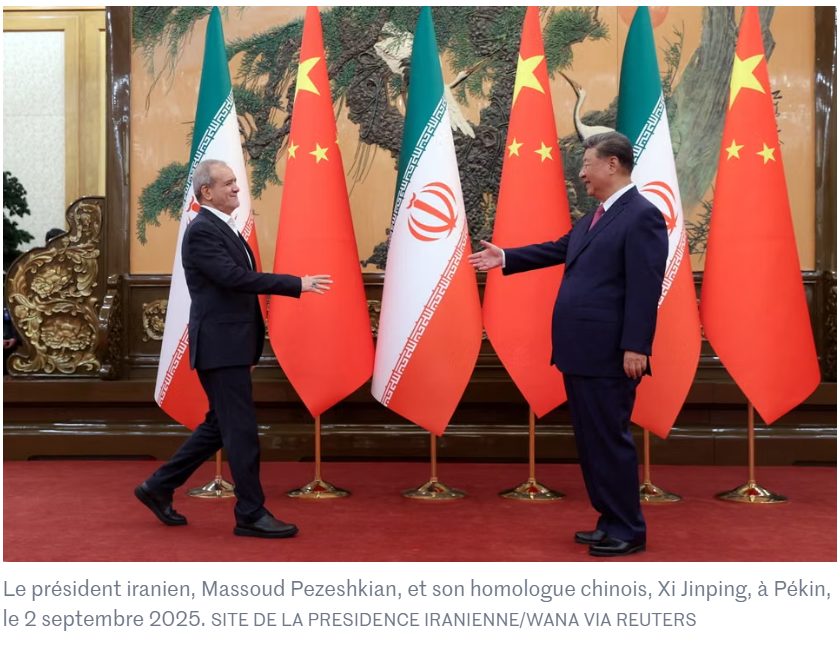
This military buildup has cascading effects far beyond the Iranian theater. The 2026 U.S. defense strategy itself emphasizes the need to strengthen defenses against China in the Pacific—an objective that the war in the Middle East makes more difficult to achieve every week. Unlike Russia and the United States, China is not engaged in any hot conflict and avoids the trap that has trapped its two rivals: allowing itself to be defeated by a weaker but determined adversary. Beijing also has considerable economic leverage over Tehran, which remains its main trading partner; a power dynamic that Washington seeks to exploit without fully succeeding; the «Operation Economic Outcast» sanctions campaign took care to spare Chinese banks as Trump-Xi’s May 2026 summit approached in Beijing.
A redistributed global order without a shot being fired
The structural lesson of this war therefore goes far beyond the Iranian dossier alone. The surge in energy prices linked to the instability of the Strait of Hormuz has directly benefited Russia, strengthening its budgetary position and its ability to continue its operations in Ukraine, where Europe fears a partial withdrawal from US support. The International Monetary Fund is also forecasting a marked regional recession, particularly in Qatar where GDP could fall by 8.6% % this year, a fragility that could push several Gulf monarchies to turn more towards Beijing. Each week of war thus translates almost mechanically into a relative gain for China in the Pacific and for Russia in Eastern Europe, without Beijing having to fire a single shot; this is undoubtedly the most lasting geopolitical legacy of this conflict.
The Iran war, or how Beijing wins without fighting
Rarely has a war benefited so much an actor who is not directly involved in it.
449

Previous article
 French
  English
  Chinese
  Arabic