
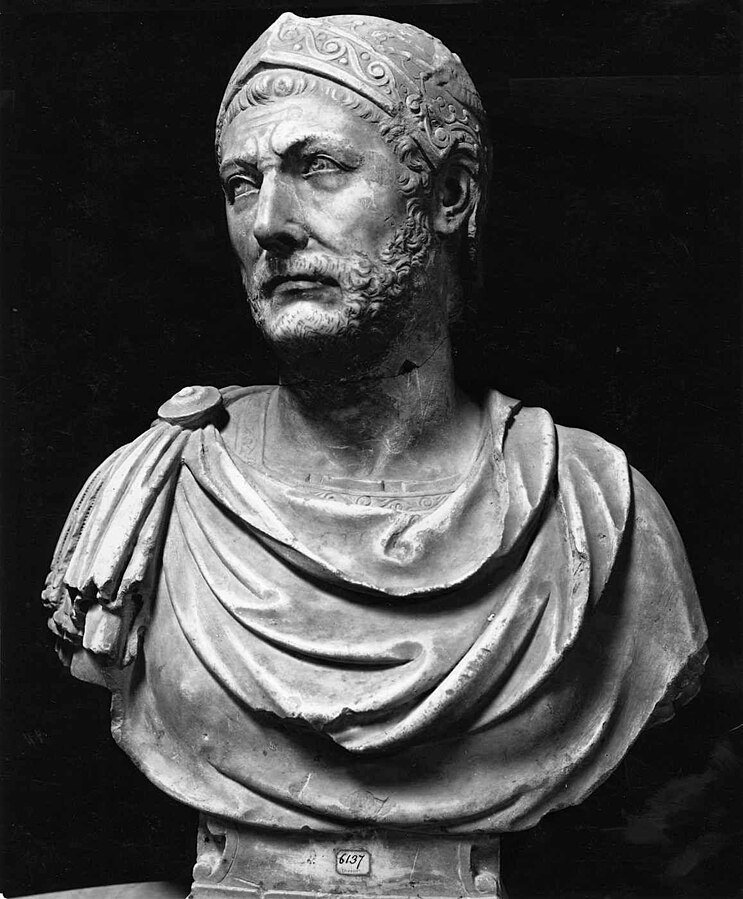

As is well known, Napoleon had a passion for Antiquity. Although the Roman civilization, its legal texts (Civil Code), its symbols (the Eagle; Legion of Honor) and its commemorative monuments (Arc de Triomphe) particularly marked him and undoubtedly inspired him in the administrative, edifying and military spheres, the Napoleonic world and imagination paradoxically reserved a prominent place for the one who embodied the nemesis from Rome, namely the famous Carthaginian strategist Hannibal Barca. It is known that Napoleon had bronze busts and pendulums in his possession[1] representing the Carthaginians. The Memoirs composed by Napoleon in the evening of his life, in exile on Saint Helena, are, moreover, a mine of information about his boundless admiration for Hannibal, as illustrated in particular by a dithyrambic passage about the man and his military achievements: «He was the most daring of all [the great warriors], perhaps the most astonishing! So bold, so sure, so broad in all things; who, at the age of twenty-six, conceives what is barely conceivable, carries out what was supposed to be impossible; who, renouncing all communication with his country, crosses through enemy or unknown peoples that must be attacked and conquered, scales the Pyrenees and the Alps … Indeed, he must have been endowed with a soul of the strongest kind and had a very high grasp of his science in war.»
Famous for his military tactics and stratagems, considered one of the greatest war leaders in history, Hannibal Barca could only attract the interested attention of Bonaparte, especially during his military studies at the Military School of Brienne. It is known that in 1788 Napoleon had taken notes on the Carthaginian strategist in the 1ster volume of the’Ancient history from Abbé Rollin – a work that he particularly appreciated – by composing in particular a «note on Hannibal» to highlight the genius of the Punique. Some «Hannibal-like» reminiscences appear in Napoleon’s military action: it is indeed impossible not to notice a disturbing resemblance between the Battle of Blietzkrieg Led by Hannibal Barca in Italy – and the series of victories won against Rome between 218 and 216[2] – and the way in which Napoleon Bonaparte waged his Campaign in Italy. It could, in fact, be applied to the army of the young Bonaparte, the heir in many respects to this movement strategy based on speed of execution – for whom «the strength of an army, like the quantity of movement in mechanics, is measured by mass multiplied by speed». The importance of speed in a strategy resolutely focused on movement is also found in Bonaparte’s other formula: «the best soldier is not so much the one who fights as the one who walks.».
This common Italian destiny will finally be embodied through the painting by the painter David, «Napoleon Crossing the Col du Grand-Saint-Bernard», a flamboyant representation that masks the reality of his dreary Alpine crossing; it presents him walking in the footsteps of Hannibal, as indicated by the name of the latter engraved on a rock. The English historian, P. Hicks, has indeed noted a certain similarity between a proclamation made by Napoleon to his soldiers in Nice before his 2nd campaign in Italy (1799-1800).e Italy campaign[3] and some speeches delivered by Hannibal to his troops, according to the Roman historian Tite-Live (1st century BC).
The testimonies surrounding Napoleon’s fascination with ancient strategists and military strategies tend to show that the Corsican was greatly inspired by them for his own strategy, even if he refused to admit it. And there is reason to believe that the Hannibalite work was not without its influence. One of the first biographers of Napoleon Bonaparte, Cousin d’Avallon, does not place Napoleon’s genius on a par with that of Hannibal?
[1] A passage from the memoirs of Baron Claude-François de Méneval mentions the presence of a bronze bust of Hannibal, as well as another of Scipio Africanus, on the fireplace in the office of Napoleon Bonaparte at the Château de Saint-Cloud. This work may have been executed by François Girardon, the sculptor of King Louis XIV, or by his protégé Sebastian Slodtz; it may correspond to a work housed in the Museum of the University of Saskatchewan in Canada.
An exceptional bronze pendulum, ordered by Napoleon 1er, and representing Hannibal, was cast in 5 copies. One of these copies, incomplete, is now in the Blue Room of the White House in Washington.
[2] Tessin, Trébie (218 BC), Trasimène, Géronium (217 BC) and especially its masterpiece, Cannes (216 BC).
[3] «This is no longer a defensive war; it is an invasion war; these are conquests that you are about to make. No equipment, no stores; you are without artillery, without clothes, without shoes, without a salary; you lack everything, but you are rich in courage. Well! here are your stores, your artillery; you have iron and lead; let's march and in a few days they will be yours (He showed them the fertile plains of Piedmont and Lombardy). The enemy, he adds, is four times more numerous than you; we will gain more glory.» This passage is taken from the State publications of 1797 and was reported to the Directory by Napoleon Bonaparte's right-hand man, Berthier.
Khaled Melliti is an associate researcher at UMR 8167 Mondes Sémitiques. He is the author of a notable thesis on the place of Hellenism in the political evolution of Carthage and one of the most accomplished scholars of the Punic city in France.

 French
  English
  Chinese
  Arabic