
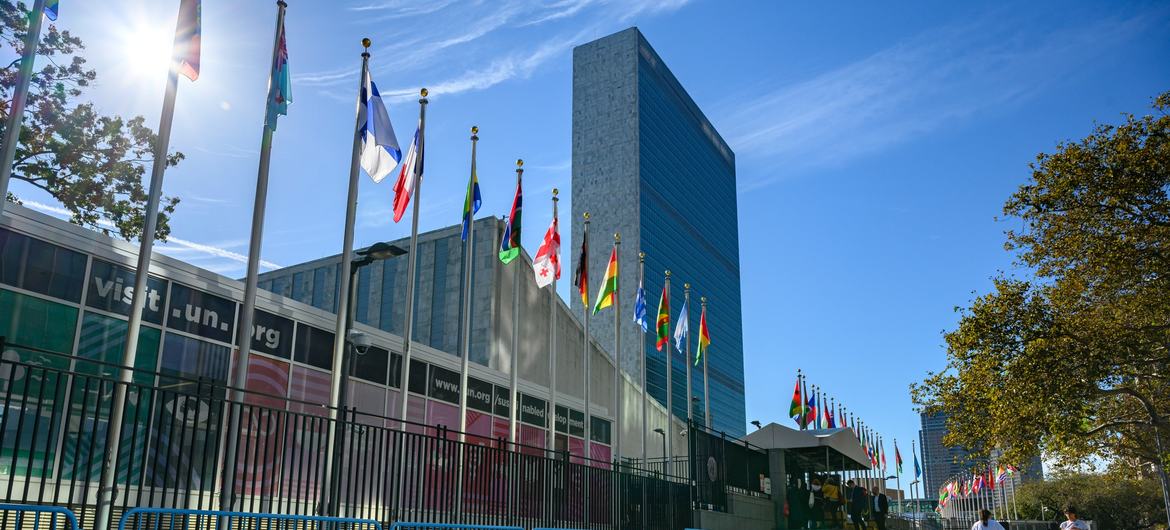
Choosing the next United Nations Secretary-General therefore comes down to answering a broader question: who can still embody a universal organization in a world that no longer shares a common vision of the international order?
A succession at the heart of a UN in crisis
Never, perhaps, has a Secretary-General taken the helm of an organization that is both indispensable and so hampered. Guterres’s term ends with a buildup of crises that are shaping a more fragmented world: Ukraine and the return of high-intensity war in Europe; Gaza, a symbol of the impotence of international law in the face of the divisions of the great powers; Sudan, a major tragedy relegated to the margins of international attention; and the Sino-American rivalry, which now structures international relations.
To these conflicts are added the climate crisis, the indebtedness of the South, migration and technological competition. These are challenges that transcend borders and call for a collective response, at a time when international cooperation is fading and the logic of power is taking center stage.
The Security Council illustrates this contradiction. Designed to allow the major powers to jointly preserve peace, it too often becomes the scene of their confrontations. Between paralysis through veto and political circumvention, it struggles to fulfill its mission.
The problem goes beyond the mere functioning of the Council: it is the very architecture of the international order of 1945 that is being challenged, because it no longer corresponds to the real geography of power in 2026.
It is in this context that Guterres’s succession begins. The question is therefore not just about which candidate has the best track record. Who can still embody a UN that is capable of speaking to the entire world when the great powers are no longer agreeing on the rules that should govern the world?
Three forces shape this succession: the institutional privilege of the five permanent members of the Security Council; the growing demand from the global South for representation that is more in line with the realities of the 21st century; and the crisis of multilateralism, in which states recognize the need without always accepting the constraints.
The paradox of the 38th floor
The appointment of the next Secretary-General follows, ostensibly, a universal mechanism. The General Assembly, which brings together the 193 member states, makes the appointment, but only on the recommendation of the Security Council. In practice, the center of gravity of the process lies in the hands of the five permanent members — the United States, Russia, China, France and the United Kingdom — which have the right of veto.
To be recommended, a candidacy must receive at least nine votes in the Council and not be vetoed by a permanent member. Behind this rule lies a much more political reality: The next Secretary-General will have to succeed in one of the most complex diplomatic balancing acts in the world.
It is in this perspective that the intervention of the straw polls, These informal votes, during which the fifteen members of the Council indicate, for each candidate, whether they wish to ’encourage« him/her, »discourage« him/her, or remain »without opinion«. These consultations allow for the measurement of dynamics and resistance, but do not designate the winner.
Because the real vote is played out less in the public arena of New York than in discreet consultations between the major capitals. One candidate can come out ahead and encounter opposition from just one major power; another may seem distant before emerging as the compromise that no one ultimately wants to block.
This is the very paradox of the 38th floor. The Secretary-General must be sufficiently representative of the 193 member states to embody the universality of the Organization, but also sufficiently acceptable to the five states that have the power to block his appointment.
In other words, he will have to be both the representative of the world and the compromise of the powerful.
This contradiction takes on a particular dimension today. The five permanent members no longer disagree only on a few issues: they are increasingly opposing the very rules that are meant to organize the world. The succession of Guterres thus becomes a test of their ability to agree on a minimum of common leadership.
Eight candidates, three worldviews
The political geography of this succession is revealing. Latin America and the Caribbean, which have never held the post, dominate the race. But this numerical strength is turning against the region: the multiplication of contenders dilutes its ability to impose a single candidate.
Carolyn Rodrigues Birkett, from Guyana, She represents the voices of the small states, the climate emergency, and a multilateralism more attentive to the vulnerabilities of the South. A former Minister of Foreign Affairs, she embodies a Caribbean candidacy firmly rooted in the global South.
Rebeca Grynspan, from Costa Rica, former Vice-President and Secretary-General of the UNCTAD, represents the agenda of development, debt and global economic imbalances. Her technocratic and multilateral profile allows her to dialogue with both the North and the South.
Michelle Bachelet, from Chile, As a former president and former High Commissioner for Human Rights, she brings strong political experience and international legitimacy based on human rights and the protection of civilians. But this profile can also evoke resistance among the major powers.
Rafael Grossi, from Argentina, The Director General of the International Atomic Energy Agency brings a unique profile to the race, forged in the heart of contemporary nuclear crises. His experience places him at the intersection of major security issues, from Ukraine to Iran, but also exposes him to the controversies and rivalries that surround the implementation of international rules in the nuclear field.
Two candidates come from Ecuador. María Fernanda Espinosa, She, former Minister of Foreign Affairs and former President of the General Assembly, is intimately familiar with the workings of the Organization. Ivonne A-Baki, As a diplomat and former minister, she places greater emphasis on conflict prevention and active personal diplomacy.
Africa also has distinct profiles. Olara Otunnu, from Uganda, a former high-ranking United Nations official and former Minister of Foreign Affairs, brings with him extensive experience of the UN system and conflict prevention.
Macky Sall, from Senegal, former president of the Republic and former president of the African Union, presents one of the most complete political profiles of this succession. His career gives him direct experience of exercising power, regional diplomacy, and the major balances between North and South.
Unlike candidates primarily from international organizations or diplomacy, he enters the race with the experience of a head of state facing the concrete constraints of governance, regional crises, and the power relations between major powers. His presidency of the African Union has also enabled him to raise African claims at the continental level for a more equitable representation in global governance.
His candidacy thus embodies a broader ambition: to make the voice of a Africa that no longer simply demands more representation heard at the UN’s highest level, but that also intends to participate fully in the definition of international rules. In an Organization that seeks both political authority and legitimacy from the global South, as well as the ability to mediate, this profile constitutes an asset that goes beyond the purely African dimension.
Behind these profiles are three orientations: a UN that is more focused on development and the global South; a UN focused on security and crisis management; and a UN that first seeks to regain its political authority and its ability to mediate.
The straw polls : the third round, the real test
The first two straw polls They provided a moving image of the race. In July, Rebeca Grynspan emerged as the winner, with her economic and development profile appearing capable of appealing to both the South and part of the West.
In August, the dynamic reversed: Carolyn Rodrigues Birkett took the lead. Her eight favorable votes translate an impetus, not a victory. Grynspan remains in the running, while Rafael Grossi remains a unique candidate, whose track record as head of the IAEA gives him direct experience of the major nuclear crises and the geopolitical tensions surrounding them.
Macky Sall holds a different position. His more directly political profile could become more important if the consultations between major powers lead to a stalemate between the top-placed candidates. The former Senegalese president indeed possesses a rare asset in this competition: experience that is both national, continental, and international. In an election where final compromise often counts more than initial popularity, a candidate capable of engaging with Africa, the global South, Western powers, and the major emerging actors could become a serious option.
But the real turning point still lies ahead. A third round of straw polls It is expected in September, under the French presidency of the Security Council. For the first time, the ballots should make it possible to distinguish the positions of the five permanent members from those of the ten elected members.
This evolution changes the very nature of the exercise. Until now, the consultations have allowed for measuring the relative popularity of the candidates. The next round should begin to reveal what really matters: Which candidates are the major powers prepared to accept — and which one of them is it prepared to block?
In this election, the votes« discourage » constitute a more decisive indicator than the simple « encourages ». A candidate can enjoy widespread support and remain without any chance if one of the five permanent members decides to oppose him. Conversely, a less well-positioned candidate can become the favorite if he appears to be the only compromise acceptable to everyone.
This third straw poll It could therefore constitute the first real geopolitical test of the succession. It may not yet say who the next Secretary-General will be, but it will reveal which candidates can actually become so.
The question is no longer just who has the upper hand; it is also who can break the invisible wall of the five vetoes.
The real voter: the five permanent members
This is where the geopolitical heart of this succession is played out. Behind the Council’s consultations, the true arbiter remains the five capitals, each of which poses a different — and sometimes contradictory — question to the future Secretary General.
Washington Looking for a Secretary-General capable of cooperating with the United States without turning the UN into a platform hostile to their interests. With China, Iran, the funding of the Organization, and especially Gaza, the equation is delicate. The Palestinian question has become a major test of the independence and limits of the UN.
Moscow Above all, he wants a candidate who is not to be instrumentalized by Washington and its allies. Amidst Ukraine, sanctions and the challenge to Western hegemony, the Kremlin is looking for a Secretary General who will not serve as a moral authority for an international order that he disputes.
Beijing Focus on the global South, but according to its own interpretation of multilateralism. China wants a Secretary-General who is in favor of rebalancing global power and a better representation of developing countries, but is hostile to the politicization of human rights, which is seen as a tool of pressure. It also seeks to appear as the defender of a less Western order.
Paris and London, Finally, they defend their status as permanent powers while calling for reform, fearing the consequences. The Palestinian question alone illustrates the limits of a system where international law and UN resolutions clash with interests, alliances, and power relations.
The paradox is this: the P5 talks about reform while maintaining the institutional privileges that make it so difficult.
The next Secretary-General will therefore have to meet five distinct requirements. No candidate can afford to disappoint several of them at the same time.
And what about Europe?
For Europe, this succession comes at a time when its influence in the international system is also being put to the test. The European Union remains a major player in multilateralism, the funding of the UN system, and the defense of international law. But it does not have a single, unified voice in the Security Council, while its relative weight is increasingly contested by the assertion of the Global South.
This situation reveals an ambiguity in European politics: France and the United Kingdom have permanent seats, but the European Union, despite its economic, financial and diplomatic weight, remains absent from the Organization’s real center of gravity.
The choice of the next Secretary-General will therefore also be revealing of the place that European powers can still occupy in the reordering of the international order. Amid the war in Ukraine, Gaza, the African crises, and the Sino-American rivalry, Europe needs a UN capable of preserving spaces for dialogue and mediation, without which it risks seeing the major international balances increasingly decided outside of its sphere of influence.
However, the stakes go beyond the mere European powers: it is a question of whether the multilateral system can still offer states other than the great powers an area where law and diplomacy allow for the tempering of power relations.
Which UN for the new world order?
Beyond the individuals, succession raises four major questions.
A global South UN? The Latin American and African candidacies reflect the shift in the center of gravity of global politics. But they also reveal two approaches: that of candidates drawn primarily from multilateral diplomacy, and that of political leaders who have directly exercised power.
In this regard, the candidacy of Macky Sall illustrates the emergence of a Africa that no longer wants to be merely better represented in international institutions, but to participate fully in defining their priorities and rules. Debt, climate, development, security and representation: the South wants an Organization that is no longer simply the institutional mirror of 1945.
A UN of law or of power? Ukraine, Gaza and Sudan pose, each in their own way, the same question: what is the value of international law when it clashes with the interests of major powers or their allies? The future Secretary-General will have to navigate between law, realism and mediation, without ignoring that the credibility of the UN depends on its ability to avoid the reproach of «two measures of the same weight».
A reformed UN or simply better managed? The problem is not just one of efficiency, but of the mismatch between an architecture inherited from 1945 and the real geography of power in the 21st century. Reforming the UN does not necessarily mean redistributing power.
A UN capable of becoming a mediator again? This may be the essential function of the next Secretary-General: not to resolve wars alone, but to maintain channels of dialogue when the powers no longer speak to one another and to preserve an area where negotiation remains possible.
Conclusion
The next Secretary-General will have to be strong enough to defend the authority of the UN, independent enough not to become an instrument of a P5, consensual enough not to be blocked by them, and representative enough of the South to respond to the transformation of the world.
No candidate ticks all these boxes perfectly. Some have intimate knowledge of the UN system, others have recognized expertise in major international crises, or strong moral legitimacy. Those who possess direct experience of power, a regional stature, and the ability to bring the aspirations of the global South into dialogue with the great powers are rarer still. It is precisely this combination that many states are seeking today in search of a new compromise.
And no P5 really wants a candidate to check all of them.
The question is therefore not just who will occupy the 38th floor from January 1, 2027. It is about whether an Organization conceived in the aftermath of the Second World War can still adapt to a world it no longer structures, but which it remains paradoxically more necessary than ever.
Because behind the name that will emerge from New York lies a broader question: can multilateralism still be the space where the rule moderates power, or will it now have to content itself with recording the relations of force?
 French
  English
  Chinese
  Arabic