
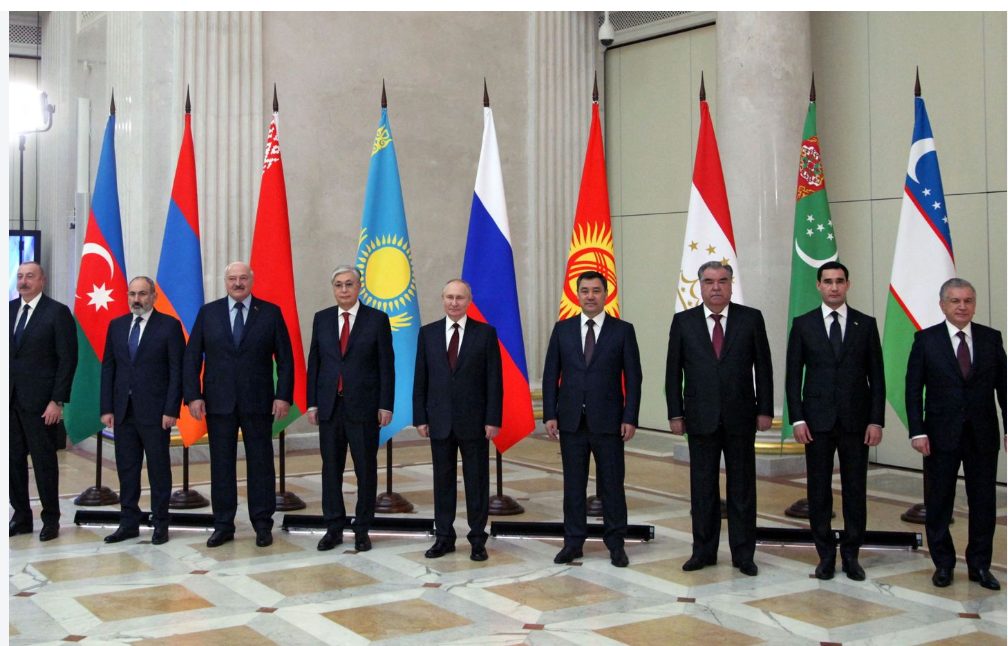
On August 31 and September 1, 2026, the city of Bishkek hosted one of these summits, the staging of which sometimes matters more than the final communiqué. Vladimir Putin, Xi Jinping, Massoud Pezeshkian, Narendra Modi, Shehbaz Sharif, and a handful of other heads of state gathered to celebrate the 25th anniversary of the Shanghai Cooperation Organization. The official photo, published by the Russian agency Sputnik, shows ten leaders aligned, smiling for the occasion, in a setting designed to project unity that the reality of their power relations largely denies. Behind this image, the SCO remains a heterogeneous bloc, undermined by rivalries that Beijing and Moscow themselves struggle to conceal in Central Asia, and by persistent tensions between India and Pakistan, two members that oppose each other except for their common presence in this organization.
But this summit was not just a mere protocolistic exercise. It took place at the exact moment when the war between Iran and the United States, after a month of relative calm, resumed in full force. A first exchange of attacks had taken place on the eve of the meeting itself. Massoud Pezeshkian, on the sidelines of the summit, made it clear that he was determined to deescalate the situation with Narendra Modi: «We are convinced that continuing the war is neither in our interest nor in that of the region.» A façade statement, no doubt, but one that reveals a deeper reality: seven months after the start of the conflict, Iran is seeking economic support capable of offsetting the asphyxiation imposed on it by Western sanctions. And that is precisely where the issue of the petro-yuan ceases to be a slogan and becomes a matter of economic survival.
A monetary escalation that is not of yesterday, but that the Gulf War has just radicalized
The idea of oil trading denominated in yuan rather than in dollars is not new; in fact, Beijing has been advocating it for more than a decade. What has changed in 2026 is the context: since the US-Israeli strikes on Iran on February 28 and the subsequent blockage of the Strait of Hormuz, the global energy market has been under a strain that had not been seen since the oil shocks of the last century. Gas prices have risen by nearly 40% % since January. The INSEE has just lowered its growth forecast for France from 0.7 to % 0.4, % citing the closure of the Strait of Hormuz as one of the reasons for the revision. More than seven million French households, whose contracts are indexed to the reference price, will see their gas bill rise as early as October.
In this climate, every barrel sold in dollars mechanically strengthens Washington’s power to impose sanctions, since almost all international transactions in dollars pass, at one point or another, through the American banking system, hence under the supervision of the US Treasury. For Moscow and Tehran, therefore, circumventing the dollar means circumventing the economic weapon itself, the one that has already largely isolated Russia since 2022 and continues to strangle the Iranian economy. It is this reasoning, which is several years old but has been revived by the urgency of the moment, that has fueled the multiplication of bilateral agreements between China and its energy suppliers.
But the reality of the figures remains, to this day, significantly more modest than the geopolitical narrative surrounding them. While the share of Sino-Russian trade settled outside the dollar has indeed increased since 2022, it was driven by necessity rather than a strategic choice: it was Western sanctions that forced Moscow’s hand, not a spontaneous monetary preference. The yuan remains a currency with partially controlled convertibility by Beijing, with closed capital markets, strict foreign exchange controls, and an international liquidity without the equivalent of the dollar. No major Gulf oil exporter, not even Saudi Arabia, which is an OIC dialogue partner, has, to date, irreversibly shifted a significant share of its contracts to the yuan. Repeated announcements of a «end of dollar hegemony» encounter, summit after summit, the same structural obstacles.
The great disparity among the Gulf monarchies
For the Arab Gulf states, the monetary issue is inextricably linked to a much broader security dilemma. Saudi Arabia and the United Arab Emirates rely heavily on American security guarantees against Iran, while fearing becoming direct targets of a conflict they did not choose. This fear was recently vividly demonstrated by the Houthi attack on a Saudi military base on September 13. Their stance on the petroyuan reflects this enduring strategic divide: exploring alternative payment mechanisms with Beijing without ever openly breaking with the dollar system, which remains the cornerstone of their own sovereign reserves and investment funds.
China, for its part, has already demonstrated its capacity for concrete influence in the region: in March, three Chinese ships crossed the Strait of Hormuz after coordination with the relevant parties, according to the words of the spokesperson for the Chinese Ministry of Foreign Affairs, Mao Ning, who took the opportunity to call for the restoration of peace and stability in the Gulf region. A calculated move: Beijing demonstrates its ability to secure safe passage where Western fleets struggle to ensure free circulation, without, however, engaging militarily in the conflict; this positioning serves, in a roundabout way, as a commercial argument to convince energy producers in the region to diversify their payment circuits towards Beijing.
What Europe receives without having chosen it
Europe, however, has no say in the monetary shift or in the war that fuels it; but it is already paying the price. The downward revision of French growth illustrates the direct cost of the Strait crisis on the continent’s energy-importing economies. A deeper and more lasting shift towards dollar-free circuits, if confirmed in the coming years, would add an additional layer of uncertainty for European businesses and central banks, already called upon to arbitrate between imported inflation and support for a growth that is not in line with the fundamentals.
The Bichkek summit therefore did not mark the end of dollar hegemony, far from it. It mainly revealed, once again, the political determination of a group of countries to prepare for a world where that hegemony could one day erode, without any of them yet having the financial instruments to organize it fully. The gap between the narrative presented in Bichkek and the reality of global monetary flows remains considerable for the time being. But it is precisely this gap that will need to be monitored in the coming months, as the Gulf War continues to weigh on every energy arbitrage on the planet and each new month of conflict makes the escape from a dollar system that is strangling them both, Moscow and Tehran, a little more tempting.

 French
  English
  Chinese
  Arabic