
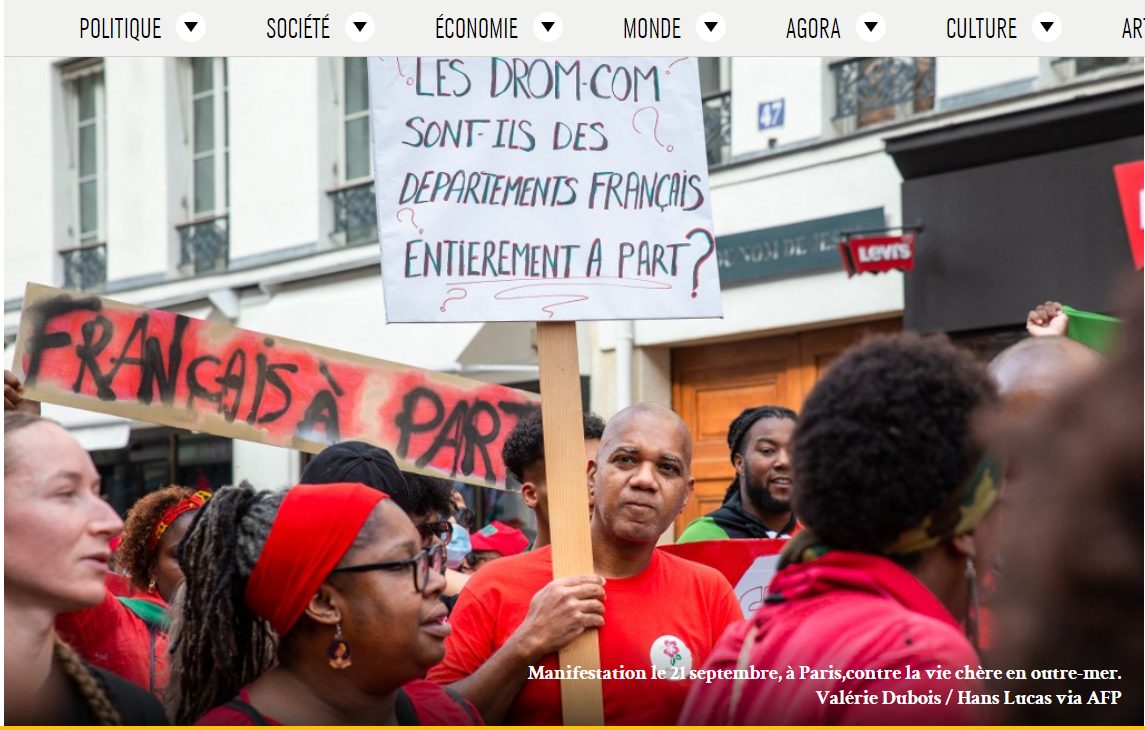
The overseas territories have never seemed to be a major concern for Emmanuel Macron. But, according to Erwan Davoux, Editor-in-Chief of Geopolitics.fr, former chargé de mission at the presidency of the Republic, the appointment of François-Noël Buffet, a veteran expert in the ultra-maritime territories, could change the situation and allow finally to provide elements of response to the combustible issue of «high cost of living».
The results of the second round of the last presidential election in the Overseas Territories reflect a deep disaffection with Macronism, even more pronounced than in metropolitan France. The case of the Martinique, The territory where the riots against «high living costs» took on the most serious proportions is particularly eloquent: Emmanuel Macron won there 77.5% % of the votes against Marine Le Pen in the second round of the 2017 presidential election.
In 2022, the result completely reversed itself, with the president of the National Rally receiving 60.9% % of the votes against 30.1% % for the President of the Republic. All thanks to a record abstention (over 50%). % The malaise is deep, primarily of a political nature, and is manifested in a massive rejection of the current power structure.
The arrival of François-Noël Buffet could change the situation: the Overseas Territories now have both a real minister, attached to the Prime Minister, and an excellent expert on these matters.
The new minister has often accused the executive of not taking into account the Senate reports on the matter, which are nevertheless enlightening. While in metropolitan France, the issue of purchasing power is a major concern, the problem of the overseas territories and, in particular, Martinique, arises with an increased severity: in 2022, the INSEE estimated the overall gap between the cost of living in the French hexagon and in the overseas departments at 14 %.
As for Martinique, food prices are 40 % % higher there than in metropolitan France (36 % for Reunion). Even though the population living below the poverty line is almost twice that in metropolitan France: 27 in % Martinique compared to 15 in % the hexagon. For many, leisure activities are a distant memory. For others, the question of malnutrition arises.
High costs
A total aberration, an explosive cocktail that evokes a wave of more than justified revolt and that will certainly not subside through mere repression. Maintaining order is of no effect against injustices of this nature and this scale.
The margins of the large distribution sector are comparable to those of Métropole.
It is common practice to accuse the large retail sector of achieving excessive margins. What about the Antilles? According to the Competition Authority, the margins achieved in the Antilles are on the same level as those in metropolitan France (Opinion No. 19-A-12 of 4 July 2019). The large retail sector is therefore no more or less guilty than in the Métropole. It is more the specificities of the overseas territories that are at issue and that should benefit from large-scale corrective measures from the public authorities.
The cost of living in Martinique is rooted in the insular nature of the market, creating structural constraints, the main ones being: the limited size of the market (360,000 inhabitants) and the geographical distance from the sources of supply. Indeed, it is estimated that about 75 % of the items in store are imported directly or indirectly.
The cost of shipping a container averages 5,000 euros, Regardless of the value of the products it contains, since freight is charged based on volume. Therefore, the lower the unit value of the product, the greater the share of transport in the cost of production. This results in a substantial increase in the cost of the products of basic necessity and a much less impact on high-value products. A travesty of social justice!
To these transport costs are added the fees for granting the sea These vary depending on the commodity (for example, 9.5 % for pasta and 22 % for rice). While not denying the important role of the sea tax (to protect local production and contribute to funding local communities), it significantly increases the cost of imported goods.
Finally, some structural reforms?
Specific initiatives have been or are being taken. Thus, in 2022 and until the end of 2023, the CMA CGM Group decided to implement a reduction of €750 per 40-foot container. Similarly, the recent decision by the territorial community of Martinique (CTM) to eliminate a tax on imported goods for thousands of essential products is in the right direction. It consists in the elimination of sea-grant rates on 54 families of essential products, representing more than 5,900 items of essential need (pasta, canned foods, diapers, etc.).
But this response is temporary and not structural (the mechanism is intended to last for three years). It is structural reforms that the Ultramarins need, and a comprehensive vision in which the protagonists do not blame each other for the situation. The intervention of the state to reform and coordinate the system is indispensable if we want the Ultramarins to be full citizens and not reduced to the rank of «crumbs of the Empire».
It might be opportune to conduct a comprehensive reflection by creating a «territorial continuity» policy that would consist of erasing or offsetting all or part of the costs associated with remoteness for food products. Such a measure would naturally have a budgetary impact but would be the result of a strategic decision of an eminently political nature. Such a scheme exists in Corsica, where approximately 187 million euros are allocated each year by the State for territorial continuity (for 340,000 Corsicans), while only 45 million were allocated for this purpose in 2023 for all the overseas territories (that is, 2.8 million inhabitants). Thus, according to the Senate Information Report (March 2023) on «Territorial Continuity», the Corsican model would likely offer valuable lessons for the overseas territories.
The other major avenue would be to resort to the equalization of approach charges and taxation, notably by eliminating freight costs and granting sea access for nearly 2,500 essential products. This targeted measure (which preserves local production) would be neutral for shipping carriers and communities. Indeed, the uncollected revenues from the import of these products would be redistributed to more expensive products, more likely to absorb the costs of approach, or to less vital products. This requires moving away from the single price for transported containers and for local authorities to agree to review the distribution of sea fees. According to preliminary estimates, this scenario for Martinique would lead to a reduction of more than 20% % in the selling price of more than 2,500 essential products.
Finally, the third track aims to promote local production. The direct impact on consumer sales prices would probably be positive, but above all, it would create activity, jobs, and therefore, purchasing power. The entire agricultural sector could work towards a gradual shift in crops towards local consumption. The time for inaction is over. Either the State takes matters into its own hands and demonstrates its will that the inhabitants of the overseas territories are considered full citizens, or the disaffection towards public authorities and the political class will become irreversible and lead to a future fraught with all sorts of dangers.

 French
  English
  Chinese
  Arabic