
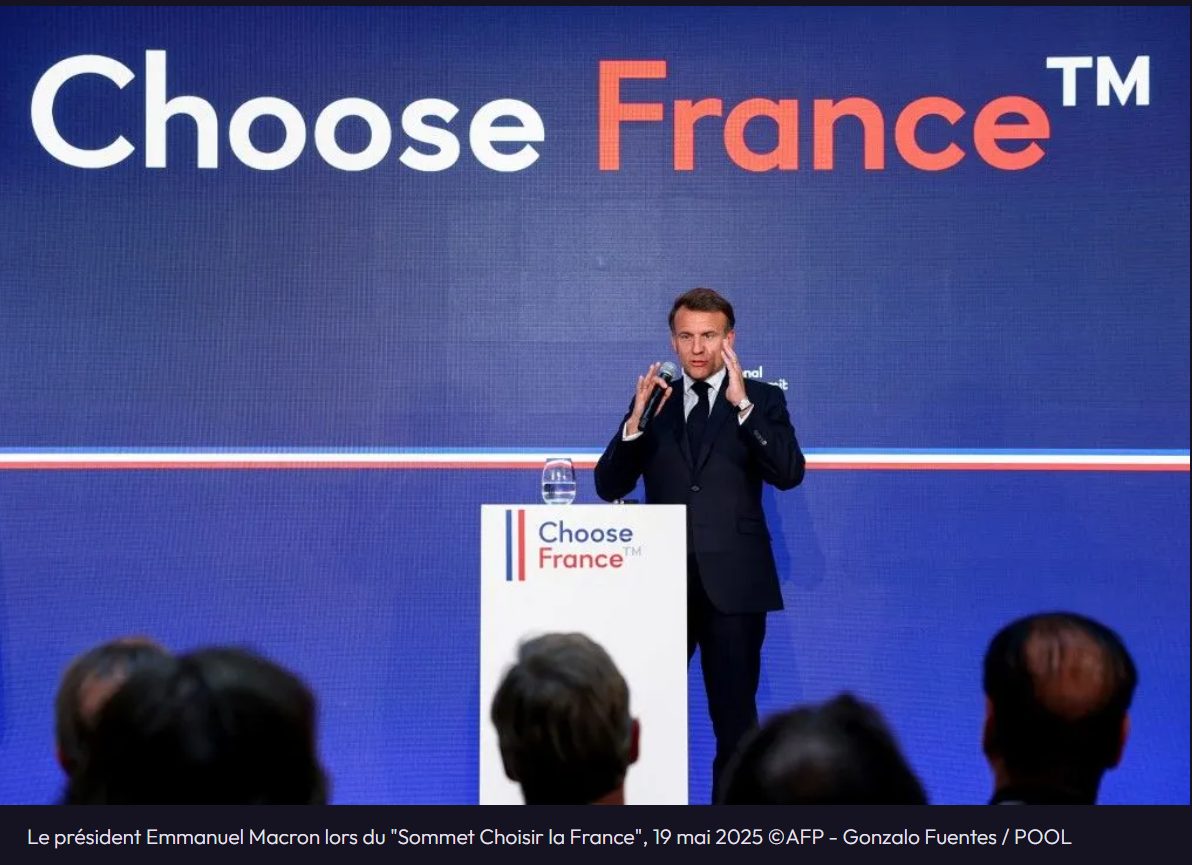
Choose France, eight years of building a national brand
Launched in January 2018, the Choose France summit is the most visible embodiment of a place-marketing strategy that Macron has elevated to the rank of a presidential priority. The initial idea was simple yet politically bold: to reverse France's image, traditionally perceived abroad as a country with confiscatory taxation, rigid labour law and a combative social fabric, by replacing it with that of an innovation hub, an attractive market and a state that partners with business. The symbolic setting of Versailles is no trivial matter: it invokes the grandeur of the French state while signalling to international bosses that France has confidence in itself.
The evolution of the figures bears witness to a steady rise in momentum. From €3.5 billion at the first edition, investment commitments grew to reach €15 billion in 2024, then €40.8 billion in 2025—of which €20.8 billion was linked to the AI Action Summit in February 2025—before culminating at €93 billion in 2026, representing 71 announcements and 15,600 promised jobs. This exponential growth reflects both the genuine success of the diplomatic tool and a form of rhetorical inflation: the announced commitments include multi-year projects, reaffirmations of previous investments and intentions that will only partially materialise.
EY's annual barometer of European attractiveness provides a more objective measure. It confirms that France remained, for the sixth consecutive year in 2025, Europe's leading destination for foreign direct investment, ahead of the UK and Germany. This leadership position is all the more remarkable as it was maintained in a context of a general decline in investment in Europe, at a time when the United States recorded a twenty per cent rise in its investment projects between 2023 and 2024, driven by the Inflation Reduction Act and Trump's pro-business promises.
The drivers of French appeal: reforms, geography and opportunism
French appeal rests on several foundations, the respective contributions of which need to be untangled. The structural reforms undertaken since 2017 – reform of the Labour Code by ordinance, cuts in corporation tax from 33 to 25 per cent, abolition of solidarity tax on wealth (ISF) on financial assets, creation of the single flat-rate levy on capital income – have significantly altered the tax and regulatory framework in which investors operate. These reforms, hotly contested on the domestic social and political front, have nonetheless had an effect on the perceptions of chief financial officers and investment committees of major multinationals.
Beyond the reforms, France offers structural comparative advantages that Choose France did not create but has managed to promote: a pool of high-level engineers and researchers, an industrial tradition in high value-added sectors—aerospace, nuclear, luxury goods, pharmaceuticals—a central geographical location in Europe, and an infrastructure network among the most developed on the continent. The 2026 edition sees the confirmed rise in power of strategic sectors such as artificial intelligence with 53 projects in 2025, up by 26 per cent, quantum technologies, semiconductors and rare earths, in which Macron announced just before the summit 1.55 billion euros of additional public investment.
A factor of geopolitical opportunism must also be taken into account. Trade tensions between the United States and China, followed by Trump's tariff policy in 2025, have led many manufacturers to reconsider their supply chains and seek locations in continental Europe offering regulatory stability and access to the single market. France has benefited from these strategic reorientations, attracting investments from companies eager to hedge against geopolitical risks through a presence on European soil.
The grey areas: between promises and industrial realities
A critical analysis of Choose France requires distinguishing between the announcement and the implementation, between the investment promise and the jobs actually created. The commitments announced during successive summits are stated intentions made during a high-profile media event, the materialisation of which spans several years and is subject to numerous conditions, such as market trends, regulatory stability, and the availability of local skills. The aggregate figures communicated by the Élysée are not subject to any systematic independent audit, which makes the assessment of the real impact particularly difficult.
The EY report also highlights a structural tension: while France is attracting investment, the number of investment projects in Europe continued to decline for the second consecutive year in 2024, signalling that French attractiveness is being built in part to the detriment of its European neighbours rather than by creating an overall surge in investment on the continent. This intra-European competitive dynamic raises questions about the consistency between the Macronist rhetoric of European sovereignty and a national practice of tax and regulatory competition. Is France the champion of investment in Europe, or is it simply snapping up investments that its European partners are failing to attract?
At a sectoral level, several traditional French industries remain structurally weakened. The automotive, steel and other manufacturing sectors are facing competitiveness challenges in the face of Chinese competition and technological changes that the Choose France announcements only imperfectly mitigate. The reindustrialisation proclaimed by Macron remains heavily concentrated on high-tech sectors and dynamic metropolitan areas, while deindustrialised regions are struggling to capture these investment flows. The 75 per cent of investments made outside the Île-de-France region constitute an encouraging signal, but the geographical distribution of the value created remains highly uneven.
Choose France as a foreign policy tool: economic diplomacy put to the test
Beyond its economic dimension, Choose France constitutes a foreign policy tool in its own right. By bringing together two hundred business leaders of forty nationalities at Versailles, Macron is creating a direct network of relationships between the Head of State and global economic decision-makers, which bypasses traditional diplomatic channels and strengthens the French president's personal influence in international chancelleries. This form of «CEO diplomacy» allows Macron to maintain a privileged relationship with American, Asian, and Gulf actors, in a context where France is seeking to preserve its room for manoeuvre in the face of the cross-pressures of Washington and Beijing.
The 2026 edition takes place against a particularly tense geopolitical backdrop, marked by the war in the Middle East and the resulting economic disruptions, rising energy prices, and the blockage of the Strait of Hormuz. The fact that investors are turning up in this context is in itself a signal of confidence in French stability, which the Élysée has managed to leverage politically. The record €93 billion thus becomes an argument in the European debate on competitiveness and a counter-argument to the thesis of French «decline» regularly put forward by the opposition.
The innovation of this ninth edition, the Choose France Days, allowing the public to visit 111 industrial sites belonging to 92 companies, illustrates a significant shift in strategy: after having convinced foreign investors, the objective is now to convince French citizens that these investments belong to them and concern them. This educational dimension and democratic legitimation of economic communication constitutes a turning point in Macronian communication, which seeks to reconcile international attractiveness with domestic popular support, a considerable political challenge in a country where globalisation remains deeply divisive.

 French
  English
  Chinese
  Arabic