
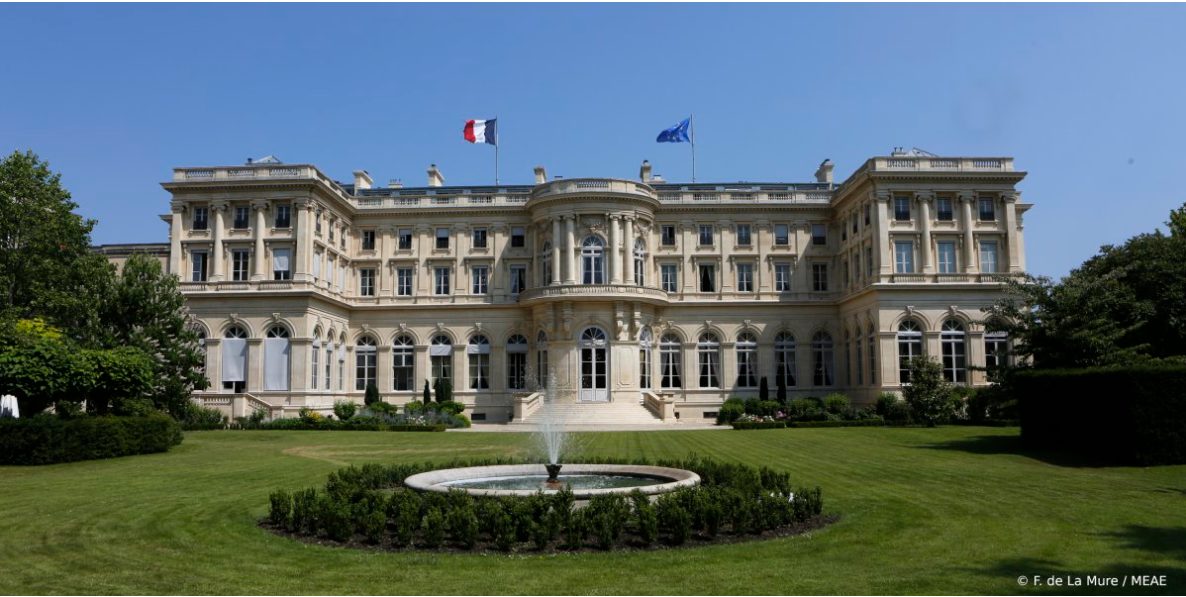
Emmanuel Macron, long-time champion of a European «third way» between Washington and Beijing, has had to implicitly acknowledge the limits of this ambition in the face of the accelerated fragmentation of the international order.
This development is part of a French tradition of constant questioning regarding its place in the world. Since the presidency of Valéry Giscard d’Estaing, who asserted as early as 1975 that France must accept its status as a second-tier power behind the superpowers, the debate has never ceased between proponents of autonomous national greatness and realists accepting the necessity of coalitions. Macron himself as recently as 2020 rejected the idea that France could conceive of itself as a «middle power", believing that the French people could not accept it. Yet Paris's current diplomatic practice bears a remarkable resemblance to what Giscard had theorised. It aims to become the leading voice of a group of powers: the United Kingdom, Japan and Germany, which follow the superpowers while preserving their autonomy of decision-making.
The concept of ’European strategic autonomy«, a French obsession for decades, has also undergone a significant transformation. It is no longer so much about Paris building a European defence truly independent of the United States, an unrealistic objective in the short term. But rather about developing capabilities that allow Europeans to act alone »when necessary«, according to a well-worn and recurring formula in French diplomacy.
This semantic nuance reflects a heightened pragmatism. France recognises that US support remains essential to achieve its political objectives, but it refuses to rely entirely on Washington, whose reliability is now being questioned.
The «coalition of the willing»: a new vector of influence
France’s commitment in Ukraine perfectly illustrates this new approach. Aware that their military stocks and finances do not allow them to supply as much armaments as other countries in proportion to their GDP, French officials have focused on another lever: that of political audacity combined with military experience and nuclear deterrence. Macron has established himself as the architect of a «coalition of the willing». The latter brings together European countries prepared to go beyond the minimal consensus of NATO or the European Union. The initiative, announced in late 2025, aimed to give a more strategic dimension to Western support for Kyiv, beyond the simple supply of equipment.
This stance represents a notable shift from Paris's traditional caution regarding NATO's eastward enlargement. Jacques Chirac had criticised the idea of the Alliance expanding towards Georgia and Ukraine, fearing a deterioration in relations with Moscow. Macron himself, prior to the Russian invasion of February 2022, repeatedly called for dialogue with Vladimir Putin and warned against the humiliation of Russia.
The turnaround is therefore considerable: at the Globsec forum in Bratislava in June 2023, the French President stated that the guarantees offered to Ukraine and Georgia in the past had been «far too weak». He expressed his wish to see Sweden join the Alliance, thereby demonstrating a position in favour of NATO enlargement.
This shift can be explained by a clear-eyed reading of the balance of power. France alone cannot wield significant influence against a revanchist Russia, tacitly supported by China, nor against a United States whose foreign policy oscillates with political changes. On the other hand, by positioning itself as the catalyst for the most ambitious European initiatives, Paris can multiply its real influence. The gamble consists in turning a handicap—limited resources—into an asset: an ability to unite and give political coherence to the scattered efforts of European partners.
The contradictions of a contested European leadership
Despite this sophisticated strategy, France is running up against persistent scepticism from several European partners. The very concept of strategic autonomy remains controversial. The public disagreement between Macron and Annegret Kramp-Karrenbauer, then German Defence Minister, over the nature of transatlantic relations illustrated this.
For many Central and Eastern European countries, any inclination towards emancipation from Washington appears as an existential threat in the face of Russia. Poland, the Baltic states and Romania systematically prioritise their ties with the United States.
The French position on the Western Balkans also reveals underlying tensions. Paris's blocking, in 2019, of the opening of accession negotiations with Albania and North Macedonia, followed by the imposition of a new enlargement methodology, were perceived as proof of French disinterest or even hostility towards the European integration of the Balkan countries.
This stance, justified in Paris by legitimate concerns regarding the functioning of European institutions and the need for internal reforms prior to any further enlargement, seemingly contradicts the rhetoric of a strong and united Europe facing geopolitical challenges.
The tax issue constitutes another major point of vulnerability. France cannot lay claim to European leadership in defence and foreign policy if it fails to clean up its budgetary situation.
The French public deficit, regularly above the Maastricht criteria, limits room for manoeuvre. It significantly influences military spending and undermines Paris's credibility. The political crisis that shook France in late 2024 and early 2025 further weakened its position. Domestic turbulence is not without effect on the geopolitics of Europe as a whole.
Towards a new grammar of French power
The future of France's standing will depend largely on the configuration of the post-American, or at least post-hegemonic, international order. If, as many anticipate, the world evolves towards a plurality of regional orders rather than a unified system dominated by a single superpower, middle powers will have increased leverage. They will no longer need to tie themselves entirely to a single hegemon as the post-World War II era required. Through the diversification of their partnerships, risk mitigation and hedging strategies, their support will become a matter of competition between great powers.
In this context, the temptation for middle powers to compete with each other rather than cooperate will be strong. The saga of the Future Combat Air System (FCAS), which was meant to embody Franco-German defence cooperation, illustrates the difficulties of overcoming national agendas in favour of genuine European integration. Yet, in areas such as defence, intra-European cooperation must prevail if the continent's countries are to wield collective influence.
France has unique assets to navigate this uncertain environment. Its permanent seat on the United Nations Security Council, its independent nuclear deterrent, its global diplomatic network, its military presence on several continents thanks to its overseas territories, and a high-performing defence industry are all factors to be taken into consideration. These attributes give it a legitimacy that few European partners can claim. But they will not suffice without the ability to build lasting coalitions. Nor even to embody a European project that goes beyond French interests alone.
The pragmatism shown by Macron since 2025 suggests that Paris has learned the lessons of past failures. Rather than proclaiming a European sovereignty for which the means are lacking, France now appears to favour concrete progress with partners willing to commit, even if it means accepting a multi-speed Europe. This approach, less ambitious on paper, could prove more effective, particularly in a world where power is measured less by the ability to impose than by the ability to bring people together.

 French
  English
  Chinese
  Arabic