
The art of staging in the service of a power strategy
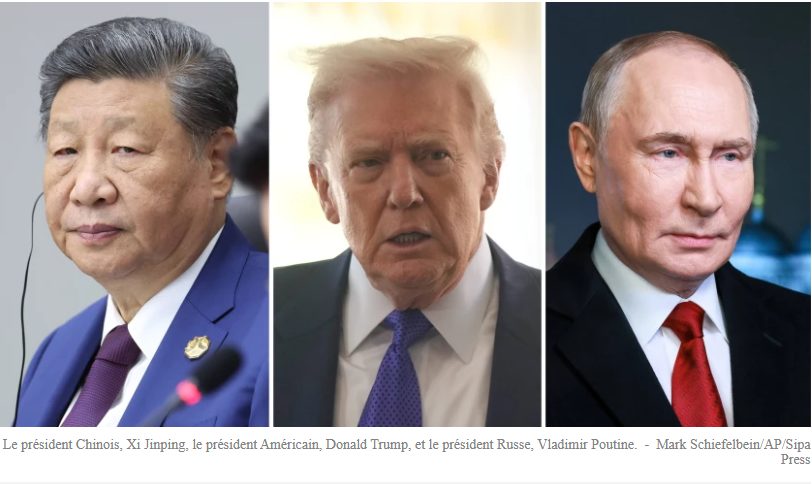
Just days apart, Beijing hosted Donald Trump on 14 and 15 May 2026, followed by Vladimir Putin from 19 to 21 May 2026. An almost identical ceremonial: red carpet, military honours, meticulously orchestrated sequences in the Great Hall of the People, and strictly controlled communications. At first glance, the scene might suggest a form of balance, as though China were treating both interlocutors according to the same diplomatic code. In reality, this apparent symmetry masks a profound asymmetry. With Washington, Beijing is primarily seeking to contain a rivalry that has become structural, without letting the confrontation slip into a costly rupture. With Moscow, by contrast, it is exploiting an increasingly asymmetric relationship to consolidate its continental, energy and financial leeway.
This dual welcome says much more than it shows. It reveals a Chinese diplomacy founded on centrality, mastery of tempo and the differentiated management of interdependencies. Beijing is not content simply to receive foreign leaders: it enrols them in a political space that it controls, where form already becomes a message. Protocol is not mere decoration; it is an instrument of hierarchisation, stabilisation and, fundamentally, power. Behind the same red carpet, China is therefore not sending the same signal: it is speaking to America of a balance of power to be managed, and to Russia of a partnership to be optimised. It is in this gap that the Chinese method can be read.
Form as an instrument of power
In Beijing, nothing is left to chance. Chinese diplomacy begins with space, rhythm and staging. Great Hall of the People, Zhongnanhai, rigorously ordered protocol sequences, subtle hierarchy of gestures, glances and speaking times. This is not mere scenery designed to impress, it is already a political language.
By entering this codified universe, any foreign power agrees to operate within a framework whose rules and tempo it does not control. Beijing's centrality is not merely geographical or institutional, it is performative. Xi Jinping does not travel to his interlocutors: it is they who come to him. This silent inversion says a great deal about the implicit hierarchy that China intends to impose.
This mastery of the framework extends to the choice of words. With Washington, the vocabulary refers to stability, predictability, safeguards and the responsible management of competition. With Moscow, it is organised around multipolarity, sovereignty, strategic partnership and cooperation presented as anti-hegemonic. These two lexicons are not interchangeable, because they do not describe the same reality. In the first case, China is dealing with a competing power with which it remains deeply interdependent. In the second, it is consolidating an asymmetrical yet functional relationship, which is useful for its continental and energy manoeuvring room.
The composition of the delegations confirms this dissociation. On the American side, the dominant subjects concern trade, critical technologies, value chains and economic security. On the Russian side, it is energy, defence, financial bypasses and Eurasian logistics that structure the exchange. By controlling the images, the meeting sequences and media filtering, Beijing is not just seeking to impress. China is seeking to neutralise tensions, reduce improvisation and transform diplomacy into a controlled process.
Two strategies beneath an apparent equidistance
Beneath the apparent symmetry of the red carpets, Beijing is actually pursuing two distinct logics. With Washington, the aim is to stabilise a rivalry that has become systemic; with Moscow, to exploit a structural asymmetry without turning it into a formal alliance.
Washington: stabilising a rivalry without a break
The Sino-American relationship is now one of systemic, long-term competition touching on technology, finance, the maritime domain, industry, and global influence. Semiconductors, artificial intelligence, Taiwan, maritime security, and technological sovereignty form a continuum of tensions that goes far beyond the mere question of trade. Beijing's objective is to make the rivalry predictable to prevent it from turning into an uncontrollable crisis.
This entails maintaining essential economic flows and preserving interdependence as an instrument of strategic management.
Moscow: exploiting a structural asymmetry
Since 2022, Russia has turned to Beijing out of necessity, strengthening China's position in the fields of energy, defence and alternative financial systems. China is reaping tangible benefits from this, but the relationship remains strictly controlled. There is no formal military alliance. Beijing avoids any delivery of lethal weapons, maintains ties with the West and limits its exposure to secondary sanctions. Russia constitutes a strategic lever, not a symmetrical partner.
Ambiguity as a structuring doctrine
The strength of Chinese diplomacy lies in this deliberate ambiguity. Beijing grants prestige to all its interlocutors while maintaining a voluntary strategic indeterminacy. In a fragmented international system, ambiguity makes it possible to dialogue with antagonistic poles and avoid being locked into rigid blocs. This is the heart of its method: holding together rivalry, cooperation and indeterminacy.
A strategy under increasing constraints
Chinese diplomacy projects the image of a confident power, but this ease rests on a fragile balance. Beijing does not operate in a strategic vacuum: its ability to play all sides depends on internal and external conditions that are tightening.
1. Internal limits
Chinese balancing acts are constrained by a structural slowdown in growth, a burdensome property crisis and rapid demographic ageing. Technologically, persistent reliance on advanced components limits its capacity to sustain a prolonged confrontation. Strategic ambiguity thus responds to a structural necessity: Beijing needs time and room for manoeuvre, yet this capital is becoming harder to preserve.
2. The international hardening
The carefully choreographed Sino-Russian interaction fuels the conviction in Western capitals of a strategic rapprochement. Even without a formal alignment, this political effect encourages the tightening of technological control policies and fosters the formation of coalitions of containment. The paradox is this: what serves China's leeway in the short term may reduce its options in the medium term.
3. The narrowing of the ambiguity window
Chinese diplomacy draws its strength from the intermediate zone of a fragmented world that is not yet fully polarised. This intermediate zone allows it to speak to antagonistic poles without locking itself into one camp. However, this window of opportunity could close under the effect of three major shocks:
- An escalated crisis around Taiwan, which would force Beijing into a direct confrontation with the United States.
- A prolonged escalation of the Ukrainian conflict, making support for Moscow extremely costly for China's image and economy.
- A sharp acceleration in technological decoupling, depriving China of vital economic levers.
The question is no longer whether Beijing will have to choose a side, but when he will be forced to, and what his real power will be at the time of this clarification.
CONCLUSION: The challenge of indispensability
Ultimately, the sequence demonstrates that Beijing does not treat Trump and Putin the same way, even if the protocol appears identical. With the United States, China seeks to contain a heavy rivalry; with Russia, it is taking advantage of an unbalanced relationship. The most important thing is not the form, but the strategy: wanting to remain at the centre of the game and retain maximum freedom.
However, this position has a limit: it works as long as the world remains fairly open. If blocs harden or economic fractures accelerate, Beijing will have to choose its priorities. The real challenge for China is therefore not to host the powerful, but to continue to remain indispensable without being locked into a camp. That is ultimately where the solidity of its power will be played out.

 French
  English
  Chinese
  Arabic