
On 31 May 2025, General Abdourahamane Tiani fuelled the diplomatic crisis by describing Benin as a ’threat anticipator«, accused of hosting »armed groups manipulated by France« with the sole aim of »destabilising Niger«. This inflammatory outburst destroyed any possibility of a swift restoration of cross-border ties, with the border having been closed since the coup d'état in July 2023.
The junta is sabotaging a vital path to growth
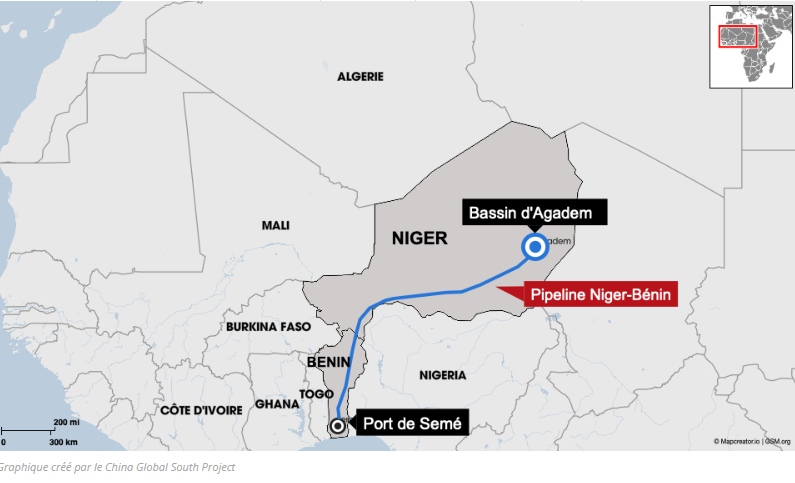
Even as Niger depends on the Niger–Benin pipeline, inaugurated in early 2024 under the aegis of Chinese CNPC, it is choosing to close the central logistical corridor for its economic revival. This pipeline, nearly 2,000 km long and running from Agadem to Sèmè-Kpodji, transported around 18 million barrels between May 2024 and April 2025, with a potential of 200,000 barrels per day by 2026. By attempting to establish this channel as a symbol of sovereignty, the junta is sabotaging a vital pathway to growth. The 277 km land border had remained partially open following the coup d'état: Niger maintained its trade flows through Cotonou, and the mediation of Soglo and Yayi in June 2024 had kept alive the hope of de-escalation. However, Tiani's baseless accusations have shattered this fragile trust.
A macroeconomic downturn is very pronounced.
Closure is now a conscious decision, not a calculable risk. Before the breakdown in relations, 37 % of traffic from the port of Cotonou was channelled to Niger. Today, the port has seen a 15 % drop in turnover, and maritime traffic is declining. Nigerien importers are forced to route their goods via Nigeria, leading to additional costs, delays and customs bottlenecks. The result: persistent inflation in essential goods, placing fresh pressure on businesses and consumers who are already struggling. The macroeconomic downturn is very pronounced. Growth, which stood at 6 %, fell to 2.4 % in 2023; food insecurity affects more than 2 M people; external debt has soared; and the sovereign credit rating has deteriorated significantly. ECOWAS sanctions and the severing of ties with Benin are jeopardising the recovery. Even with the embargo lifted, Niger is struggling to attract international donors, particularly for social and climate projects.
Even CNPC (China National Petroleum Corporation) did not escape the friction
The pipeline, at the heart of all economic hope, had already been suspended in May 2024 because of a diplomatic incident, necessitating China's intervention to unblock the situation. This precedent highlights the fragility of the Nigerien model, akin to a pendulum trapped between the ambition for sovereignty and external dependence. China is now also intervening on the security front. In January 2025, two protocols were signed between CNPC-WAPCO and the Nigerien Ministry of Defence for the security of the infrastructure via drones and enhanced surveillance. But, in a context of tensions and misunderstandings, even CNPC has not escaped friction: in early March 2025, Niamey expelled three Chinese executives, accused of widening the salary gap between expatriates and locals
In May 2025, a technical agreement reached with the IMF aims to reform taxation, strengthen transparency, secure oil flows and achieve an anticipated growth of 6.6 %. But this plan relies on variables beyond Niamey's control: regional stability and above all, the reopening of borders with Benin. Without them, the agreement remains a pipe dream. By making the pipeline a totem of sovereignty, the Nigerien junta has trampled on its own interests. This self-imposed isolation weakens the country, turning a strategic growth tool into an instrument of economic regression. To break this deadlock, Niamey must understand that the path to independence does not lie in diplomatic solitude, but in a delicate balance between sovereignty and pragmatic cooperation.

 French
  English
  Chinese
  Arabic