
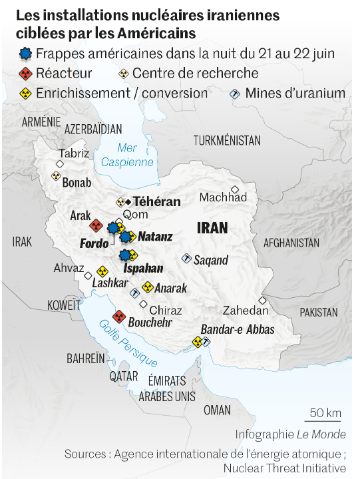
Rising Lion, or the lion rises, is the massive attack launched by Israel on the night of 12-13 June against Iran, with the objective of destroying Iran's nuclear development programme and, in the process, toppling the Iranian regime by targeting key regime figures such as the Chief of Staff, the Commander-in-Chief of the Revolutionary Guards and the head of the intelligence service. This operation is undoubtedly part of a logical progression to initiate the disintegration of the Iranian regime's «axis of resistance», with regime change as the objective.
It is worth recalling some of the factors that led to the Israeli offensive on Tehran.
First, there was the expiry of the deadline that the US president had set for Iran to sign an agreement on its nuclear programme, an agreement that Iran had previously already signed in 2015 under the presidency of Barack Obama with the group of five from the Security Council (China, France, Russia, United Kingdom, United States, plus Germany). It aimed to limit Iran's nuclear programme in exchange for the lifting of international sanctions and allowed IAEA (International Atomic Energy Agency) scientists to monitor the development of Iran's nuclear programme. The agreement was broken in 2018 by the US president, thus continuing sanctions on Iran; the country had therefore decided to continue developing its programme. And recently this agency published its damning report for the Iranian regime and its uranium enrichment programme, which is said to have crossed the «60%» mark. The US intervention on the night of 21 to 22 June amply proves that the US president was not looking to obtain an agreement with Iran around a negotiating table. One wonders how Iran can return to a negotiating table after having seen its main nuclear sites hit by the USA? The question remains open for the moment.
Then there is the joint organisation (by France and Saudi Arabia) of the International Conference at the United Nations,
This conference, which was scheduled to be held on 17 June 2025 in New York, was moving towards the recognition of a Palestinian State. It must be said here that the situation in Gaza was beginning to weigh heavily on the international community, and actions were undertaken both at the International Court of Justice and at the United Nations.
To this must be added the statement by an Iranian military official on 12 June, to quote, «that the Iranian regime has enough material to build 15 atomic bombs in a few days».
And on the Israeli side, Benjamin Netanyahu's government was also facing internal dissent: Israel is a tiny country and its army relies on the deployment of reservists, and the latter were beginning to stop answering the call to fight, especially regarding Gaza.
So this state of affairs was a perfect window of opportunity for B. Netanyahu to divert the International Community's attention from the situation in the Gaza Strip, and also to settle a long-standing obsession of his, which is to halt the Iranian nuclear programme.
This is how the operation is launched with the bombing of several Iranian nuclear sites, also killing scientists and emblematic figures of the regime, including nuclear scientists.
Iran’s retaliation was not long in coming. Even though the US government denies any involvement in the offensive, it is clear that the Israelis were greatly aided in the preparation of the attack and in their defence. Most of the missiles launched by Iran were intercepted thanks to the support of the US government.
Following this aggression, which is at odds with International Law, the international community has so far distinguished itself with standard or even palliating statements.
France, which initiated the conference on Palestine, immediately announced its postponement (a victory for the Hebrew State) and expressed its support for Israel by stating that the latter «has the right to defend itself»—perhaps it is unnecessary to point out that it is Israel that launched the military offensive.
On the American side, D. Trump had made a succession of contradictory statements about a potential US intervention and was using the situation to pressure the Iranian government into signing a new agreement to halt its nuclear development. This was practically impossible given the technicality and complexity of the nuclear dossier. It is worth remembering that it had taken two years of negotiations to conclude the 2015 agreement. Based on this observation, US intervention was only a matter of days away.
In the Middle Eastern region, Turkey is considering diplomatic solutions with its neighbours, notably Syria and Saudi Arabia, but no concrete action is being taken for the time being. And this even after the entry of the USA into the war.
Russia and China are allies of Iran, and Russia has in the past helped Iran with the installation and equipment of its nuclear power plants. An article in Le Grand Continent revealed a few weeks ago the «historic» agreement between the two countries in January 2025 «ratifying a lasting partnership in the fields of defence, intelligence and the circumvention of international sanctions». It has to be said that Russia is taking a wait-and-see approach, multiplying theoretical condemnations despite the aforementioned agreement.
China, while always having refused to sanction Iran for failing to respect (according to Westerners) the terms of the NPT (Nuclear Non-Proliferation Treaty), is limiting itself to condemnations that are certainly firm but do not suggest the possibility of military support.
The reality is that we have a situation very similar to that of the Cold War: a Russian-Sino-Iranian bloc and, on the other side, Israel with the support of Western countries. And in this great global chaos, only China stands out; it appears as the most stable and rational state, and one that could undertake diplomatic solutions.
Which brings us to the question of what the consequence of this escalation is for global security.
It is nevertheless worth noting that the situation is disastrous for both Iran and Israel, and potentially for the entire region, but it is not (for the moment) a nuclear war strictly speaking. The Israeli attacks did not target the heart of the Iranian nuclear programme. It required American intervention for the main sites to be hit, notably the one at Fordo, buried at a depth of 800 metres. At this stage it is difficult to say whether the Iranian nuclear programme has been halted, because the expertise that has already been acquired cannot be erased; Iranians are known for having numerous high-level scientists. It will therefore always be possible to remobilise this expertise to restart the nuclear programme, which has undoubtedly been slowed down following the Israeli and American attacks. This is why the main objective of this offensive against Iran is to bring about regime change, or at worst to force Iran to accept an agreement on American terms. The demonstrations by Iranians in support of the mullahs' regime and the salvo of missiles launched since the American intervention prove that Iran is not on the path to capitulation for the time being.
The situation is, admittedly, a far cry from 1945 and Hiroshima or Nagasaki. Israel is therefore methodically pursuing its project to remodel the Middle East, decided upon since the attack of 7 October 2023. First Gaza by annihilating Hamas (the assassination of the Hamas leader in July 2024 in Tehran during the inauguration of the President of Iran); next Hezbollah in Lebanon and today Iran, which it considers to be the nurturing mother of all these entities
What must be remembered about this offensive against Iran is that it is a pretext to make people forget the situation in Gaza, and the responsibility of the international community, especially the UN, is being singled out. There are more than 55,000 deaths in Gaza, Israel is blocking humanitarian aid with impunity in defiance of the UN Charter, international law and international humanitarian law, and no punitive measures are being taken against it, and it is doubted that this is possible because if such measures are undertaken the USA will always use their veto as has already happened in the past. Countries like South Africa are trying to do something, a complaint has been lodged with the ICJ (the International Court of Justice); it is supported by Spain, Egypt and Chile, but the rest of the world has merely shrugged its shoulders.
This situation therefore creates a high risk of escalation in the region and that, driven into a corner, Iran might decide to close access to the Strait of Hormuz. There is a strong culture of martyrdom that is deeply rooted in Iranian society and if the regime believes it is threatened with extinction, it could go all the way and close access to the strait to disrupt the global economy. .

 French
  English
  Chinese
  Arabic