
Geopolitical context
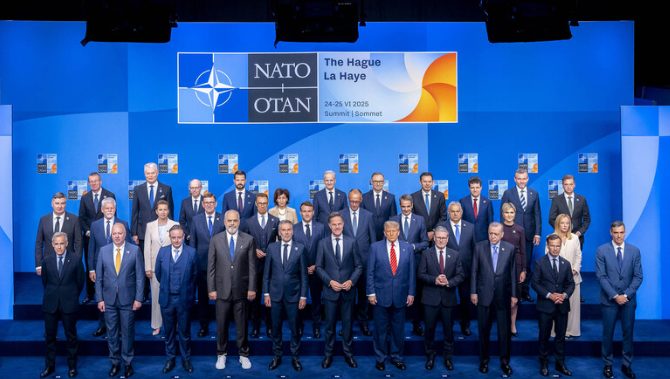
The Hague, the world capital of law and peace, was transformed for the duration of a summit into the epicentre of global strategic tensions. On 24 and 25 June 2025, NATO met there in an atmosphere heavy with uncertainty, reminiscent of the Cold War, marked by Donald Trump's return to the US presidency.
Upon taking office, Trump shook the confidence of allies by casting doubt on the solidity of Article 5, the founding principle of collective defence. He publicly stated that there were «many definitions» of this commitment, and that it should be conditional on the financial contributions of each partner, reviving across Europe the fear of an American disengagement perceived as a major threat.
In this charged atmosphere, this first summit of the Trump II era took on a singular dimension. It was taking place as the war in Ukraine was bogging down and US strikes against Iranian nuclear sites had just upended regional equilibria. More than a simple diplomatic meeting, this event was shaping up to be a decisive test for transatlantic cohesion and the Alliance's ability to reinvent itself in the face of the challenges of a changing international order.
European security issues
Europe is currently facing a security environment of unprecedented intensity. The war in Ukraine, now in its fourth year, is bogging down and intensifying to the point where NATO Secretary General Mark Rutte describes it as an existential threat to the Alliance. According to him, Moscow is stepping up its demonstrations of force on NATO's doorstep and preparing for a prolonged confrontation.
Added to these challenges is the rise of China, perceived as a major issue. Beijing, which is providing technical and logistical support to Russia, is tightening its military cooperation with Moscow and opposing outright NATO expansion in the Asia-Pacific region, giving this crisis an unprecedented global dimension.
Amid this entanglement of tensions with Russia, crises in the Middle East, and Sino-American rivalries, the Hague summit stands out as a decisive moment. More than just a diplomatic gathering, it was expected to demonstrate the Alliance's ability to reinvent itself and preserve its cohesion in the face of 21st-century challenges.
Mark Rutte's preparations and strategy
The profile of the new general secretary
For his first summit at the head of NATO, Mark Rutte was able to draw on his long political experience and his reputation as a consensus-builder. As the former Prime Minister of the Netherlands (2010–2024), he distinguished himself through consistent pragmatism and a rare ability to unite people, invaluable qualities in an Atlantic context marked by uncertainty. The choice of The Hague, his home town, was not insignificant: it gave the meeting a strong symbolic dimension, reinforcing the image of a grounded leader capable of breathing new life into the Alliance on his home turf.
The strategy of flattery
Faced with Donald Trump’s unpredictability, Rutte opted for a diplomacy of close contact and flattery. On the eve of the summit, he made numerous gestures of goodwill, even adopting the tone and language of the US President in private messages that were made public. This approach, of which the surprising use of the expression «Daddy» remains the most talked-about example, aimed to defuse tensions, preserve dialogue and avoid an open break with Washington. Thanks to this strategy, Rutte established himself as an agile mediator, keen to maintain transatlantic cohesion in the midst of a period of profound uncertainty.
Proceedings of The Hague summit, tensions and key decisions
Right from the opening of the summit, the atmosphere was laden with uncertainty, fuelled by Donald Trump's ambiguous statements on Article 5, which he now made conditional on the financial efforts of members. In an attempt to dispel the tensions, the Netherlands deployed exceptional hospitality, inviting the US President to the royal palace in a symbolic gesture of conciliation. The first day continued with a defence industries forum, focused on accelerating arms production and European industrial coordination, while Washington insisted on the need for massive rearmament.
The following day was devoted to crucial negotiations within the North Atlantic Council, which resulted in an ambitious final declaration: it reaffirmed the collective commitment and enshrined a historic increase in defence budgets to 5 % of GDP.
Despite the enthusiasm shown by Trump at the press conference, where he hailed a «monumental success», most participants remained aware of the concessions wrung and the immense challenges that would weigh on the future cohesion of the Alliance.
The concrete results: a financial turning point and a unified declaration
The summit sealed an unprecedented financial commitment: under pressure from Washington, NATO members will increase their defence spending to 5 % of GDP by 2035. This threshold, which disrupts budgetary balances, marks a major strategic turning point. The agreement provides for 3.5 % to be allocated to strict defence (modernisation, personnel, armaments) and 1.5 % to broader security, with a degree of flexibility for civil-military expenditure.
This commitment sparked mixed reactions: Poland and Germany supported it, while Spain expressed its reservations.
The «The Hague Declaration» solemnly reaffirmed commitment to Article 5, to reassure European publics. Russia is designated therein as a «long-term threat», a sign of a united front displayed against Moscow despite persistent divisions. Support for Ukraine was confirmed, without any immediate prospect of accession.
In short, the summit crystallized a transatlantic revival around a historic budgetary effort, while revealing the compromises and uncertainties that still undermine the Alliance's cohesion.
The reactions of the allied countries between support and reservations
The target of allocating 5 % of GDP to defence has provoked mixed reactions within NATO. The Baltic states – Lithuania, Latvia and Estonia – as well as Poland have expressed their unreserved support, viewing this increase as a strategic necessity and a matter of national survival. These states had, in fact, already begun a significant increase in their military budgets as early as 2024. The United Kingdom, for its part, welcomed the initiative, which it regards as an act of solidarity and a means of maintaining its status as a major military power.
The Netherlands, hosts of the summit, also welcomed the agreement, with Mark Rutte describing it as a «historic turning point» and highlighting the driving role played by his country.
Behind this facade of unity, deep differences remain. Germany, led by Friedrich Merz, refused to commit to a numerical threshold, fearing a lasting impact on public finances and a weakening of investment in the energy transition and innovation. France, through the voice of Emmanuel Macron, made any substantial increase conditional on the resolution of transatlantic trade disputes and guarantees of industrial independence, arguing for a strengthening of the European defence industrial and technological base.
Spain, under Pedro Sánchez, secured a partial exemption, refusing to reach the 5 % threshold citing budgetary constraints and the priority given to social cohesion, whilst reaffirming its commitment to the Alliance. Finally, Italy, represented by Guido Crosetto, deemed this objective «impossible» to achieve in the current economic context and called for a revision of the criteria, one more suited to national realities.
European economic challenges and international reactions
Beyond political debates, the financing of this military build-up is raising deep economic concerns across Europe. In Germany, reaching the 5 % of GDP threshold would represent a colossal budgetary effort, deemed unsustainable by many economists. Several governments are already considering resorting heavily to borrowing, at the risk of weighing down public debt even further.
Industrial fragmentation is another major challenge. Many European officials are calling for the establishment of a European preference in armaments procurement, in order to support innovation, preserve strategic jobs and strengthen the continent's autonomy.
Thus, despite a facade of unity displayed in The Hague, the summit highlighted the tensions and considerable challenges that Europe faces in order to build a credible and sovereign defence.
Reactions in Russia and China
The summit's conclusions prompted strong reactions from Russia and China. Speaking through Vladimir Putin, the Kremlin denounced European rearmament commitments as an «irresponsible escalation» and a «colossal waste of resources», accusing NATO of using Russia to justify its militarisation and strengthen American influence. Russian messaging focused on criticising the sacrifice of European social welfare for the benefit of the Western military-industrial complex, seeking to fuel scepticism and division in Europe, while brandishing the threat of «asymmetrical responses» and new military manoeuvres.
For its part, China has urged NATO to «abandon the Cold War mentality» and stop fuelling confrontation. Beijing accuses the Alliance of exploiting the Russian threat to justify its military expansion, not only in Europe, but also in the Indo-Pacific, warning of the risk of a new global arms race. For China, the Hague summit marks a further step in the systemic confrontation with the West, legitimising the reinforcement of its own defence capabilities and the consolidation of its regional alliances.
Behind the scenes and games of influence: diplomacy, Ukraine and flashpoints
Beyond the official discussions, the diplomacy of hospitality took centre stage, perfectly illustrating the Dutch strategy. The exceptional reception given to Donald Trump at the royal palace was by no means incidental: it was about flattering the US president to influence the dynamic of the negotiations and foster an atmosphere conducive to dialogue, despite palpable tensions. This staging, carefully orchestrated to project a personal rapport between Mark Rutte and Trump, momentarily masked the fundamental differences, even if several Southern European leaders viewed the move as risky, or even counter-productive.
Behind the scenes, the Ukrainian dossier has emerged as the most sensitive subject. The meeting between Trump and Volodymyr Zelensky focused on the quest for a ceasefire and the conditions for long-term Western military support. Yet, the final declaration took care to avoid any direct condemnation of the Russian offensive, a sign of calculated caution so as not to cross the red lines set by the Kremlin.
While financial and military support for Kyiv was reaffirmed, the lack of a concrete prospect of NATO membership confirmed the allies' restraint, keeping Ukraine in a zone of uncertainty.
The Middle East as a backdrop
Against this backdrop, the standoff between Iran and Israel further heightened the prevailing tension. A fragile ceasefire, brokered by Trump, momentarily boosted the diplomatic prestige of the United States by averting a regional escalation. However, some provocative statements by the US president, alluding to Hiroshima and Nagasaki, caused unease among several partners, revealing just how difficult it is to maintain a common position in the face of multiple crises.
These behind-the-scenes manoeuvres illustrate the complexity of diplomatic balances and the fragility of Western unity, in a context where every word and every gesture can weigh heavily on international security.
Geopolitical analysis and outlook
Trump's tactical victory
The Hague summit marked a clear victory for Donald Trump. In two days, he succeeded in forcing Europeans to make an unprecedented increase in their defence budgets, sealing a historic shift in priorities and consolidating the strategic supremacy of the United States within the Alliance.
Beyond the figures, Trump recalled that European security remains largely under American control. Despite their ambitions for autonomy, Europeans remain dependent on the military umbrella and technologies coming from across the Atlantic. This dependence is becoming even more entrenched, as most of the new funding directly benefits the American industry, reinforcing the asymmetry that structures NATO.
The summit also extended the «burden-sharing» doctrine to Asian allies, such as Japan, South Korea and Australia, paving the way for the increasing militarisation of other strategic areas, with the risk of heightened instability.
European challenges
For Europe, this sequence has highlighted deep-seated vulnerabilities. Strategic autonomy remains, for the time being, more of an objective than a reality, hindered by the inability to forge a common vision and pool resources.
Divisions over funding, industrial fragmentation and the lack of shared leadership expose the European project to constant pressure from Washington.
Industrially, despite calls to favour European equipment, disunity is hindering the creation of a credible technological base. Europe now finds itself at a turning point: either it overcomes its internal blockages to build a truly autonomous defence, or it accepts lasting dependence, with the risk of gradually fading from the global stage.
The future of NATO
In the short term, the summit is accelerating the militarisation of the continent and intensifying the arms race. Without collective reflection on the meaning of this dynamic, it could exacerbate tensions, both within the Alliance and with its rivals.
The gradual transfer of the security burden to Europe, a long-standing American project, threatens to undermine transatlantic solidarity. Disparities in capabilities, divergences of interest and national frustrations risk widening, putting NATO's cohesion to the test.
Finally, the spectre of fragmentation has never been closer: the delicate balance between collective solidarity and national sovereignty, subjected to budgetary pressure and strategic rivalries, could undermine the unity of the Alliance.
Conclusion: a pivotal moment for Euro-Atlantic cohesion
The NATO summit in The Hague stands out as a major strategic milestone in the evolution of Euro-Atlantic relations. By formalising unprecedented financial commitments and reaffirming solidarity, the Alliance has demonstrated its capacity to adapt in the face of a rapidly changing security landscape.
Yet these advances have come at the price of delicate compromises, revealing latent fractures and persistent divergences of interest. This transatlantic dynamic reflects a redistribution of responsibilities: Europe is asserting a more prominent role in its own defence, whilst remaining deeply dependent on American leadership.
This new balance highlights all the difficulty of reconciling the aspiration for strategic autonomy with the constraints of a collective solidarity that remains essential.
The adopted decisions open an unprecedented phase for NATO, marked by accelerated military reinforcement and increased attention to resilience in the face of hybrid, economic and informational threats.
In an international context more unstable than ever, the Alliance is trying to reinvent itself, conscious that the true significance of these choices will only be measured over time.
The Hague will be remembered as a moment of strategic readjustment, a symbol of the precarious balances of a collective security constantly redefined by geopolitical rivalries and the pressure of upcoming crises.

 French
  English
  Chinese
  Arabic