
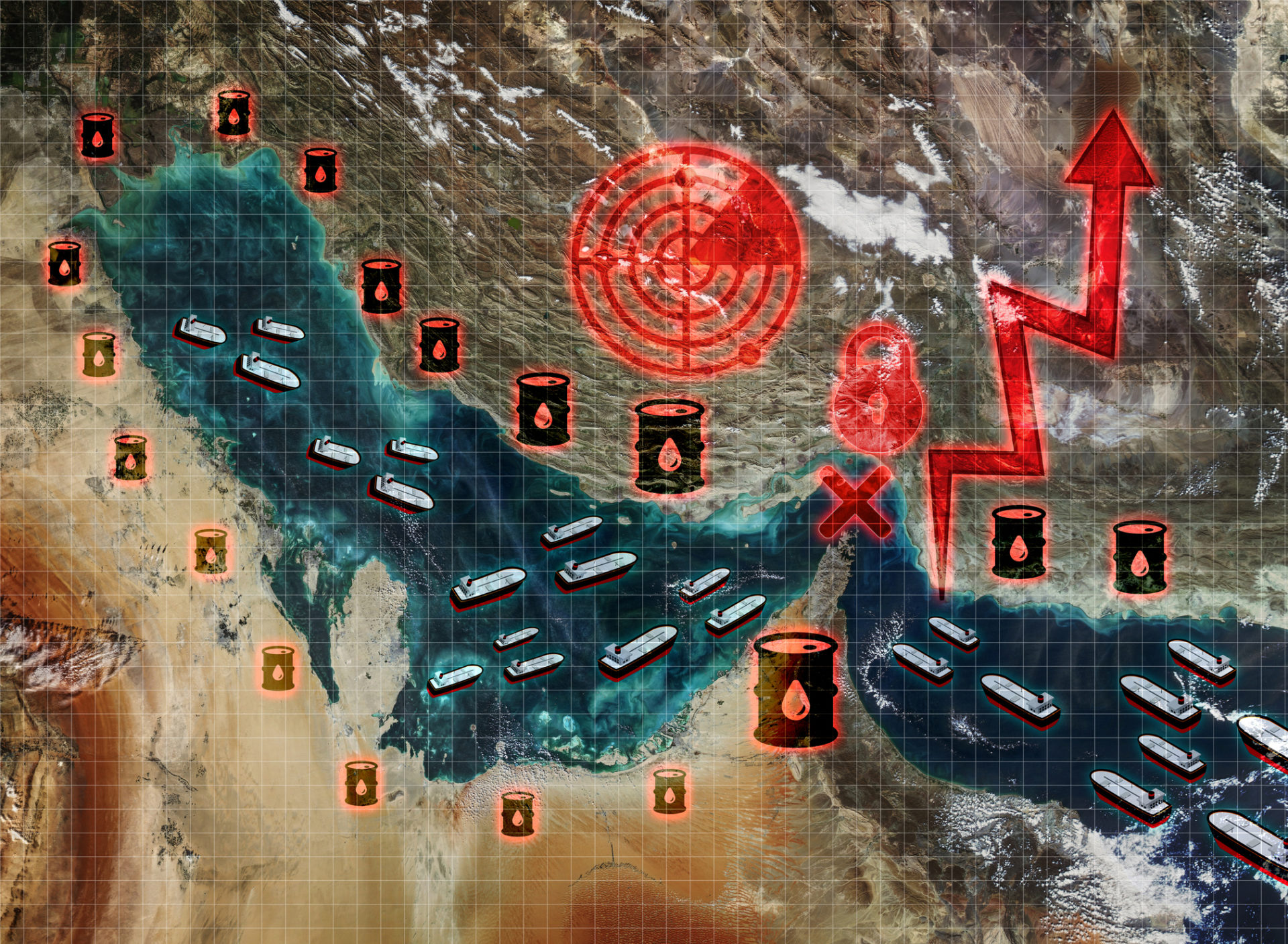
Hormuz, the strait upon which the global energy balance depends
Scarcely thirty kilometres wide at its narrowest point, this passage sees between 20 and 21 million barrels of oil and petroleum products pass through it every day. This accounts for nearly 20 % of global liquid hydrocarbon consumption. It also constitutes an essential artery for global trade in liquefied natural gas (LNG), particularly Qatari LNG. Hormuz is thus much more than a shipping lane: it is the nerve centre of an economic model largely based on energy rent.
Behind the production figures and massive modernisation projects, however, lies a deep structural dependency. The smooth flow of energy exports is not merely a matter of logistics. It underpins the public finances, social stability and diversification strategies of the entire Gulf. Any threat to the strait thus turns a maritime risk into a potential crisis of economic sovereignty — disrupting supply chains, squeezing budget revenues and undermining investor confidence.
To what extent does a disruption of the strait act as an indicator of the vulnerabilities of the Gulf, beyond the mere interruption of exports?
To understand this, we must analyse how the geography of a chokepoint is transformed into economic and strategic pressure, how the monarchies are attempting to increase their resilience, and why maritime security remains one of the central conditions for the geopolitical stability of the Middle East.
From real risk to perceived risk: the geopolitical premium
In contemporary markets, the threat can have as much of an effect as the crisis itself. As soon as tension arises around Hormuz, contagion mechanisms are triggered: a rise in maritime insurance premiums, changes to routes, and a rapid increase in freight costs. During the most serious episodes, certain premiums have multiplied within a few days — illustrating the extreme sensitivity of markets to the stability of the strait.
This geopolitical premium immediately reduces the competitiveness of Gulf exporters, whose economies rely on smooth and predictable logistics. However, the impact goes beyond the energy sector alone: major infrastructure projects, industrial investments and multinational setups all depend directly on the region's image of stability. Hormuz thus acts as a barometer of international confidence — its stability attracts capital, its fragility drives it away. The economic power of the Gulf rests as much on the security of its sea lanes as on the wealth of its underground resources.
The economic impacts of a disruption: a multidimensional shock
Public finances immediately under pressure
The first consequence of a slowdown in traffic through Hormuz directly affects the public finances of the Gulf States. In several monarchies, hydrocarbons still account for between 60 % and 90 % of public revenue. A prolonged disruption would therefore quickly undermine macroeconomic balances, forcing governments to slow down their diversification projects. Energy and water subsidies, as well as social spending, would be threatened. In systems where the redistribution of rent remains at the heart of the social contract, this budgetary pressure quickly becomes a threat to internal stability.
Disorganised supply chains: the cost of disruption
If energy constitutes the engine of the Gulf economies, logistics is their circulatory system.
A crisis in Hormuz immediately triggers a surge in maritime insurance premiums, higher freight rates and longer delivery times. This shock hits economies that are paradoxically highly dependent on imports: despite their status as hydrocarbon exporters, some GCC states import more than 80 % of their food requirements. The effects rapidly spread to the entire real economy — trade, industry, real estate, infrastructure — independently of oil prices themselves.
Investor confidence: stability made vital
Beyond the figures, trust has become a pillar of the Gulf's economic power. Dubai, Doha, Riyadh and Manama have built their appeal on an image of stability and openness. As soon as tensions rise around Hormuz, capital is redirected, recruitment slows down and investments are postponed. The Gulf hosts several tens of millions of foreign workers and is massively dependent on foreign direct investment. The slightest deterioration in the security climate has an immediate effect on its attractiveness. When Hormuz falters, the entire regional economic model is weakened.
Qatar: exposing the vulnerabilities of the Gulf
A gas power under absolute dependency
Qatar provides the most striking illustration of this exposure. As the world's leading power in liquefied natural gas (LNG) alongside the United States, the emirate alone accounts for roughly 20 % of global trade. It is shipped mainly to Asia and, since the war in Ukraine, increasingly to Europe. However, this gas can only be exported by passing through Hormuz. The colossal facilities at Ras Laffan are therefore entirely dependent on the security of the strait. Geography here becomes an almost absolute strategic dependency.
Diversification, still funded by gas
This dependency undermines the ambitions supported by the Qatar National Vision 2030. Doha has dedicated hundreds of billions of dollars to finance, education, technology and high-end tourism.
But behind this transformation remains an essential reality: these new sectors remain largely financed by gas revenues. Diversification still relies on the rent it precisely seeks to overcome — a central contradiction that Qatar shares with the entire Gulf.
Qatar, a barometer of regional confidence
For a country that relies on foreign investment and its image as a stable and modern hub, any crisis around Hormuz quickly becomes a major economic problem. Capital is redirected, partnerships slow down, and trust erodes. Qatar is no exception. It is the most visible indicator of a vulnerability shared by all the Gulf monarchies. It is also a sign that no diversification strategy, however ambitious it may be, can prosper sustainably if the security of the regional energy corridor remains fragile.
A regional vulnerability with uneven effects
Saudi Arabia: a partially protected power
While Qatar exemplifies an almost total dependency, all Gulf states remain exposed to varying degrees. Saudi Arabia has greater leeway thanks to its East-West pipeline to the Red Sea. The latter is capable of transporting several million barrels per day. However, this infrastructure remains insufficient to replace the volumes normally transiting through the strait. In the event of a prolonged crisis, Riyadh would nevertheless suffer a significant drop in its exports — all the more so since, despite «Vision 2030», oil revenues remain essential to its public finances. Even for the leading Gulf power, the stability of Hormuz remains a vital strategic issue.
United Arab Emirates: a real yet vulnerable diversification
The Emirates have built one of the most diversified economies in the Middle East. Dubai has established itself as a global financial and tourism centre. Abu Dhabi has developed leading industrial and technological sectors. The pipeline to the port of Fujairah partially reduces reliance on the strait, but does not shield their economy from a lasting deterioration in the regional security climate.
Ports, free zones, airlines and foreign investment all depend on a stable and predictable environment. A major crisis around Hormuz would first affect this image — which is precisely their main strategic advantage.
Kuwait, Iraq, Bahrain and Oman: limited room for manoeuvre
For these four states, adaptive capacities are more limited. Heavily dependent on hydrocarbons and poorly endowed with logistical alternatives, they would quickly experience budget strains, a slowdown in public investment and pressure on social spending. Their fragility highlights a systemic reality: in such a commercially and energetically integrated area, the failure of a single link spreads to the entire regional ecosystem.
Hormuz and the politics of resilience: between adaptation and structural limits
Infrastructure and logistical responses
Faced with the permanent risk represented by Ormuz, the Gulf monarchies have multiplied their resilience strategies: bypass pipelines, port modernisation, and the building up of strategic reserves.
Yet none of these solutions is currently capable of absorbing the gigantic volumes that pass through the strait every day. Costly and technically limited, they mitigate the risk without eliminating it. Geography continues to impose its constraints.
Economic diversification: transition suspended on the rent
All the Gulf monarchies have launched vast national strategies — Saudi Vision 2030, Emirati financial hubs, Qatari global investments — to prepare for the post-oil era. But a fundamental contradiction remains: this diversification is still largely funded by hydrocarbon revenues. The Gulf sovereign wealth funds, among the most powerful in the world, continue to be fuelled by the energy rent. The new economic sectors thrive on two conditions: high oil revenues and a stable regional environment. As long as Hormuz remains vulnerable, so too will diversification. It mitigates the Gulf's energy dependency; it has not yet freed itself from it.
Risk management: preserving stability and confidence
Faced with this vulnerability, risk management has become a strategic priority. In times of tension, governments mobilise their financial reserves to maintain social welfare and public employment, subsidise essential imports and strengthen their military and diplomatic partnerships with major powers. Communication itself has become a strategic instrument: reassuring investors, containing capital outflows, and preserving the image of stability. In economies deeply integrated into global markets, trust is worth almost as much as exports.
However, these responses remain defensive. The true resilience of the Gulf will stem neither from multiplying pipelines nor from accumulating sovereign wealth funds. It will require regional cooperation capable of transforming Hormuz from an area of rivalry into a space of collective security. Indeed, maritime stability is now a shared vital interest for all states in the region.
Global ramifications and the recomposition of the regional order
Immediate consequences for the global economy
A crisis in Hormuz is never confined to the Gulf. The slightest tension in the strait causes immediate shockwaves across global markets. Indeed, oil and gas prices can soar within hours, fuelling inflation, rising transport costs and an economic slowdown.
Asian economies are the first to be exposed — China, India, Japan and South Korea import an essential share of their energy needs from this region.
Since the war in Ukraine and the drop in Russian imports, Europe has also become dependent on Qatari LNG and Gulf hydrocarbons. A prolonged crisis in Hormuz would directly undermine its energy security. The strait has thus become a point of pressure on the entire global economy: its stability determines prices, growth and energy balances far beyond the Middle East.
The major powers face the risk of deadlock
This reliance explains the military and diplomatic involvement of the major powers. Washington considers freedom of navigation in the Gulf to be a top strategic priority and maintains a permanent military presence to prevent any disruption to energy flows. Brussels favours an economic approach — diversifying supplies and reducing reliance — while knowing that a rapid decoupling from Gulf hydrocarbons remains out of reach in the short term. Asian powers, for their part, are multiplying their energy investments and developing strategic reserves to cushion their vulnerability. Hormuz has thus become the space where energy interests, geopolitical rivalries and power projections intersect. Behind the maritime issue lies an essential part of the global balance.
Hormuz, or the paradox of Gulf power
Thirty kilometres. That is the width of the choke point through which one-fifth of the world's energy passes. Thirty kilometres that are enough to transform some of the richest states on the planet into partial hostages of their own geography.
The Strait of Hormuz is not just a monitored maritime route. It is the revealing sign of a contradiction that neither the wealth of the subsoil, nor the ambition of sovereign wealth funds, nor the modernity of megaprojects has yet resolved: the power of the Gulf remains suspended upon a passage it does not control.
No Vision 2030, no financial hub, no bypass infrastructure removes this reality. Economic diversification mitigates dependence on rent — it does not yet free itself from dependence on the seas. As long as maritime security remains fragile, modernisation remains vulnerable.
The issue now goes beyond the protection of an energy corridor. It is about transforming a shared geographical weakness into a collective architecture of regional stability. This narrow passage forces upon the Gulf monarchies a strategic choice that prosperity has long deferred: to build together the security that none of them can guarantee alone.
For Hormuz ultimately raises a question that contemporary geopolitics has not finished hearing: how far can a power extend when it is contained entirely within a strait?

 French
  English
  Chinese
  Arabic