
Melaka, the strait of the invisible Cold War
Malacca is no longer just a trade route. In the twenty-first century, the major straits—Hormuz, Suez, Bab el-Mandeb or Malacca—are once again spaces of power. Intersecting there are maritime control, surveillance technologies, digital infrastructure and strategic competition. Beneath the waters of Malacca run submarine cables essential to financial markets, international communications and the global flow of data.
In this context, the «Malacca dilemma» has changed profoundly. For Beijing, the vulnerability is no longer solely about the risk of a naval blockade. It also affects the supply chains, digital networks and critical infrastructure upon which the Chinese economy depends. For Washington, conversely, the strait represents a major strategic lever. The aim is to exert permanent pressure on China. All without officially closing the maritime route or provoking a direct confrontation.
The Sino-American rivalry around Malacca thus takes the form of a discreet Cold War, made up less of naval battles than of satellite surveillance, cybersecurity, flow control and technological competition.
Therefore, one question arises: how did the Strait of Malacca become one of the main theatres of 21st-century power?
More than just a maritime passage, Malacca now appears as a space of control where the energy, digital and strategic security of the Indo-Pacific is at stake.
The Malacca dilemma: a vulnerability that has become systemic
Long considered a mere maritime corridor, the Strait of Malacca has become one of China's main vulnerabilities. This dependency no longer concerns oil alone. It now affects the entirety of China's economic, industrial and digital model.
What American strategists call the «Malacca dilemma» is today a systemic vulnerability at the heart of the Sino-American rivalry.
A Chinese structural dependency
Between 60 and 80 % of China's energy imports pass through Malacca, including a large proportion of its crude oil and liquefied natural gas. For an economy that is still heavily dependent on hydrocarbons, any prolonged disruption to the strait would quickly put pressure on the country's industry, supply chains and economic stability.
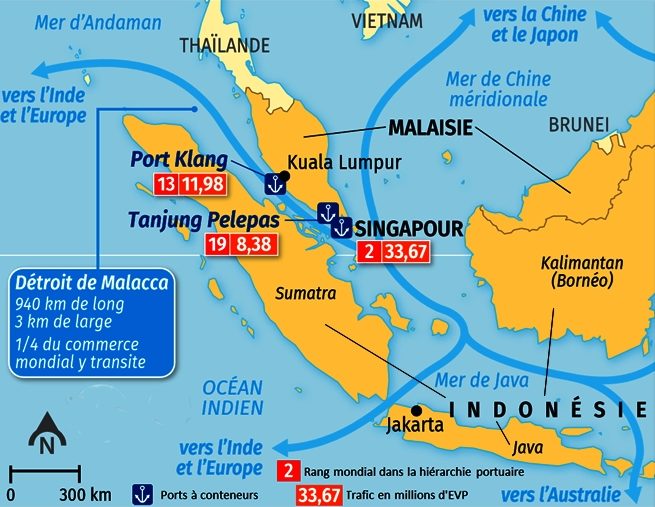
However, the stakes go far beyond energy. Malacca is also an essential artery for Chinese manufacturing exports to Southeast Asia, the Middle East, Europe and the Indian Ocean. Singapore is its main regional logistics hub.
In other words, a major part of Chinese industrial power depends on a corridor that Beijing does not directly control, in an environment marked by the American presence and the caution of littoral states in the face of any excessive militarisation.
The digital transformation of the strait
The most significant transformation of Malacca lies in the superposition of maritime and digital routes. Beneath the waters of the strait run some thirty major submarine cables linking Asia to Europe and carrying an essential part of global internet traffic, financial transactions and strategic communications.
Malacca is therefore no longer just an energy and trade corridor. It has become a vital hub for global data traffic. A severance of these cables could disrupt financial markets, slow down payment systems and disorganise part of international communications.
The strait now concentrates two fundamental strategic resources: energy and information. It is this dual function that gives it a new geopolitical importance.
A hybrid vulnerability
The threat hanging over Malacca is no longer solely military. It is now hybrid, diffuse and often invisible.
It can take several forms:
- sabotage of submarine cables; ;
- cyberattacks against ports and navigation systems; ;
- GPS jamming disrupting maritime traffic ;
- monitoring of trade and digital flows.
In this context, control of the strait no longer depends solely on traditional naval power. It also relies on the ability to secure — or disrupt — the critical infrastructure that crosses its waters.
Malacca thus becomes one of the symbols of the new rivalries of the 21st century. Confrontations where data, networks and technologies now matter just as much as warships.
The American strategy: controlling without blocking
Washington is not seeking to close the Strait of Malacca. Its objective is more subtle: to transform this passage into a space of permanent pressure, where the mere possibility of disruption is enough to weigh on Beijing.
The strait thus illustrates a new form of American power. Not direct control or an open blockade, but an enduring capacity for surveillance, deterrence and graduated coercion. For the United States, the issue is not to interrupt globalisation, but to retain a strategic lever over China as part of the pivot towards the Indo-Pacific.
An indirect control strategy
The United States has integrated Malacca into a vast maritime and technological surveillance network covering the entire Indo-Pacific. Satellites, drones, coastal radars, intelligence networks and naval patrols make it possible to track ship movements and monitor the major trade flows linking the South China Sea to the Indian Ocean.
Officially, Washington defends freedom of navigation. But its military presence and security agreements with several countries in the region give it a significant capacity for indirect pressure. The United States can tighten controls, increase logistical costs or make certain flows more vulnerable. All without officially closing the strait.
That is the entire logic of indirect control: maintaining a permanent capacity for coercion without crossing the threshold of open military confrontation.
QUAD, AUKUS and the containment architecture
This strategy is built upon two major regional partnerships: the QUAD—bringing together the United States, Japan, India and Australia—and AUKUS, an alliance between Washington, Canberra and London.
The Quad now goes beyond mere naval cooperation. It is expanding into the protection of critical infrastructure, maritime routes and undersea cables. The group's members are sharing maritime traffic data, coordinating their patrols and strengthening their security cooperation in the Indo-Pacific.
AUKUS plays a more technological and military role. Nuclear submarines, cybersecurity, artificial intelligence and advanced sensors strengthen the American capability to monitor and project its power around Malacca from the Indian Ocean.
American containment is therefore no longer just naval. It is also becoming technological and informational. The control of networks, data and critical infrastructure is now taking on as much importance as traditional military power.
The invisible war: cables, data and cybersecurity
The rivalry surrounding Malacca is also playing out beneath the sea. For several years, Washington has regarded submarine cables as major strategic infrastructure. The United States is thus supporting alternative cable projects and helping several Asian partners to strengthen their cybersecurity.
Singapore, already at the centre of regional digital trade, is cooperating closely with Washington to secure its communication networks and limit vulnerabilities around the strait.
Malacca thus becomes a laboratory for hybrid warfare: surveillance of trade routes, protection of port systems, securing of naval communications and control of digital flows.
American logic remains constant: without officially blocking the strait, to maintain the capacity to progressively disrupt the supply and technological chains upon which a large part of the Chinese economy depends.
The Taiwanese postman
The Taiwanese question gives Malacca an even more strategic importance. In the event of a major crisis around Taiwan, the strait could become a central lever of pressure against Beijing.
If the United States were to tighten trade controls or restrict certain flows linked to China, Malacca would immediately become a flashpoint for Chinese energy and industrial supply.
Such a crisis could cause:
- tensions on the energy markets; ;
- disruptions in global semiconductor supply chains; ;
- cyberattacks targeting ports, cables and navigation systems.
From this perspective, Malacca emerges as one of the primary theatres of the Sino-American rivalry. It is a confrontation where control over infrastructure, data and networks is becoming just as strategic as military power itself.
The Chinese response: bypass, protect, project
Faced with the American «shadow control» around Malacca, China has not sought to build a world without straits. Its strategy is more pragmatic and graduated: to reduce its dependence, secure its supply routes and extend its strategic depth in the Indian Ocean.
Beijing knows that Malacca will remain structurally indispensable in the medium term. The aim is therefore not to eliminate this vulnerability. It is to neutralise it politically by making any attempt at pressure much costlier for its adversaries.
Reduce reliance on Malacca
The first Chinese response involves the terrestrial diversification of energy and trade flows. For several years, Beijing has been developing energy corridors, oil pipelines, gas pipelines, and rail links as part of the Belt and Road Initiative (BRI).
From Russia, Central Asia and certain Middle Eastern routes, a growing share of Chinese hydrocarbons now takes overland routes. The objective is clear: to reduce the proportion of imports forced to transit through Malacca.
The BRI is playing a structural role here. By financing ports, railways and logistics hubs across Eurasia, China is seeking to diversify its supply chains and thereby increase its resilience in the face of any maritime disruption.
However, this strategy remains structurally limited. No land corridor can absorb the volumes of global maritime trade. Transport costs, geographical constraints and the current organisation of globalisation keep Malacca as a central and virtually irreplaceable chokepoint for the Chinese economy.
The «string of pearls»
Beyond terrestrial routes, Beijing has progressively strengthened its maritime presence in the Indian Ocean through what Western analysts have termed the «string of pearls». This is a network of port and logistics infrastructure structured around the major routes connecting Malacca.
Among the main pillars are:
- Djibouti, where China has its first overseas military base; ;
- Gwadar, in Pakistan, integrated into the China-Pakistan Economic Corridor; ;
- Hambantota, in Sri Lanka, has become a strategic hub under Chinese financing.
These infrastructures fulfil an immediate logistical function: resupply, maintenance, and support for Chinese trade flows in the Indian Ocean.
However, they also have a progressive strategic dimension. Many of these projects, initially presented as economic, can evolve into dual-use capabilities, combining commercial functions with potentially military support.
Finally, this network contributes to a logic of indirect deterrence. By multiplying footholds around the Malacca arc, Beijing seeks to complicate any containment strategy focused exclusively on the strait.
Securing digital infrastructure
The Chinese response is not limited to physical infrastructure. It now extends to digital infrastructure, which has become central to the Indo-Pacific rivalry.
Submarine cables crossing or bypassing Malacca now constitute a critical artery of global communications. Beijing is therefore investing in fibre-optic networks, transoceanic cable projects and digital corridors linking Asia, Africa and the Middle East.
This strategy goes hand in hand with a strengthening of maritime cybersecurity: protection of port data, securing of logistics systems and development of Chinese capabilities in cloud computing, 5G and digital infrastructure.
The Sino-American competition is thus increasingly shifting towards these invisible infrastructures. Cables, data centres, navigation networks and logistics systems are becoming direct instruments of power.
In this context, Beijing is seeking to build a form of extended deterrence around Malacca. Any disruption to the strait would affect not only maritime trade, but also global energy, digital and logistical flows. The initial vulnerability is thus partially transformed into a lever for potential retaliation.
Littoral states: sovereignty, balance and refusal of alignment
Behind the rivalry between Washington and Beijing, the littoral states of Malacca — Singapore, Malaysia and Indonesia — refuse to be reduced to mere spheres of influence. Their priority is clear: to preserve the sovereignty of the strait, avoid alignment and prevent this vital artery from becoming a theatre of permanent confrontation between major powers.
Singapore, Malaysia, Indonesia: balancing strategies
Singapore embodies the most delicate balance. The city-state depends heavily on China for its trade, whilst viewing the American presence as an essential factor for maritime security. Its strategy consists of simultaneously maintaining these two relations without locking itself into a bloc mentality.
Malaysia adopts a similar, but even more pragmatic stance. Kuala Lumpur cooperates with Washington on maritime security while welcoming major Chinese investments linked to the Belt and Road Initiative. This approach reflects a constant priority: preserving trade stability and avoiding any escalation in the strait.
Indonesia, finally, favours a more sovereignty-focused approach. Jakarta accepts certain security cooperation, but remains committed to strict control of its maritime areas. For it, the shipping lanes surrounding Sumatra and Java fall primarily under national sovereignty.
Despite these differences, one commonality stands out: preventing Malacca from becoming a direct flashpoint between China and the United States.
Rejection of a regional polarisation
The littoral states seek above all to avoid a structuring of the strait into rival blocs. In this logic, ASEAN plays a discreet but essential role as a regional stabiliser.
Joint patrols between Malaysia, Singapore and Indonesia, intelligence-sharing and maritime cooperation mechanisms demonstrate a clear resolve. This is about managing the security of the strait autonomously, without exclusive dependence on Washington or Beijing.
This strategy relies on two imperatives:
- preserve their strategic autonomy; ;
- limit any excessive militarisation of Malacca.
Because for these states, a major crisis in the strait would not primarily be a global geopolitical event, but an immediate regional economic rupture.
This position gives them a particular role: that of a moderating force in a rivalry that goes beyond them.
The structural vulnerabilities of the strait
The stability of Malacca also depends on more discreet but equally decisive factors. Despite its decline, piracy remains an occasional threat to maritime traffic and crew safety. Added to this are traffic congestion, the risk of collisions and growing pressure on trade routes.
Environmental issues further heighten this vulnerability. Oil pollution, industrial discharge and the accumulation of plastic waste are weakening marine ecosystems and coastal communities reliant on fishing, particularly in Sumatra and on the Malay Peninsula.
Here, the environment is not a peripheral subject: it is directly linked to the economic and social stability of the region.
Thus, Malacca appears as a double-bind space: strategic on a global scale, but fragile on a local scale.
The strait, a place where global power is recomposed
The Strait of Malacca has become much more than just a simple shipping lane
It now concentrates the main flashpoints of the 21st century: energy security, data control, technological rivalry and competition between powers.
Between Ormuz, Suez and Bab el-Mandeb, Malacca occupies a unique position. Power is no longer measured solely in terms of fleets or military bases, but by the ability to monitor flows, secure critical infrastructure and control the invisible networks of globalisation.
That is the very paradox of the strait. The United States still has a significant advantage in maritime surveillance, underwater technologies and regional alliance networks. It can exert constant pressure on Beijing without ever officially closing the route.
However, an overt blockade would have such a global systemic cost that it would become almost as risky for Washington as for China.
For its part, Beijing is seeking to reduce this vulnerability through land-based diversification, port infrastructure and digital investments. Yet no alternative can truly replace Malacca as long as globalisation remains structured around maritime trade.
This interdependence reduces the likelihood of direct confrontation. Nevertheless, it establishes a lasting, silent and increasingly technological competition. Sino-American rivalry is thus shifting beneath the surface: into cables, data, navigation systems and critical infrastructure.
In this context, the future of the strait will be marked by growing pressure on strategic infrastructure, forms of hybrid conflict involving cyberattacks and economic coercion, and a continuous battle for control of global digital flows.
Littoral states and ASEAN will then remain decisive actors. Their ability to maintain a regional balance could prevent Malacca from becoming the main front of a new Asian Cold War.
Because at heart, controlling Malacca no longer simply means controlling a maritime route. It means being able to act on the very rhythm of globalisation. Slowing down trade, weakening flows, disrupting data and influencing global economic balances.

 French
  English
  Chinese
  Arabic