
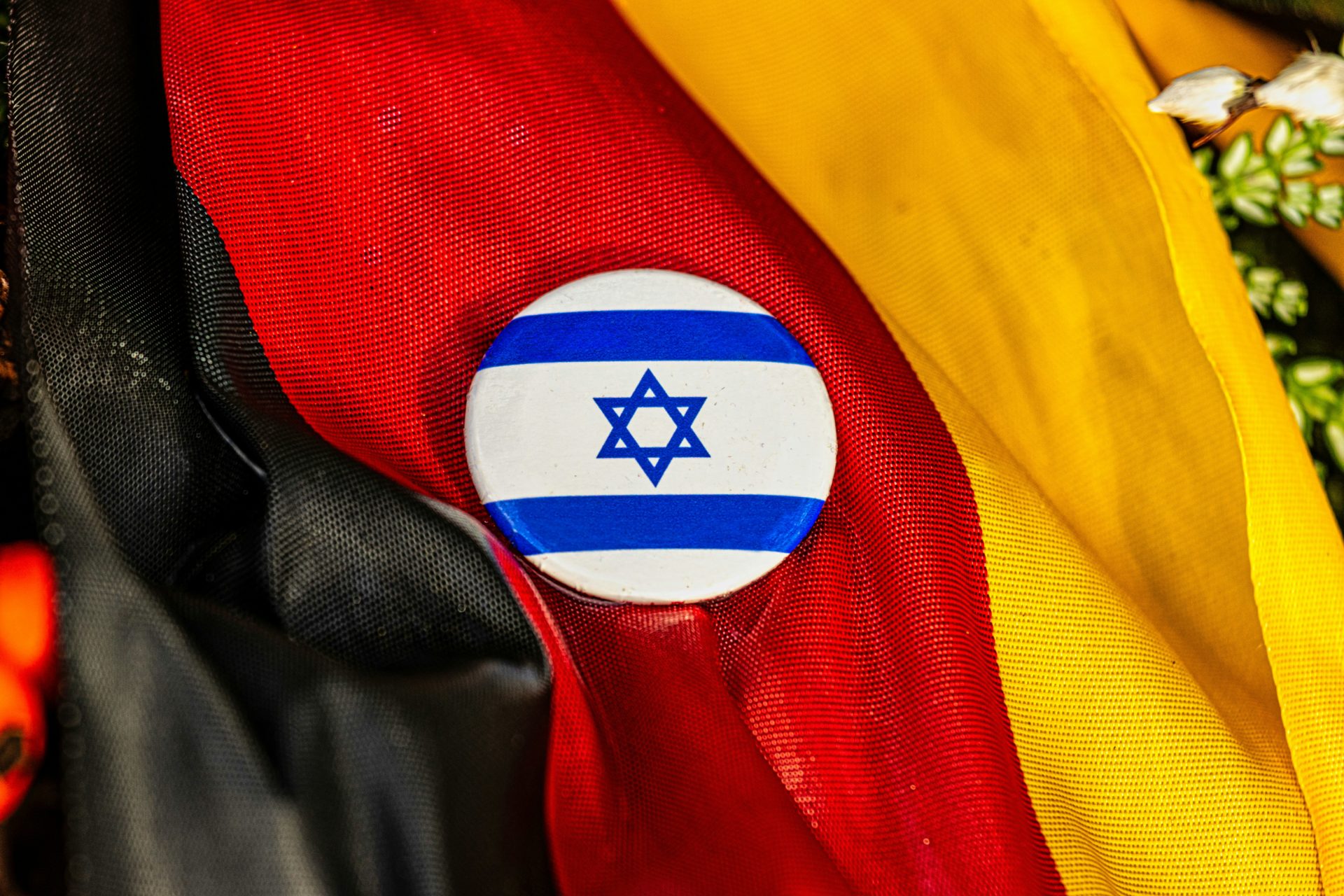
The weight of the past, the blindness of the present
On January 27, 2025, under the pale rays of a Berlin winter, Chancellor Friedrich Merz declared in front of the Brandenburg Gate that, for Germany, «never again» would now mean «never without Israel.» A few weeks later, his government authorized a new arms transfer to Tel Aviv — at the very moment when the devastating UN reports on Gaza recalled the human cost of this militarization.
This contrast illustrates the entire ambiguity of German diplomacy: a duty of memory that has become an intangible red line, but increasingly difficult to defend in the face of a region in a state of reconstruction, impatient of fair treatment of the norms.
Since the founding of the FRG, support for Israel has gone from a gesture of moral reparation to a sacred principle institutionalized under the pudgy name of «culture of responsibility».
President Steinmeier’s last trip in May 2025 is a perfect illustration of this: he limited himself to Israel, whereas his visit to Riyadh and Amman earlier in February was of little significance. This diplomatic imbalance — warm proximity in Jerusalem, coldness in Riyadh — embodies the narrow line that Berlin strives to follow: defending an unconditional alliance while claiming to play a mediating role in a region where the Palestinian cause remains central, and the increasingly unacceptable double discourse.
When international justice disrupts German certainty
There are moments when the weight of principles clashes head-on with the harshness of political choices. When the International Court of Justice delivered its advisory opinion on violations of Palestinian rights in 2024, the silence that reigned within the German Foreign Ministry at the time said far more than any official statement. This silence was not just a diplomatic posture; it revealed a deep unease.
How can a nation that claims the role of guardian of international law continue to proclaim its universal commitments while suspending them, when they concern a privileged ally?
When the arrest warrants issued by the International Criminal Court against Israeli officials are described as «counterproductive,» the entire credibility of Germany as a defender of a rule-based world order is shaken.
Now the question goes beyond diplomatic circles: to what extent can this rigid adherence to a tragic memory justify a policy perceived as partial in a young, connected, and increasingly demanding Arab world regarding the universality of standards?
When morality becomes foreign policy
The history of this unique relationship dates back to 1952, with the Compensatory agreements, These reparatory agreements established a moral and strategic alliance between Bonn and Tel Aviv. What was initially an act of repentance gradually became a doctrine. Under the Merz era, this support became a State reason — a state reason elevated to dogma, sometimes in disregard of the universal principles that Berlin claims to uphold.
During his last visit to Israel, President Steinmeier stated that Israel’s security constituted an «absolute red line.» He made no mention of the illegal settlements, which undermine international law more and more every day. This silence is not an omission: it reveals a profound contradiction—that of a state that claims to uphold standards but chooses to ignore them when they concern an ally.
A fragile balance, between humanitarian aid and military exports
On paper, Berlin tries to maintain a balanced discourse:
– In 2024, 287 million euros in humanitarian aid were sent to Gaza, relieving a devastated people.
– At the same time, arms deliveries to Israel reached 1.2 billion euros – an alarming record for a neutral power.
– Official statements proclaim support for a two-state solution.
– Yet, silence persists in the face of the continued expansion of the colonies, an act contrary to international law.
This double language, so often denounced in the Arab capitals, does not deceive anyone. It draws a paradox: a country that claims to be a model of moral consistency seems incapable of reconciling its actions with its values.
The Crisis of Credibility: When History Interlocks with Politics
March 15, 2025: A date that reveals the German fissures
On March 15, 2025, one of the most revealing contradictions of Germany’s stance crystallized. On that day, Berlin opposed a United Nations resolution condemning the forced displacement of Palestinians to East Jerusalem — while at the same time funding reconstruction projects in these same destroyed neighborhoods spearheaded by its own Foreign Ministry.
It is difficult not to see in this the expression of a deeper malaise, which the former SPD president and former vice chancellor, Sigmar Gabriel, rightly described as the «unbearable weight of our history».
When the past imposes a rigid diplomatic line, it prevents a coherent reading of current issues. This discrepancy confuses Germany’s message and weakens its ability to be perceived as an impartial and credible actor in the region.
Three major flaws in the German posture
This moral rigidity is manifested today in three crucial challenges:
A legal erosion: International law in limbo
By systematically ignoring the opinions of the International Court of Justice (ICJ) and the International Criminal Court (ICC), Berlin is undermining its own legitimacy as a defender of international law. Each refusal to recognize these institutions weakens Germany’s credibility on the global stage.
A democratic deficit: Freedom of expression under pressure
The rise in prosecutions for «anti-Semitism» linked to positions on Palestine (42 cases in 2024) is worrying even the most ardent advocates of civil liberties across the Rhine. When debate becomes banned, democracy itself falters.
A geopolitical cost: Partnerships in danger
The Arab capitals, from Rabat to Doha, through Tunis and Cairo, observe with bitterness that the country that severely punishes Russia suddenly adopts a rhetoric of «prudence» in the face of Israeli actions. This perception of partiality comes at a cost: not only in terms of influence, but also in terms of trust.
The silent decline of «Made in Germany»: Between memory and strategic myopia
A long-standing symbol of excellence and reliability, the Made in Germany it enjoyed solid prestige in the Arab world.
But this image is gradually fading, weakened by an unfavorable geopolitical realignment and a decline in strategic sectors once dominated by Berlin. The figures remain encouraging — nearly 95 billion euros in exports to Arab countries in 2023 — but the momentum is weakening, while other actors, such as China, are advancing discreetly but surely.
This decline is not solely explained by economic competition. It reveals a deeper fracture: that of a diplomatic positioning perceived as unbalanced. Germany’s unreserved alignment with Israeli positions, particularly under the Netanyahu governments, has undermined the image of neutrality that Berlin had carefully built up. In many Arab societies, this perceived unilateral support fuels a widespread but growing rejection.
The manifestations of this disenchantment are multiplying: boycotts campaigns, freezing of academic cooperation, a decline in the attendance at German cultural centers. These are all signs of a weakening of the soft power German in a region where it seemed to be firmly established.
The irony is striking: while trade with Israel represents only a tiny part of Germany’s foreign trade, it is decades of dense and varied relations with the Arab world that are breaking down.
The rift is now extending beyond the diplomatic sphere. It extends to cultural and academic spheres. In 2024, the cancellation of a conference on Palestine by the Free University of Berlin sparked a wave of indignation. More than 500 Arab intellectuals denounced a form of intellectual censorship and a «criminalization of debate» under the guise of combating anti-Semitism. The withdrawal of Palestinian works from university bibliographies only reinforced the sense of a conditional academic freedom.
It is therefore not only official diplomacy that is eroding, but also the cultural, intellectual, and human bridges that have been patiently built. Berlin, by neglecting the sensitive balances of the region, risks squandering a trust capital that it had taken decades to consolidate. A silent but heavy warning with serious consequences.
Towards a new Staatsräson? The time for choices for Berlin
In the shadow of the Holocaust Memorial, where Germany anchors its national memory and its historical responsibility, a central political question arises: how to articulate loyalty to the past and commitment to an international order based on law and equality?
The unconditional support for Israel, which has become an intangible principle of German diplomacy, is now coming into open conflict with the expectations of the Arab world — a long-standing strategic partner that is now disoriented by a position that is considered unbalanced.
Berlin cannot evade this moment of truth: maintaining lasting influence in a region in flux requires more than a moral legacy—it requires the ability to readjust its stance, to listen to other narratives, and to uphold the same principles everywhere, with the same rigour.
Possible alternatives: Renewed diplomacy
Yet alternatives do exist — provided that Berlin dares to rethink its stance, not as a break, but as a necessary evolution.
Security yes, impunity no
It is time to clearly distinguish between Israel’s security and any tacit approval of policies that are contrary to international law.
The military support could be accompanied by discreet but firm pressure for a freeze on the settlements, while humanitarian aid in Gaza would benefit from being free of any political conditions.
Dialogue restored, partnerships revived
Berlin must restore dialogue with the Arab capitals, not as a supplicant, but as a demanding partner.
Restarting the stalled Euro-Mediterranean forums, supporting concrete cross-border projects — these are actions capable of repairing weakened bridges.
A bold initiative: A Marshall Plan for Palestine
To respond to the political and humanitarian emergency, Germany will not be able to do without a more structured engagement, driven by coherent and supportive European diplomacy.
Alongside France, it could initiate an ambitious approach: a genuine «Marshall Plan» for Palestine, combining massive investments, security guarantees, and diplomatic pressure in favor of genuine negotiations.
But such a vision cannot be realized without calling for what has all too often been lacking: the political courage to prioritize principles over the logic of immediate interests.
The moment to choose: Fixed memory or living justice
The time has come for Berlin to choose:
– Will she continue to be the keeper of a painful but frozen memory?
– Or will she be able to become the architect of a future where justice for the one no longer means injustice for the others?
The answer will determine not only its role in the Middle East, but also its soul as a nation enlightened in a world in search of moral compasses.
As the Arab world evolves and reshapes its alliances, Germany sees one of the foundations of its regional influence faltering: its ability to embody ethical, balanced, and respected diplomacy. By persisting in a line perceived as unbalanced, it risks not only eroding its partnerships but also compromising the moral legitimacy that made it unique on the international stage.
History has conferred a particular responsibility on Berlin: that of upholding the principles of law, human dignity, and justice. But this responsibility, in order to remain audible, cannot be exercised with varying degrees of intensity. At a time when multilateralism is weakening, and standards are being challenged, ethical consistency is not a diplomatic luxury: it is a political necessity.
Faced with an Arab world that no longer demands symbols but clear and consistent positions, Germany can no longer rely on the moral comfort of its heritage. It is called upon to adopt a more lucid, more committed stance commensurate with the principles it claims.
Faithfulness to history does not excuse either silence or blindness to the realities of the present. For it is in the ability to unite memory and justice, responsibility and courage, that Berlin’s credibility—and its place among the respected actors of an equitable international order—now hangs in the balance.

 French
  English
  Chinese
  Arabic