
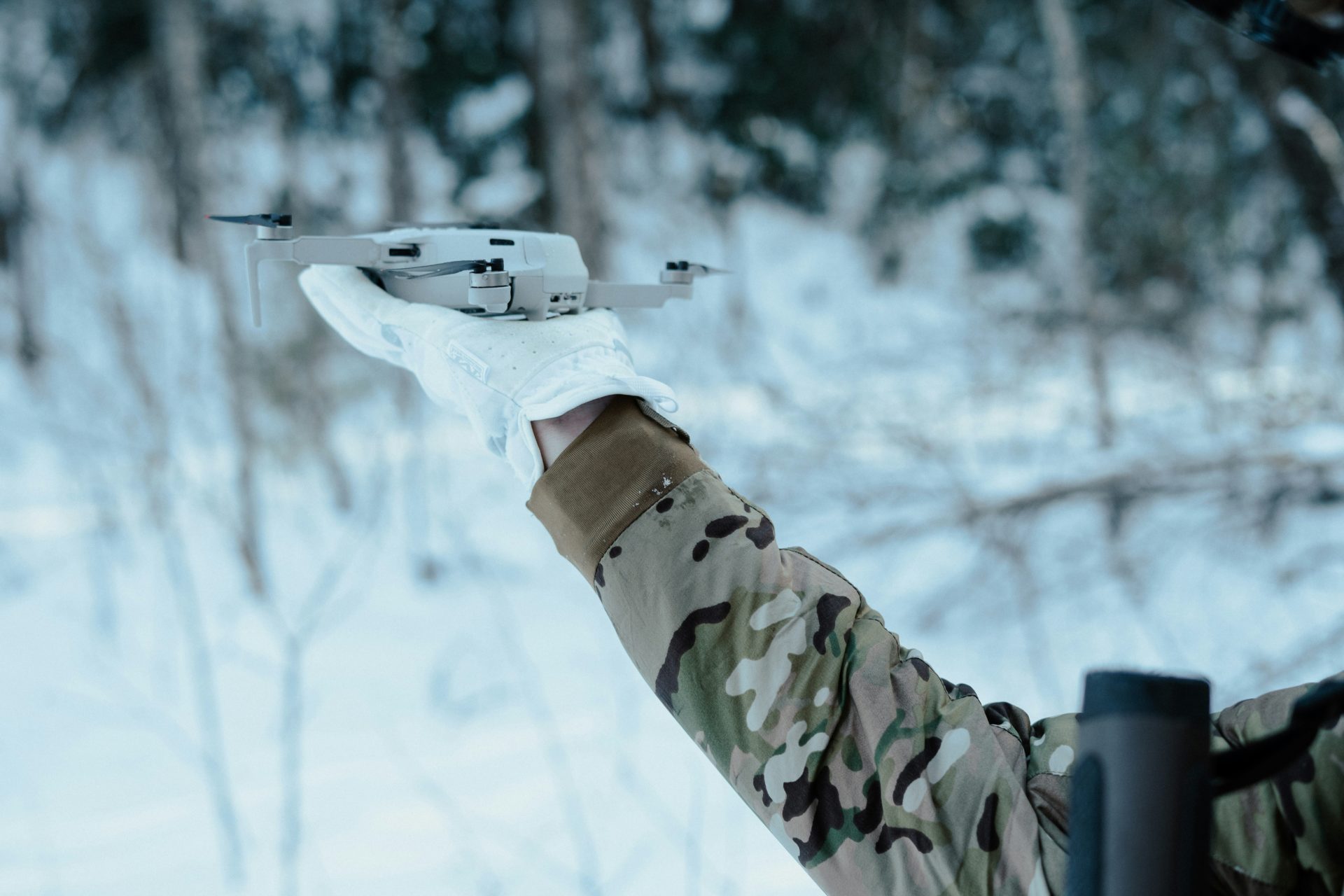
New conflicts demand new weapons. As geopolitical alliances are redrawn and power dynamics shift, drones are emerging as the strategic weapon par excellence. Inexpensive and adaptable, they offer marginalised actors the means to defeat sometimes superior adversaries.
Welcome to the era of cheap warfare.
Does deterrence still cost billions? Fewer, thanks to drones low-cost
The drone is not the poor man’s weapon. It is the weapon of those who must do more with less. Strike without declaring war. Deter without the ability to dominate. Threaten without appearing too much. In a world where stealth fighters, satellites and ballistic missiles remain the preserve of the major powers, these uncrewed vehicles are cracking the monopolies of air superiority. Accessible, effective, precise, they are reshuffling the pack. And all at low cost.
Today, for a few hundred dollars, a modified hobbyist drone can neutralise an armoured vehicle, disrupt logistics or target a general holed up miles behind the lines. The asymmetry no longer lies in firepower, but in the cost of the entry ticket. The drone “sympathises” without equalising: it does not restore the balance, but gives the weakest and most cunning a margin for manoeuvre that conventional warfare denied them.
Turkey understood this before others. In less than a decade, Ankara has become one of the world's leading exporters thanks to its Bayraktar TB2, sold to over 30 countries. At less than 5 million dollars per unit, twenty times cheaper than an F-35, it combines 24 hours of endurance and proven effectiveness: Syria, Libya, Nagorno-Karabakh, Ukraine… and this is only the beginning. In 2024, its exports crossed the 2 billion dollar mark. Ankara has not simply designed a weapon nicknamed “the Kalashnikov of the skies” for its robustness: it has created a market, and, with it, a strategic model now envied by other middle powers.
Drones do not replace traditional armies. They graft onto them, thicken them and reorient them, synchronising strikes and reconnaissance with artillery or infantry. Above all, however, they democratise functions hitherto reserved for the powerful: real-time intelligence, precision strikes, reduced human exposure. From now on, a state with a limited budget can slow down or erode a superior adversary, without a massive army or security alliances that are as costly as they are restrictive. The drone has not made war fairer nor the way it is waged any more noble. It has simply changed the list of those who can wage it or defend themselves against it.
Are drones redrawing the balance of power between states? More than ever
The drone has made possible a resistance that asymmetry rendered unimaginable yesterday. Facing a Russian army equipped with one of the largest arsenals in the world, deprived of NATO troops, dependent on Western funding and suffering from a severe shortage of heavy equipment, Ukraine has compensated with a doctrine of DIY warfare. For less than $1,000, locally 3D-printed FPV drones become kamikazes, equipped with improvised charges, destroying expensive Russian T-90 tanks, Pantsir systems or logistics depots. In 2024–2025, more than 10,000 vehicles neutralised and half of Russian casualties are reportedly due to drones. The 2026 target: to produce 5 million of them. Simple to manufacture but devastating, these machines have greatly enabled a disadvantaged state to stand up, for three years, to the world's second-largest army.
Azerbaijan had already demonstrated the power of drones during the second Nagorno-Karabakh war in 2020. In 44 days, Baku recaptured 90 % of the disputed territories that it had been unable to retake for thirty years, without air superiority and with lower human losses than Yerevan. Its strength? A dual drone strategy. Turkish TB2s provided real-time intelligence and guided near-instantaneous artillery strikes. Israeli Harops carried out targeted decapitation strikes on Armenian armour and defence systems..
Taiwan, for its part, is preparing. Like Kyiv pre-2022, the island is facing a threatening and more powerful Chinese neighbour. Also aware that American support is not eternal, Taipei is banking on a decentralised defence doctrine, inspired by recent asymmetric wars. Drones, distributed strikes, saturation of enemy lines: every metre is conceived as an attrition zone. Not to win quickly, but to make any invasion costly, slow, and unmanageable.
And for non-state actors: effective or illusory?
Drones are no longer the monopoly of states. Their operational results, low cost, commercial accessibility and tactical adaptability have made them the tool of choice for non-state actors to strike behind enemy lines. With mixed results.
In Yemen, the Houthis were among the first to strike strategic and distant targets using Iranian drones such as the Qasef-1 or the Shahed-136. The iconic 2019 attack on Aramco facilities in Saudi Arabia — which temporarily crippled 50 % of the Kingdom's oil production — illustrates the disruptive capacity of a terrorist group. Since 2023, they have also been deploying kamikaze drones to target merchant and military vessels in the Red Sea, disrupting up to 15 % of global maritime traffic. In 2024, they even reached Tel Aviv 1,500 km away, proving their destabilising potential.
In Lebanon, since the 2000s, Hezbollah has developed an advanced drone unit, initially for reconnaissance and later for attack. However, their offensive effectiveness has remained limited due to Israeli technological superiority in electronic neutralisation and preventive targeting. The Party of God’s drones have frequently fallen victim to the Israeli Iron Dome. Meanwhile, Israeli forces make daily use of killer drones to surgically target Hezbollah commanders and decapitate its chain of command.
Easy war? Miracle weapon? Unbeatable? Not quite
The lesson is twofold: the drone is an asymmetric, yet imperfect weapon that does not guarantee victory. Its effectiveness requires a clear doctrine, tactical coordination and precise intelligence. Without this, despite its power, it remains vulnerable to jamming, the weather, and human error.
Its global proliferation is already raising the question of the response. Faced with massive or stealthy attacks, conventional anti-aircraft systems are no longer enough. The challenge is no longer just about possessing drones, but knowing how to neutralise them. Israel is developing the’Iron Beam, to complete its Iron Dome. The United States is testing microwave cannons. Russia, for its part, is using electromagnetic jamming to disable Ukrainian FPVs. Ironically, the cheap weapon is forcing the powerful to design expensive antidotes.
But the real upheaval lies elsewhere. Drones lower the barrier to entry for waging war. Anyone can strike without a pilot, trace or prior declaration: war is becoming more accessible, and therefore more probable. A strike can be denied or lost in the media noise.
AI promises new breakthroughs. Already, systems incorporating facial recognition and deep learning are tested to automate targeting. Strikes carried out without human intervention? On paper, fewer mistakes. But, in practice, above all less accountability...
And tomorrow? Regulate before it is too late
The main challenge is political. Unlike nuclear, biological or chemical weapons, to which the UN reacted quickly, it is staggering to note that there is still no international framework regulating the military use of drones. No treaty, no red lines, and no accountability mechanism for targeting. As the most proliferating weapon of the decade, the drone also remains the least governed. It is not the machine that kills, but the absence of rules.
It is time to act. The law of war remains too vague to regulate the technical, strategic and ethical realities of the contemporary drone. As with nuclear or chemical weapons, an ‘International Agency for Drone Regulation’, in the style of the IAEA or the OPCW, is essential to define and demand global standards. Here are four priority areas to guide its action:
- Transparency enable targeted inspections, in particular through the analysis of post-strike images in the event of a credible suspicion of a violation of jus in bello ;
- Responsibility Bans on 100 % autonomous lethal strikes; maintaining a «human in the loop», even in an AI-assisted context; ;
- Certification oblige states to train and certify all drone operators on the principles of international law to integrate moral responsibility and ethical restraint.
- Control : restrict the exportation of drones to authoritarian regimes, non-state entities or conflict zones without guarantees of compliance with international law.
If the drone is the war of tomorrow, its use must be regulated before anarchy sets in.
Drones are neither good nor bad. They are powerful. And this power, precisely because it is accessible, must be thought about, regulated, and taken responsibility for.
They are neither the weapon of the poor, nor that of the rich. They are the weapon of the present. And the means to counter them still belong to the future.
The drone enables threatened states to survive, to strike, and sometimes to win. It heralds an era of distant, dehumanised, asymmetrical warfare. And that, fundamentally, is perhaps the true break with the past: major powers no longer dictate the rules of the game alone.
The 20th century was that of the nuclear arms race and the conquest of space.
The 21st century could well be that of pilotless and lawless wars.
Except that this time, the competition is no longer reserved for superpowers.
The weapon is already in the hands of those who refuse to bow to the art of war.

 French
  English
  Chinese
  Arabic