
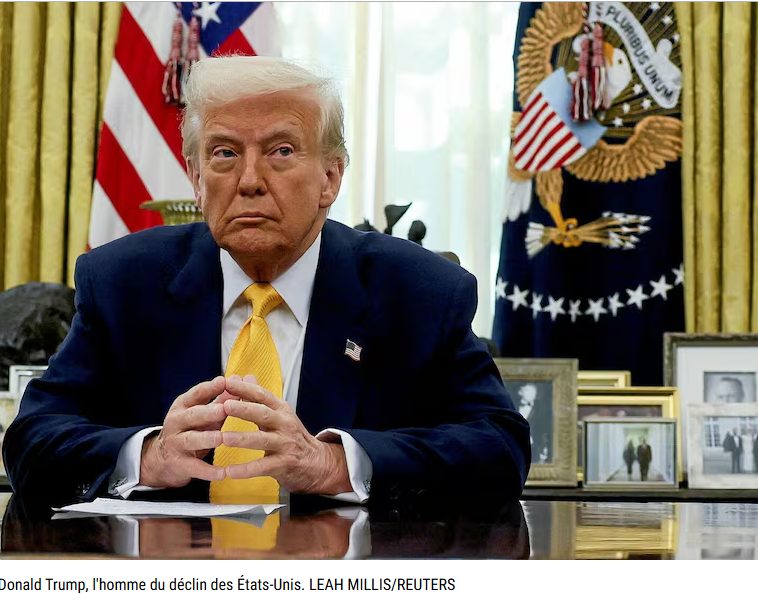
Washington is negotiating under pressure. Tehran is dictating the pace
On 29 May, Donald Trump gathered his main advisers in the White House Situation Room. This meeting was presented as the final decision regarding a potential agreement with Iran. The meeting ended without any major announcement. At the same time, US markets were rising while oil prices were falling, driven not by a concluded agreement but by the mere prospect of a de-escalation. It is precisely in this gap between the announcement and the outcome, between political communication and diplomatic reality, that one of the major characteristics of the current sequence is revealed.
Noise diplomacy
On Truth Social, Donald Trump claimed that an agreement was «largely negotiated» between the United States, the Islamic Republic of Iran and «various other countries». Twenty-four hours later, Tehran publicly played down this interpretation. In particular, the spokesman for the Iranian Ministry of Foreign Affairs pointed out that the Strait of Hormuz «has nothing to do with the United States» and that any decision concerning this strategic waterway was primarily the responsibility of the littoral states.
This mismatch between the rhetoric is not necessarily a sign of diplomatic confusion. It mainly reflects the existence of differing priorities. Washington seeks to reassure the markets, its regional allies and its domestic public opinion. Tehran intends to demonstrate that it is negotiating without giving up its strategic prerogatives. In this context, communication itself becomes an instrument of negotiation. Statements serve as much to shape perceptions as to prepare for a potential compromise. Rather than a diplomacy of resolution, the United States currently appears to be engaged in a diplomacy of time management.
Hormuz, revealing a new balance of power
The Strait of Hormuz remains the centre of gravity of the crisis. Disruptions to maritime traffic have caused energy prices to rise, accentuating inflationary pressures in the United States at a particularly sensitive time politically and economically. Once again, the vulnerability of global markets to a strategic choke point has been highlighted.
According to the Iranian agency Fars, Tehran has reportedly agreed to a gradual return of maritime traffic to levels close to those observed before the conflict. However, the Iranian authorities continue to present the management of the strait as an issue that essentially falls under their sovereignty and that of the riparian states. This distinction is far from symbolic. It illustrates Iran's desire to turn its geographical position into a lasting political lever.
Hormuz is no longer just an essential energy artery for the global economy. In Tehran's eyes, it has become an instrument of sovereignty and a means of influencing regional balances. For Washington, it remains a test of strategic credibility.
The nuclear file or the deadlock of red lines
Negotiations are also faltering on the nuclear issue. Washington continues to demand a complete halt to uranium enrichment, while Iran rejects this demand. Disagreements also concern the duration of any potential limitations: twenty years according to American proposals, five years according to Iranian counter-proposals.
The gap is not merely a matter of technical considerations. For the United States, enrichment constitutes the primary proliferation risk. For the Islamic Republic, it represents an attribute of technological sovereignty and a central element of its national security strategy. Under these conditions, each potential concession is perceived as an existential issue by one side or the other.
Discussions also mention an Iranian commitment not to develop nuclear weapons, as well as a negotiation period dedicated to the future of high-enriched uranium stockpiles. However, Tehran has not publicly validated any agreement of this nature. Furthermore, some of the infrastructure concerned is reported to have been severely damaged during the previous year's strikes. This situation complicates both the verifications and any potential implementation mechanisms. Far from simplifying negotiations, there is an additional layer of uncertainty to a dossier already marked by deep mutual distrust.
Pakistan, unexpected mediator in a more fragmented world
One of the most telling developments of this crisis lies in the role played by Pakistan. It was Islamabad that helped facilitate the 8 April cease-fire, which has since been extended, and which continues to provide a channel for dialogue between Washington and Tehran. This simple fact deserves attention. Thus, a regional power, equipped with nuclear weapons and long considered a peripheral partner in American strategy, finds itself today at the heart of a mediation involving the United States and Iran. This state of affairs illustrates the evolution of international crisis management mechanisms.
The Pakistani Prime Minister praised Donald Trump's «extraordinary efforts» while expressing hope to host a new round of negotiations soon. Beyond diplomatic statements, this involvement reflects a broader trend. In an increasingly fragmented international system, regional mediations and informal formats are occupying a space once reserved for major powers or traditional multilateral institutions.
Pakistan has not become a dominant power. But its ability to act as an intermediary in a crisis of this scale reveals the extent to which the contemporary international order now relies on a proliferation of actors capable of occasionally influencing balances that were once structured around a few centres of decision-making.
Washington under constraint: power facing its own limits
The Trump administration is facing a particularly delicate choice. An agreement perceived as too favourable to Iran risks being denounced by a section of its political base, which expects a demonstration of firmness rather than a compromise. Conversely, a resumption of hostilities would entail considerable risks in an already unstable regional context and at a time when several Western allies are reluctant to countenance any further escalation.
This situation does not mean that Washington is devoid of leverage. The United States retains unrivalled military, financial and diplomatic assets. But the ability to unilaterally impose a solution appears more limited than before. American power remains considerable; the cost of exercising it, however, continues to rise.
This evolution is also reflected in the controversy surrounding the new Persian Gulf Strait Authority, created by Iran to supervise part of the regional maritime traffic. Its addition to the US sanctions list illustrates Washington's determination to maintain pressure.
However, the announced continuation of its activities is a reminder of a reality that has become frequent in contemporary international relations. While sanctions remain a powerful instrument, their effectiveness depends increasingly on the political, economic and diplomatic environment in which they are applied.
Tehran is playing the long game
The relative confidence shown by Iranian officials in these negotiations stems from a strategic calculation. Despite the strikes suffered, despite the damage inflicted on certain military and nuclear infrastructure, the Islamic Republic believes it has preserved the essentials: the continuity of the regime, a regional deterrent capacity and several negotiation levers.
Tehran is therefore approaching the discussions without considering itself to be in a position of defeat. Its influence on regional energy balances, its capacity to disrupt strategic maritime flows and its essential role in any Gulf security architecture give it a margin for manoeuvre that recent events have not entirely erased.
Faced with a US administration subject to market constraints, economic imperatives and the domestic political calendar, the time factor itself becomes an instrument of negotiation. Where Washington seeks rapid results, Tehran appears to favour attrition and strategic patience.
A reorganisation rather than a mere crisis
What is at stake between Washington and Tehran now goes beyond the mere management of a bilateral dispute. The crisis reveals a more profound transformation of the Middle East's strategic environment and, more broadly, of the international system.
It would be going too far to see this as the disappearance of American power. The United States remains the planet’s most influential military, financial and diplomatic actor. On the other hand, it is becoming increasingly difficult for a single power to define the rules of the game on its own and impose their application without negotiation or compromise.
The outcome of the discussions remains uncertain. A compromise is still possible, as is a new phase of confrontation. But whatever path is chosen, the current crisis highlights a reality that is henceforth difficult to ignore. A world where power dynamics have become more diffuse, centres of decision-making more numerous and the margins of autonomy of regional powers greater.
The region is not simply entering a new sequence of crisis management. It is part of a broader process of the recomposition of balances, the contours of which remain shifting but the effects of which are already being felt across the entire Middle Eastern geopolitical landscape.

 French
  English
  Chinese
  Arabic