
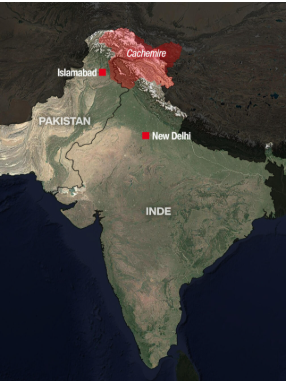
India had announced, in the weeks following the attack, the suspension of its participation in the consultation mechanisms provided for by the treaty. The reason: the alleged support by Pakistan-based groups for the perpetrators of the attack. This decision, unprecedented in history, plunged the two countries into considerable legal and technical uncertainty. The treaty divides the waters of the six rivers of the Indus basin. The three eastern rivers (Sutlej, Beas, Ravi) are allocated to India, while the three western ones (Indus, Jhelum, Chenab) go to Pakistan. However, limited usage rights are granted to New Delhi for irrigation and hydroelectric production.
The issue of water is of existential importance to Pakistan. The Indus basin supplies over 90 % of the water used by Pakistani agriculture, a sector that employs nearly 40 % of the country's active workforce. Any significant reduction in flows originating from Indian-administered Kashmir would directly threaten Pakistani food security. This structural dependence leads Islamabad to view the treaty as an absolute red line, regardless of fluctuations in political relations.
Water as a geopolitical weapon: a growing Indian temptation
On the Indian side, perception of the treaty has evolved over the decades. Long regarded as a model of pragmatic cooperation transcending political antagonisms, the agreement is now criticised. A section of the New Delhi establishment considers it excessively generous towards Pakistan. Hindu nationalists feel they have deprived themselves of precious water resources for their own development, notably in the arid states of Rajasthan and Haryana. The idea of using water as a lever of pressure on Islamabad has gained ground in the Indian public debate.
This potential weaponisation of water resources is part of a broader regional context. Sino-Indian tensions in Ladakh, the competition for influence in South Asia, and New Delhi's perception of a Pakistan that is increasingly aligned with Beijing are fuelling a more assertive Indian vision. For Narendra Modi's government, the suspension of the Indus Waters Treaty represents a signal sent to Islamabad, but also to the entire region. India will no longer tolerate what it considers to be state-sponsored terrorist aggression by its neighbour without inflicting significant costs.
Yet, the use of water as a weapon carries considerable risks. Beyond the humanitarian implications of a water crisis in Pakistan, such a strategy could have unpredictable retaliatory effects. Pakistan possesses nuclear capabilities. It has historically demonstrated a willingness to resort to non-state actors when it feels cornered. A water war between two nuclear powers would represent a nightmare scenario for regional and global stability.
Which forum to restart the dialogue?
The suspension of the treaty raises the question of mechanisms likely to facilitate a resumption of dialogue between the two capitals. The World Bank, the original guarantor of the agreement, finds itself in a delicate position. Indeed, it has historically avoided taking sides in bilateral disputes, preferring to encourage the parties to resolve their differences through the procedures provided for by the treaty. These bodies are the Permanent Indus Commission, neutral experts, and a court of arbitration. However, these mechanisms presuppose a minimal willingness to cooperate, which India's suspension has precisely called into question.
Several observers are raising the possibility of international mediation, potentially under the auspices of the United Nations or extra-regional powers. The United States and China are being mentioned. However, India has traditionally refused any internationalisation of disputes with Pakistan, considering that they fall exclusively within the scope of bilateral dialogue. This position, which has been strongly reaffirmed by New Delhi since the Pahalgam attack, considerably limits the options.
China, a strategic partner of Islamabad but also keen to stabilise its Himalayan border with India, could play a facilitating role. However, Beijing has its own hydrological disputes with New Delhi concerning the Brahmaputra, which complicates any claim to neutrality.
As for the United States, their attention is largely absorbed by the Iranian conflict and tensions with China, leaving little diplomatic bandwidth for Indo-Pakistani mediation.
The prospects for an uncertain normalisation
One year after Pahalgam, the prospects for normalising Indo-Pakistani relations remain bleak. Both countries remain locked in a spiral of mistrust. Every gesture by the adversary is interpreted in the most unfavourable light possible. Pakistan denounces what it considers to be a policy of economic and water strangulation orchestrated by New Delhi. India accuses Islamabad of having taken no serious action against terrorist groups operating from its territory.
The Kashmir question, the primary source of the Indo-Pakistani conflict, remains as far from a resolution as ever. New Delhi's repeal in 2019 of Jammu and Kashmir's constitutional autonomy and its division into two Union territories was perceived in Pakistan as a unilateral annexation. For Islamabad, no genuine normalization is conceivable without a discussion on the final status of Kashmir. India categorically rejects this condition, considering the issue to be an internal matter.
The future of the Indus basin will ultimately depend on the ability of the two countries to separate the technical management of shared resources from their political antagonisms. The history of the treaty demonstrates that this separation is possible; it has worked for six decades. But the current episode also serves as a reminder that nothing is set in stone. Water, a vital resource that is becoming scarcer under the effect of climate change, could become the trigger for much more serious conflicts if mechanisms for cooperation are not restored.

 French
  English
  Chinese
  Arabic