
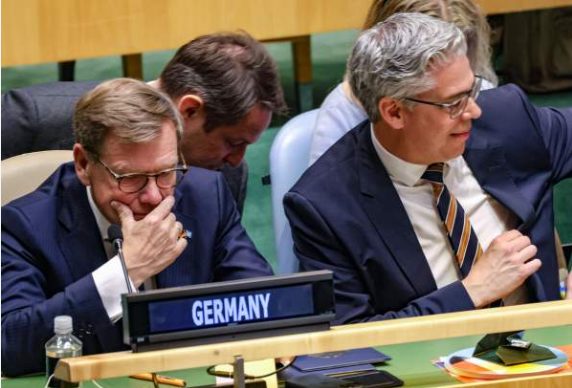
The 3 June 2026, in New York, German diplomacy suffered a clap of thunder for the first time in its history, Berlin saw its bid for a non-permanent seat on the UN Security Council rejected by the General Assembly. With 104 votes — far from 126 required for the two-thirds qualified majority —, Germany was more than twice as far ahead by Portugal (134 votes) and Austria (131 votes). This failure unprecedented breaks a tradition of excellence: since 1973, Berlin had systematically won this seat, in six reprises, without ever suffering a major setback.
Yet, this snub is not the result of chance. On the contrary, it reveals a convergence of strategic flaws — historical, geopolitical and tactical — which the German Chancellery, despite its economic weight and European leadership, was able neither to anticipate nor to counter.
The burden of history: when memory becomes a trap
At the heart of this setback lies the German historical heritage and its contemporary translation, often perceived as a untouchable dogma. Since the 7 October 2023 attacks and the war in Gaza, Berlin has locked his support for Israel, establishing himself as the Europe's leading supplier of arms to Tel Aviv — and the second floor, with an estimated share of 30 % of Israeli defence imports. This posture, claimed as an absolute moral imperative, fits into the doctrine of «Responsibility» (responsibility), the cornerstone of German foreign policy since the Second World War.
Yet, this ideological rigidity collided head-on with the developments in the international landscape. Whilst European countries like the France, Spain, Ireland or Norway — but also key players from the Global South have takes the step of recognising the Palestinian state, Berlin a persisted in his inaction. This diplomatic monolithism caused a systematic social distancing on behalf of Member states of the Arab League and some Organisation of Islamic Cooperation (OIC) country, two decisive blocks in UN arithmetic.
The electoral consequences were immediate and brutal according to diplomatic sources, this position is said to have cost between 20 and 30 votes to Germany, mainly in the African, Asian and Latin American regional groups — thereby depriving Berlin of its core electoral base. As acknowledged Johann Wadephul, Minister for Foreign Affairs, during a hearing at the Bundestag: «Our commitment to Israel, however legitimate it may be, was perceived as a barrier to neutrality that many were expecting of us.»
The geopolitical bill of the turning point : when Ukraine becomes a UN liability
The second pillar of the German failure lies in the geopolitical consequences of its involvement in Ukraine, symbol of the turning point - this historic turning point announced by Chancellor Olaf Scholz in February 2022. By establishing itself as spearhead of the Western coalition in support of Kyiv, Berlin has crystallised the opposition from Moscow, but also, and most importantly, alienating a growing part of the Global South.
Russia, mastering the art of obstructionist diplomacy, has methodically exploit the fractures within the General Assembly. According to diplomatic sources, Moscow has mobilised his networks in Africa, Asia and Latin America to know the German application, by capitalising on the growing rejection of automatic alignment with the West. Result: about ten additional voices — mainly among non-aligned countries or those traditionally close to Russia — would have shifted against Berlin, transforming a conflict European En UN electoral trap.
The tactical blind spot: inertia, redundancy and the «too big to fail» syndrome»
Beyond ideological divides, Germany has suffering from two major strategic errors :
1. The inertia of an improvised application
As highlighted in an opinion piece published by Foreign Policy in May 2026: «Berlin made the classic mistake of great powers: underestimate the preparation »While Vienna a building its application over more than a decade, en weaving regional alliances with a lacemaker's precision (particularly in sub-Saharan Africa and Southeast Asia), Germany has I was late entering the election campaign. Worse: she has overlook informal mechanisms of the UN — these influence networks and quid pro quo which, often, carry more weight than official speeches.
2. The redundancy trap: when size becomes a disadvantage
Berlin was also hoisted by its own petard. Judged too close to Austria substantively (two European countries, two strong economies, two EU members), but too large in its stance, Germany has I underwent a ruthless arbitration :
- Austria benefited from its image of «small neutral state», perceived as less threatening by the countries of the Global South, who fear a Western hegemony at the Security Council.
- Portugal, he, has play the flexibility card. En voting in favour of resolution ES-10/21 (condemning Israeli actions in Gaza in December 2023), Lisbon scoring decisive points with Arab States and countries OIC members, while avoiding offending its European partners. A diplomatic manoeuvre that Berlin, locked in her pro-Israeli dogma, was unable to reproduce.
Lessons in brutal diplomatic realism: Germany at the hour of choice
1. The end of certainty: economic power ≠ automatic influence
This failure comes as a shock for the first time, Berlin finds that its economic weight (4th global GDP) and European leadership are no longer enough to secure a seat on the Security Council. In a multipolar world, where the traditional alliances (NATO, EU) coexist with new blocks (BRICS+, OIC, Arab League), influence is negotiates, she did not’impose plus.
2. The German dilemma: between Atlantic loyalty and global pragmatism
The turning point a strengthen transatlantic ties from Germany, but at the cost of a weakening of its position in the Global South. The message from the New York ballot box is clear :
- The unconditional commitment to Kyiv (more €20 billion in military and humanitarian aid since 2022 Pardon?, but angers Moscow and its allies.
- Unwavering support for Israel secure relations with Tel Aviv, but alienates Arab and Muslim countries.
Result Berlin is back together caught between a rock and a hard place, incapable of to reconcile one's moral imperatives (historical responsibility, defence of democracy) and its strategic interests (access to emerging markets, energy stability).
3. Tomorrow's diplomacy: agility, humility and ground-level engagement
For regain a central place in multilateral bodies, Germany will:
- Anticipating the dynamics of the Global South no longer be satisfied with react to the crises, but become a proactive player in forums like the G77+China or the’African Union.
- Diversify one's alliances : step outside the Western paradigm for building bridges with key countries like India, Indonesia or Brazil, without however compromise one's principles.
- Investing in on-the-ground diplomacy : as Portugal did, by sending envoys in African and Asian capitals starting in 2024, well before the vote.
In short, as a German diplomat summarised off the record: «We have learned the hard way that Leadership cannot be decreed — he deserves, step by step, behind the scenes at the UN as well as on the playing fields of the Global South.»

 French
  English
  Chinese
  Arabic