
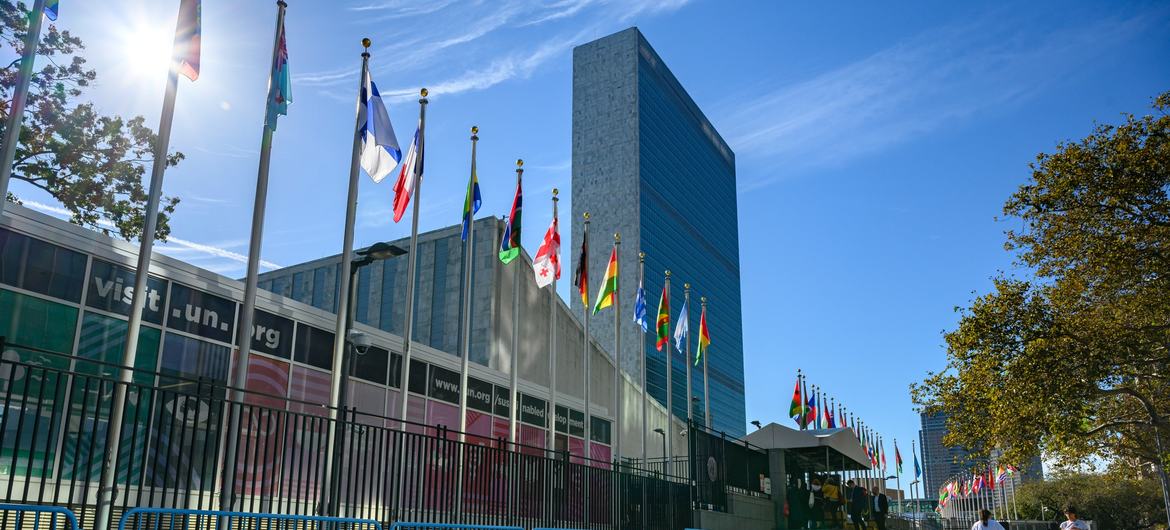
The UN General Assembly presented the main part of its 79th session on Tuesday, December 24th, by proposing a budget of 3.72 billion dollars for the United Nations in 2025, and adopting a new program aimed at supporting landlocked developing countries. This budget for the year that begins is definitively approved.
The regular budget is approved for 2025. With an amount of 3.72 billion dollars, it will be increased by approximately 1 million dollars following the proposal made last October by the Secretary-General to the Fifth Committee of the Assembly, which is responsible for administrative and budgetary matters.
This budget also includes technical adjustments following the adoption of several resolutions and decisions by the organization’s intergovernmental bodies since the presentation of its draft. Thus, the total amount of budgetary appropriations for 2025 has finally and precisely reached 3,717,379,600 dollars.
For the record, the regular budget finances the UN’s programs in key international areas, including political affairs, justice and law, regional cooperation for development, human rights and humanitarian affairs, as well as public information.
In addition, the UN has a separate budget for peacekeeping operations, whose fiscal year extends from July 1 to June 30, while the regular budget cycle aligns with the calendar year.
A new action program for landlocked developing countries
Notably, the General Assembly adopted the «Action Programme for Landlocked Developing Countries» for the decade 2024-2034, which aims to address the particular challenges faced by nations that do not have direct access to the high seas.
The landlocked developing countries (LLDCs) do indeed face significant and specific obstacles in terms of trade and development, as they depend on transit countries, which leads to higher trade costs, delays, and reduced competitiveness in global markets.
This action program defines five priorities: promoting sustainable economic growth through innovation and structural transformation, strengthening regional trade integration, improving transport connectivity, strengthening climate resilience, and finally ensuring effective implementation strategies.
The new framework builds on the Vienna Action Programme (2014-2024) and the Almaty Action Programme (2003), which laid the foundations for combating the persistent obstacles faced by landlocked developing countries.
A new convention against cybercrime, for a safer digital and physical world
Aware that billions of people worldwide should benefit from increased online security but also in the physical world, the United Nations General Assembly also voted on a legally binding treaty on cybercrime.
Indeed, after five years of intense negotiations, the 193 member states of the United Nations adopted the Convention against Cybercrime by consensus, a first of its kind on an international scale.
An essential tool, but also a constraint in the face of growing threats
According to the World Bank in 2023, more than 67 % % of the world’s population now has access to the internet. From personal or professional communication, to shopping and online transactions, to advanced search and innovation, this population on the five continents relies on connectivity and the web.
However, and as cases are becoming increasingly common, this hyper-connectivity also exposes more than two-thirds of global users to the dangers of cybercrime. For those on the wrong side of the digital divide, the lack of resilience further increases their vulnerability once they are online.
It would be a complete mystery to explain once again that cybercriminals exploit digital systems using malicious software, ransomware, and hacking in order to steal funds, data, and other valuable and yet monetizable information. Information and communication technologies (ICT) are also used to facilitate the development of criminal enterprises such as drug trafficking, arms smuggling, human trafficking, money laundering, and fraud, etc.
Several regions, such as Southeast Asia, have been widely described as the «zero point» of organized cybercrime operations, often highly sophisticated and coordinated. Undoubtedly, the threat is intensifying, undermining economies, disrupting critical infrastructure, and consequently eroding trust in digital systems.
Until now, there was no international agreement on cybercrime. This new agreement, signed by all members and committing them, at least in theory, against cybercrime, aims to provide faster, better-coordinated and therefore more effective responses, linking the digital world and real life in a safer way.
Permanent cooperation in investigative and judicial matters
According to the United Nations, transnational criminal investigations, whether they originate online or not, depend essentially on electronic and therefore dematerialized evidence, which poses many new challenges for both the investigating law enforcement forces and the judicial investigators.
One of the main difficulties lies in the decentralized nature of data, networks, and the multitude of operators, with potential evidence often scattered across multiple jurisdictions.
Furthermore, the electronic material elements characterizing a crime often need to be readily accessible in order to prevent them from being altered or deleted by the high fluidity of the processes, especially storage processes.
Thus, this new concern of NU through this convention focuses on the frameworks for accessing and exchanging electronic and dematerialized evidence, and of course aims to facilitate the course of investigations and, finally, judicial prosecutions.
Also, the member states and parties to this agreement will benefit from a network that operates 24 hours a day, 7 days a week, in order to stimulate international cooperation in investigations, then in international prosecutions by national jurisdictions, in the seizure of criminal proceeds, and finally in judicial assistance and the possible extradition of individuals involved.
Protecting children, an increased priority
It is no longer a mystery and many legal cases have largely revealed that online platforms such as social networks, «chat» applications and games allow users to remain anonymous, which predators can exploit to prepare, manipulate or harm the youngest.
Thus, the 2025 United Nations Convention is the first global treaty specifically addressing sexual violence committed against children using information and communication technologies (ICT).
By making these criminal offenses now subject to international law, the Convention provides governments with more powerful tools to protect minors in particular, and of course to bring the perpetrators to justice.
Strengthening and encouraging a better response to the needs of victims
Cybercrime is one of the global evils of the 21st centuryth century. For the UN Assembly, a priority resolution attached to the Convention aims to ensure that each victim receives adequate and essential support.
Thus, the Convention encourages States to provide victims, regardless of their country of origin, with access to recovery, compensation, restitution, and removal services for illicit content.
This assistance and support must be implemented in accordance with the national laws of each member country.
Strengthening prevention
As we all know, the United Nations General Assembly: it is not enough to react to cybercrime once it has occurred and only in a repressive manner. Therefore, and in order to prevent cybercrime, it is more than necessary to invest massively in proactive measures, which the Convention against Cybercrime strongly emphasizes.
Thus, it invites the Member States and signatories to develop comprehensive national prevention strategies, including specific training for both public and private sector actors, programmes for the rehabilitation and reintegration of offenders, and to further strengthen support for victims.
Through these measures, the Convention aims to address risks unequivocally, detect and effectively manage threats, thereby fostering a safer digital environment for all.

 French
  English
  Chinese
  Arabic