
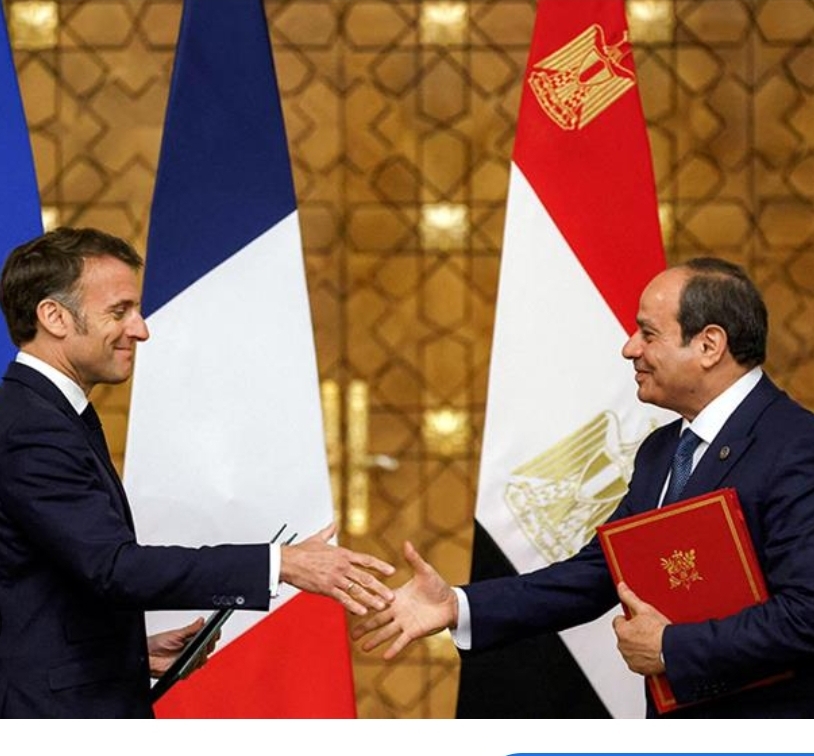
Cairo as the pivot, Alexandria as the backdrop. On 9 May 2026, Emmanuel Macron set foot in Alexandria to inaugurate the new campus of the Senghor Francophone University in Borg el-Arab, in the presence of Egyptian President Abdel Fattah al-Sisi. A gesture at first glance cultural, almost academic.
This visit forms the first stage of a five-day African tour that will also take Macron to Nairobi and Addis Ababa, in what looks like an unabashed stocktaking of his African policy with less than a year left of his term in office.
Egypt, the strategic anchor of a volatile Middle East.
The Macron-Sisi meeting cannot be reduced to simple diplomatic courtesy. According to the Élysée, the two heads of state spoke to «reinforce a strong bilateral relationship between France and Egypt» and to address the ongoing crisis in the Middle East.
Egypt occupies a pivotal position here: guardian of the Suez Canal, historic mediator in the Israeli-Palestinian conflict, and an essential interlocutor on Gaza. During the preparations for the visit, the two presidents had already discussed developments in the Gaza Strip and Egyptian efforts to achieve a ceasefire, highlighting the importance of an immediate ceasefire and the delivery of humanitarian aid, and affirming that the two-state solution remains the only guarantee of a lasting peace.
By choosing Egypt as his first stop, Macron is not only paying tribute to a long-standing bilateral relationship; he is repositioning France as a key player on the Middle Eastern issue, within an increasingly contested diplomatic space.
The Strait of Hormuz: France tries a three-cushion billiard shot
The most ambitious challenge of the Egyptian stopover remains the maritime issue. Emmanuel Macron wishes to promote a «maritime coalition» of non-belligerent countries to secure commercial navigation in the Strait of Hormuz, a strategic crossing point for an essential part of the world's oil.
Paris says it is ready to shorten the implementation time for a security restoration operation in the strait «as soon as circumstances permit», claiming to be «capable of securing navigation». The effects of the blockade are already visible: rising energy prices, skyrocketing insurance premiums for shipowners, and growing concern on the markets.
By appealing to Egypt on this issue, Macron is seeking to broaden his coalition to include moderate Arab powers capable of giving regional legitimacy to an operation that, without this, risked being perceived as yet another Western interference. The logic is that of a facade multilateralism that allows Paris to exert influence without exposing itself alone.
La Francophonie as an instrument of soft power
Macron described the Senghor University as a «magnificent universalist project», insisting on the need to ’root the dialogue between cultures« and »ensure a shared future’. The register is lyrical. The reality is more prosaic.
In a continent where anti-French sentiment has become a structuring political force, particularly in the Sahel, investing in a training institution for French-speaking African executives constitutes a long-term geopolitical investment. Training elites, spreading a language, anchoring networks: this is influence diplomacy in its most classic form, the very one that France has long neglected in favour of military interventions that are now compromised.
Anti-French sentiment is strong in certain former African colonies, as the continent once again becomes a diplomatic battlefield marked by growing Russian and Chinese influence. Mali, Burkina Faso, Niger: capitals where the tricolour has been pulled down, and where French forces have packed their bags under pressure from juntas allied with Moscow.
That is why this «Africa Forward» summit in Kenya, scheduled for earlier in the week, is the first summit with African leaders to be held in an Anglophone country since Macron came to power in 2017. The geopolitical message is crystal clear: France is pivoting towards an East and Anglophone Africa, which is less imbued with the post-colonial resentment of Françafrique.
France has indeed pledged to abandon the so-called «Françafrique» strategy, through which Paris maintained its influence via political collusion, exclusive access for French companies, and opaque financial arrangements. Officially renouncing it is one thing; demonstrating this convincingly is quite another.
A heritage to build against the clock
In Addis Ababa at the end of his tour, Macron will take part in a meeting at the African Union headquarters alongside United Nations Secretary-General António Guterres, focused on resolving the continent's crises. The scenography is that of a president who wants to leave on a multilateral and positive note.
The fact remains that time is running out. With less than a year to go before the end of his second term, Macron is scrambling as much to build up his legacy as to forge new alliances. Egypt, the Strait of Hormuz, La Francophonie, Kenya: these are all items on a packed, if at times disorganised, geopolitical agenda, yet one that bears witness to France’s undiminished ambition – that of a power which refuses to leave the table, even when its seat is being challenged.
Macron’s stopover in Alexandria will be remembered for what it is: not a simple tribute to Léopold Sédar Senghor, but a political act in an Eastern Mediterranean undergoing complete reorganisation, at a time when every presidential visit is also a message sent to Moscow, Beijing and Washington.

 French
  English
  Chinese
  Arabic