
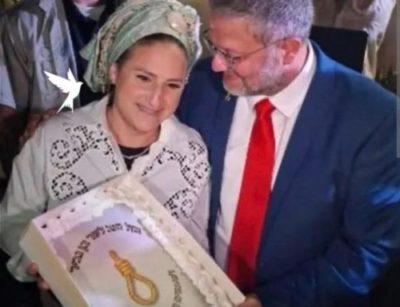
In a villa in the south of Israel, near Ashdod, a party is in full swing. High-ranking police officers in uniform, far-right activists, smartphone cameras held aloft, Itamar Ben Gvir, Israel's National Security Minister, is celebrating his 50th birthday. The most talked-about moment of the evening occurs when his wife, Ayala, presents him with his birthday cake: a three-tier wedding-style cake topped with a golden hangman's noose. A second, larger cake features a golden gallows erected above a map representing Israel, Gaza and the West Bank, with weapons pointed towards the Palestinian territories. The inscription, carved in sugar, leaves no room for ambiguity: «Congratulations Minister Ben Gvir. Sometimes dreams come true.».
This is not a bad joke. This is not an isolated provocation. It is a political symbol with surgical precision, celebrating the passage, a few weeks earlier, of a law introducing the death penalty by hanging, applicable almost exclusively to Palestinians. Behind this macabre anecdote lies the structure of a power that, since October 2023, has turned a war into a humanitarian catastrophe documented by all United Nations agencies: over 100,000 Palestinian deaths, with nearly 70 % of identified victims being women and children. An officially declared famine, over 10,000 prisoners including hundreds of children, and over 300 journalists killed between October 2023 and December 2025 during Israeli military operations in Gaza.
Ben Gvir: ideology made minister
From Goldstein poster to ministerial portfolio
To understand the gallows cake, one must understand the man smiling at it. Ben Gvir had in his bedroom a poster of Baruch Goldstein, the terrorist who gunned down 29 Palestinian civilians in Hebron in 1994. For the future minister, Goldstein is a hero and a source of inspiration.
Decades later, Ben Gvir sits in Benjamin Netanyahu's government, heading the Ministry of National Security, the ministry that oversees the police, prisons, and the conditions of detention of tens of thousands of Palestinians. This cake is a striking metaphor for the political platform of the far right in Israel, embodied today by the newly turned fifty-year-old. He embodies a vision of Israel rejected by Yitzhak Rabin, whom his assassins had wanted to kill along with him, assassins whose disciples now sit in government. By the grace of a Prime Minister as cynical in 1996 as in 2026.
The death penalty law: a tailor-made hanging
The noose is a reference to the controversial law passed by the Knesset in March, which imposes the death penalty on Palestinians accused of terrorism, a law long championed by Itamar Ben-Gvir and his Otzma Yehudit party. This text, named the Death Penalty for Terrorists Law, establishes hanging as the automatic punishment for Palestinians in the West Bank. If they are found guilty of murders classified as terrorist acts by Israeli military courts, hanging is handed down following expedited proceedings.
The UN human rights chief, Volker Türk, has urged Israel to repeal this law, which he considers discriminatory against Palestinians. It should be noted that Israel has applied the death penalty only twice in its history: against an Israeli officer in 1948 and against Adolf Eichmann in 1962. The third application, should it happen, will be reserved for Palestinians.
The loosening of gun laws: a militarised society
The lower tier of the cake featured two firearms pointed at a map of Israel including Gaza and the West Bank, symbolising Ben Gvir’s controversial gun policies, which were significantly relaxed during his tenure. The effects of this policy have been documented in numerous incidents involving armed settlers in the West Bank, some of which resulted in the deaths of Palestinians without ever leading to legal prosecution.
Gaza: chronology of a catastrophe
The starting point: the attack of 7 October 2023
Any honest analysis requires recalling the triggering context. On 7 October 2023, Hamas launches a terrorist-nature attack against Israel. 695 Israeli civilians and 71 foreign nationals are killed. At the Reïm music festival, 260 Israelis are murdered, some by the Israeli army in application of the «Hannibal directive». The latter is a secret directive of the Israel Defense Forces whose objective is to prevent the capture of Israeli soldiers by enemy forces during combat.
251 people are taken hostage, including a baby, «Kfir», killed in captivity.
Facts documented by Haaretz, an Israeli left-wing media outlet. This will be the starting point for a military response whose scale and methods are now at the heart of serious international accusations.
Completely disproportionate reprisals with no other objective than total destruction
The death toll among Palestinians has exceeded 100,000, with women and children making up nearly 70 % of the identified victims. This asymmetry in losses has raised profound questions regarding compliance with international humanitarian law. By the end of 2024, UNICEF recorded more than 80,000 Palestinian deaths, including at least 30,000 children, over 150,000 injuries, including more than 50,000 children, and over 15,000 missing persons.
UN Women reports that more than 50,000 women and girls were killed between October 2023 and December 2025, an average of at least 50 deaths per day over the entire period. These figures are based on data from the Health Cluster Dashboard as of 31 December 2025. However, the true figures could be much higher: many bodies remain buried under the rubble, whilst the collapse of health systems severely limits the accurate recording of casualties.
By September 2025, 3,000 families had been completely wiped out, with no survivors, and 7,000 had only a single member still alive. Surnames are disappearing from Gaza's civil registry. Entire family trees have been erased, bombed, killed at point-blank range, and burnt alive. Thirst-ridden and starving.
The systematic destruction of infrastructure
Israeli strikes have caused widespread destruction of infrastructure: water, sewage, telecommunications, housing. Most hospitals are out of service. The UN Human Rights Office has warned against the «systematic destruction of Gaza City». Satellite imagery analysed by Amnesty International has revealed the total destruction of entire areas, documenting «wanton destruction». Virtually the entire population of Gaza, 1.9 million people, is internally displaced within the enclave.
According to a joint assessment by the EU, the UN and the World Bank, $71.4 billion will be needed over ten years to rebuild Gaza. $26.3 billion must be mobilised immediately to restart vital services, rebuild devastated infrastructure and revive a stalled economy.
Famine as a weapon of war
the blockade: a documented political decision
On 9 October 2023, right from the day after the start of the war, Israel imposed a total blockade on Gaza. On 2 March 2025, with the first phase of the ceasefire barely over, Israel decided to suspend all entry of goods and supplies into the Gaza Strip. All crossing points for the delivery of aid into the Palestinian enclave were closed.
The WHO Director-General does not mince his words: «There is no need to wait for famine to be declared in Gaza to see it: starving, the inhabitants are falling ill and dying. Yet food and medicine are readily available, just minutes away, on the other side of the border.» UN Security Council Resolution 2417 (2018) explicitly condemns the use of starvation as a weapon of war. Israel is a signatory to this resolution.
On 22 August 2025, the United Nations officially declared a state of famine in the Gaza Governorate, due to Israel's ’systematic obstruction« of food deliveries. The figures are difficult to verify, but around 440 people, including 147 children, had died of starvation. UNICEF indicated in October 2025 that over 60,000 children were registered for treatment for malnutrition.
Since the start of the humanitarian blockade on 2 March 2025, more than 60 children have died as a result of malnutrition, according to data from the Hamas-run health ministry, an underestimated figure that is destined to rise. Had the situation continued, acute malnutrition would have affected nearly 80,000 children under the age of five over the following eleven months.
From the end of May 2025, the Gaza Humanitarian Foundation, tasked by Israel with ensuring food distribution, caused nearly 1,500 deaths over three months during its distributions amid chaotic conditions.
A famine averted, but still threatening
The state of famine, declared in August during the humanitarian blockade imposed by Israel, was officially lifted in December 2025, thanks to the October ceasefire and a partial lifting of obstacles to aid deliveries. The UN Secretary-General welcomed the news, but immediately warned: «Needs are growing faster than aid can get through.»
Between 1 December 2025 and 15 April 2026, approximately 1.6 million people, or more than three-quarters of the enclave's population, will remain at levels of food insecurity deemed «critical», «urgent» or «catastrophic». FAO, UNICEF, WFP and WHO warn that without a sustained, large-scale increase in food aid, hundreds of thousands of people could rapidly relapse into famine.
The health system: target and victim
Hospitals as war zones
As of 5 December 2025, at least 2,000 health professionals have been killed and more than 700 aid workers, mostly Palestinian, have lost their lives in Gaza. Fifteen MSF staff members have been killed by Israeli forces since 7 October 2023, some while on duty.
In August 2025, MSF facilities are operating at over 100 % capacity, while some Ministry of Health hospitals are reaching over 200 %, notably Al-Shifa Hospital. Waiting lists for surgical operations are so long that patients often die before teams can operate on them.
Hundreds of thousands of Palestinians remain uprooted, living in makeshift tents pitched directly on the ground or crammed into damaged buildings, without reliable access to water, electricity, healthcare or sanitation.
In these catastrophic health conditions, the poliovirus resurfaced in Gaza after an absence of 25 years, in July 2024. In response, the UN and the Gaza Ministry of Health launched a two-phase vaccination campaign. Overcrowding and poor hygiene conditions in displaced persons camps are driving the spread of diseases and infestations such as scabies and lice. Accumulated waste and rubble are promoting the proliferation of rats and mice, which are vectors of serious diseases, with no rodenticides available to humanitarian workers.
Journalists: a war against information
The deadliest conflict for the media in modern history
Between October 2023 and mid-December 2025, more than 300 journalists were murdered during Israeli military operations in Gaza. At the same time, over 200 Palestinian journalists were arrested, often placed in administrative detention under arbitrary conditions.
In its 2025 annual report, Reporters Without Borders records 67 journalists killed worldwide in a year, nearly half of them in Gaza «under fire from the Israeli armed forces». The NGO describes the Israeli army as the «worst enemy of journalists», emphasising that these are not «strays» but deliberate attacks aimed at preventing reporting from the ground.
In one of the most documented incidents, on 7 April 2025, the Israeli army targeted a group of journalists sleeping in a tent near the Nasser Hospital in Khan Younis. Journalist Hilmi Al-Faqaawi from Palestine Today TV was burnt alive, and nine of his colleagues were injured. One of them, Ahmed Mansour, who was severely burned, did not survive his injuries. The Israeli authorities claimed they had targeted «a terrorist posing as a journalist.»
Israel continues to impose a blanket ban on independent access to Gaza for international media, alongside excessive restrictions on the work of the media in the West Bank. Between January and May 2025, Al Jazeera was banned following the closure of its offices by Israeli forces. Released journalists described interrogations focusing on their reporting or social media posts, based on vague accusations of ’incitement«, »support for terrorism« or threats to Israel's »national security«.
Israeli prisons: the other front
More than 10,000 prisoners: mass incarceration
En mai 2025, plus de 10 100 prisonniers palestiniens sont identifiés dans les prisons israéliennes, à l’exclusion des détenus de Gaza dont le nombre exact demeure inconnu. Parmi eux : près de 4000 en détention administrative, 2000 au titre de « combattants illégaux », plus de 500 enfants et autant de femmes.
Des fondements juridiques pour le moins discutables
Les détenus administratifs sont emprisonnés sans procès ni inculpation, sur la base d’un « dossier secret » auquel ni le détenu ni son avocat n’ont accès, ce qui les prive de tout moyen de se défendre devant les tribunaux militaires israéliens. Depuis 1967, au moins 50 % des hommes palestiniens ont connu la prison à un moment de leur vie, une dimension systémique que plusieurs juristes internationaux qualifient d’incarcération de masse.
Des enfants détenus arbitrairement
Israël est le seul pays au monde à juger des enfants devant un tribunal militaire. Dès l’âge de 12 ans, un mineur palestinien peut être condamné à 20 années de prison pour « jet de pierres », le chef d’accusation le plus fréquent. En moyenne, 1000 mineurs palestiniens sont poursuivis chaque année devant les tribunaux militaires par les forces israéliennes, selon Defense for Children International.
Parmi les prisonniers dont la libération a été envisagée dans le cadre d’échanges, cinq n’avaient que 14 ans. La question posée par des observateurs : comment un garçon de 14 ans peut-il devenir un « prisonnier de sécurité » ? La majorité des mineurs détenus ont été accusés d’infractions mineures, dont le jet de pierres pour un grand nombre d’entre eux. Aucun n’a été condamné pour meurtre.
La durée moyenne de détention pour les mineurs palestiniens est de 120 jours. Dans 80 % des cas, le droit à la présence d’un avocat ou d’un parent lors des interrogatoires n’est pas appliqué, pourtant obligatoire selon le droit israélien lui-même, selon des juristes documentant ces abus. L’UNICEF qualifie les mauvais traitements subis par les enfants prisonniers de « répandus, systématiques et institutionnalisés ».
La torture : témoignages et documentation internationale
Les témoignages d’anciens détenus palestiniens recueillis par des ONG font état de brûlures de cigarette sur le corps, de torture à l’eau, de lâchers de chiens. Dans certains centres de détention, la plupart des détenus ne sont vêtus que de couches. La méthode dite « disco », détention dans une salle avec musique à très haut volume, est décrite par plusieurs anciens prisonniers. Elle est reconnue comme torture par les organisations internationales. D’autres témoignages décrivent des viols à l’aide d’objets, des cassages de doigts répétés, des humiliations en tous genres.
En avril 2025, les autorités israéliennes ont annoncé la mort de deux prisonniers palestiniens en détention. Les résultats d’autopsie du jeune Walid Ahmad, 17 ans, mort en mars, ont établi que la cause principale du décès était la privation de nourriture. Depuis le 7 octobre 2023, au moins 200 Palestiniens sont morts en détention israélienne.
C’est dans ce contexte,10 000 prisonniers, des centaines d’enfants, des morts en détention, des témoignages de torture, que la loi sur la peine de mort adoptée en mars 2026 prend toute sa signification. Ben Gvir avait publiquement déclaré vouloir utiliser l’exécution des prisonniers palestiniens comme solution à la « surpopulation carcérale ». Le gâteau à la potence n’est pas une métaphore. C’est un programme politique, cohérent, assumé, célébré en public devant des officiers de police en uniforme.
La CIJ et les accusations de génocide
En décembre 2023, l’Afrique du Sud saisit la Cour internationale de Justice d’une plainte contre Israël pour violation de la Convention pour la prévention et la répression du crime de génocide. En septembre 2025, un rapport d’une commission d’enquête des Nations Unies a conclu à la commission d’actes de génocide par Israël à Gaza. Des hauts responsables de l’ONU ont estimé que les frappes israéliennes meurtrières sur des zones densément peuplées s’apparentent à des crimes de guerre..
L’Assemblée générale a adopté une résolution approuvant l’avis consultatif de la Cour internationale de Justice sur les obligations d’Israël en Palestine.
La loi antiterroriste israélienne de 2016 et les règlements de défense de 1945 sont utilisés pour perquisitionner les ONG palestiniennes, restreindre leurs financements et arrêter leur personnel. En février 2025, un projet de loi à la Knesset visait à criminaliser le partage d’informations avec la Cour pénale internationale.
Les restrictions imposées par Israël aux activités des ONG internationales compliquent encore davantage les opérations humanitaires à Gaza. Le Secrétaire général de l’ONU a exhorté les autorités israéliennes à revenir sur leur décision d’interdire les ONG internationales, rappelant leur rôle crucial dans les opérations humanitaires.
Le 2 mai 2026, Itamar Ben Gvir sourit devant une potence en sucre. Au même moment, plus de 10 000 Palestiniens sont détenus dans les prisons israéliennes, dont 500 enfants. Au même moment, 1,6 million de Gazaouis vivent dans une insécurité alimentaire aiguë. Au même moment, les ruines de Gaza attendent 71 milliards de dollars de reconstruction.
Une idéologie d’État fanatique
Le gâteau à la potence est un symbole trop parfait pour être accidentel. Il synthétise en un objet comestible ce que deux ans de guerre ont produit : une idéologie d’État fanatique et génocidaire qui a transformé l’urgence sécuritaire née du 7 octobre en machine à broyer une population civile, avec la paralysie embarrassée d’une grande partie de la communauté internationale totalement impuissante alors que le génocide d’un peuple est en court depuis près de trois ans, sous les yeux du monde entier.
António Guterres a déclaré : « Cela me brise le cœur de voir l’ampleur persistante de la souffrance humaine à Gaza. Les familles endurent l’insupportable. »
Les chiffres, eux, sont déjà là. L’histoire jugera. Et elle risque ne pas être tendre avec les acteurs et les spectateurs passifs.

 French
  English
  Chinese
  Arabic