
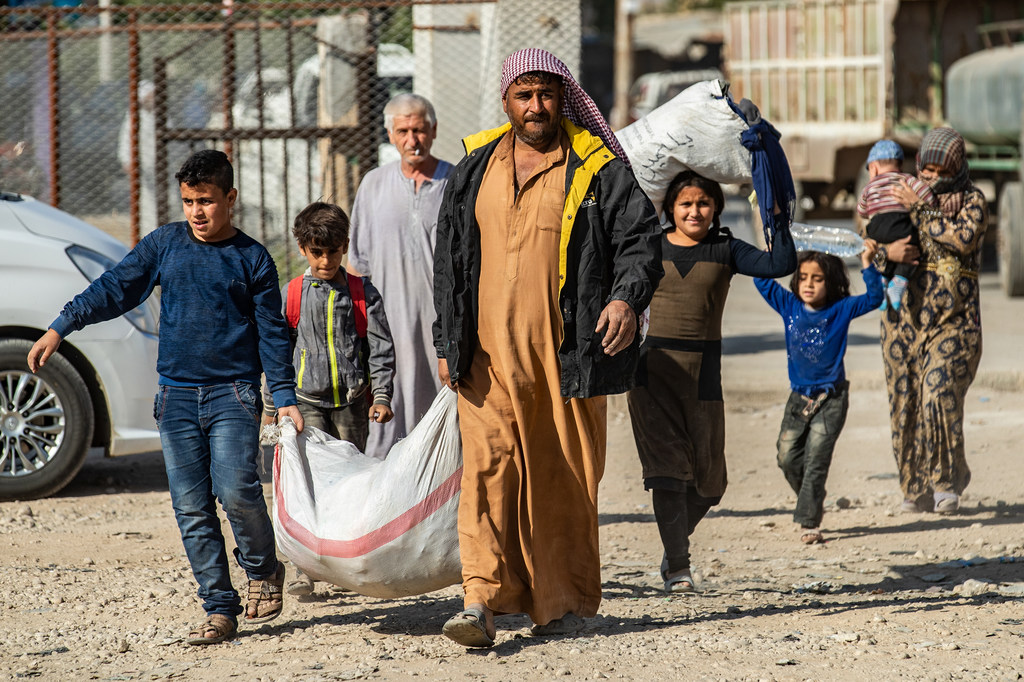
Since the start of the lightning offensive led by the jihadist group Hay’at Tahrir al-Cham (HTC) in association with other rebel factions in Syria, more than 280,000 people have been displaced by the fighting in the north of the country, United Nations agencies reported last Friday, fearing that this number could further increase to reach 1.5 million individuals.
« The figures we have are 280,000 people since November 27th. This is the updated figure as of last night. And this does not include the number of people who fled Lebanon during the recent escalation of fighting between Hezbollah and Israel. »", said Samer AbdelJaber, Director of Emergency Coordination for the World Food Programme (WFP), during a regular UN press briefing in Geneva.
At the time of this publication, it is no longer a mystery that the hostilities in northern Syria have spread to other parts of the country, putting the entire country in danger.« danger to civilians and humanitarian workers, causing serious damage to essential infrastructure and disrupting humanitarian operations », as the UN agency rightly fears.
The UN fears that the number of displaced people will reach the alarming figure of 1.5 million
« And if the situation continues to evolve at this pace, we expect that, collectively, about 1.5 million people will be displaced and need our support. »", added Samer AbdelJaber.
Indeed, a report presented the day before by the United Nations Office for the Coordination of Humanitarian Affairs (OCHA) indicated that at least 178,000 people have been displaced due to the recent escalations in northern Syria, according to a count carried out on Thursday, December 5th. Among these displaced people, 128,000 are new displaced people and 39,000 have been forced to flee their homes at least twice. A very sad figure.
Thousands of affected people continue to flee the areas and seek refuge in safer places within the affected governorates and in other governorates. Thousands of people have temporarily relocated to the northeast of Syria, passing through the Tabqa and Bu Assi border crossings.
In Tabqa, 35 buildings have been designated for the reception of displaced persons. The situation in Ar-Raqqa is chaotic, although more than 70 buildings have been designated as temporary collective centers. The wave of displacement is overwhelming the capacity for reception, forcing people to sleep in the streets and in their cars. Since December 4, four new reception sites have been established in the cities of Ain Al-Arab, Al-Hasakeh and Qamishli, where more than 400 families are already being accommodated.
In short, this factual observation and figures are far from the idyllic scenes of joy imagined by uninformed Western commentators—or interested ones?
A heavy toll for the civilian population
Generally speaking, the security situation in Syria remains very worrying with an intensification of hostilities since November 27, particularly in the northern and northwestern regions, notably in the governorates of Aleppo, Idlib, Hama and Homs. Although the exact number of casualties remains to be confirmed, the United Nations estimates that hundreds of civilians have lost their lives or been injured over the past seven days.
« At least 69 civilians are believed to have been killed, including 26 children and 11 women, and more than 200 injured have already been counted, mainly in the northwest of Syria. Furthermore, more than 370 civilians are believed to have been killed in Hama due to the ongoing clashes. »", the OCHA specifies in its latest humanitarian situation report.
Due to a lack of sufficient supplies, growing food insecurity
Due to insufficient deliveries and supplies, basic food products are becoming scarcer, especially bread, significantly exacerbating the fluctuations in exchange rates and inflation that have already led to a sharp rise in the prices of food and other basic products.« Given the fluidity of the conflict, it is difficult to accurately estimate the levels of stocks in bakeries, and this will require continuous monitoring. », the UN organization believes.
Based on field reports from just a few days ago, the bakeries in the city of Aleppo will only be able to operate for about a month. Moreover, the obvious shortage of «emergency ready-to-eat rations» distributed to the displaced populations in the Idlib region is becoming increasingly noticeable.« The exact needs are difficult to estimate, as the situation is evolving daily, the number of arrivals is increasing, and the movements of humanitarian partners are limited by the ongoing hostilities and the prevailing insecurity. », note the observers on the ground.
In addition in Aleppo, in the north of Hama and in Idleb, access to healthcare and humanitarian aid has been severely limited. The movement has exacerbated already difficult living conditions for the civilian population, increasing the risk of malnutrition, especially for children under five years of age.
A complete disappearance of public services in Aleppo
On another front, and due to the absence of an operational institutional system, public services and essential facilities in Aleppo are interrupted or cannot function due to the shortage of medical supplies and personnel mobilized on the various fronts. The escalation of violence has severely affected the local health system, leading to the suspension of surgical interventions and the distribution of heavy treatments for chronic illnesses, in the main health facilities in Aleppo and Idlib.
In the northeast, not only are the collective emergency centers filling up within a few hours of being set up, but the permanent reception centers are also overwhelmed by the influx, and due to the cold temperatures, many families have no choice but to sleep in the streets and in their cars when they are lucky enough to have them. On-site, new assessments are underway to identify the needs of newly arrived families.
« Of course, the humanitarian partners are working on both sides of the front line. We are trying to reach the communities where they need help and we are working with our teams on the ground to secure the routes so that we can deliver the aid and assistance to the communities that need it. »", added Samer AbdelJaber.
1.5 million children deprived of schooling in Idleb, Aleppo and Raqqa
Furthermore, nearly 1.5 million children are now deprived of education in Idleb, Aleppo and Ar-Raqqa due to the closure of schools. More than 1,000 educational institutions are now being used as makeshift shelters. As a result of recent events, more than 60 schools in Ar-Raqqa and Tabqa are now being used to accommodate displaced populations.
« As the number of arrivals continues to increase, it is expected that other schools will be reassigned to Ar-Raqqa, Tabqa, Ain Al Arab, Al-Hasakeh and Quamishli, which will result in the interruption of teaching. », report humanitarian personnel on the ground.
These same humanitarian partners, having chosen to remain in the various areas of intervention, coordinate closely to ensure the rapid sharing of information on displacements, the location of potential host sites, and, of course, on new needs.
« I must say that we collectively know that the situation in Syria was not easy before this escalation. That is why we insist on the urgent need for funding, flexible funding so that we can support all the efforts of humanitarian partners to prepare themselves and be ready to face any scenario of displacement that could evolve in the coming days or months. », concluded the Director of Emergency Coordination and Humanitarian Diplomacy of the WFP.

 French
  English
  Chinese
  Arabic