

« The Universal Declaration shows the way towards a community of values and approaches that can help resolve tensions and create the security and stability that our world so desperately needs. ». António Guterres, Secretary-General of the United Nations.
The Day and the Universal Declaration of Human Rights, a founding act
Certainly, Noyée was caught up in a flurry of celebrations that for some took the pompous form of an «international day of…» Human Rights Day It is celebrated every year on December 10 to mark the anniversary of one of the most important global commitments: the Universal Declaration of Human Rights, this founding act that proclaimed the inalienable rights of every individual as a human being, without distinction of any kind, including race, color, sex, language, religion, political opinion or any other opinion, national or social origin, wealth, birth or any other situation.
This Declaration with a capital D was proclaimed by the United Nations General Assembly in Paris on December 10, 1948 and for the first time, at the end of the devastating Second World War, set out the fundamental rights that must be universally protected.
Imagined as a « a common ideal to be achieved by all peoples and all nations »The text aims to establish and enforce international, national and local laws and policies, and is one of the pillars of the 2030 Agenda for Sustainable Development. A beautiful utopia?
Available in more than 500 languages, from Abkhaz to Zulu, the Universal Declaration of Human Rights is the most translated document in the world, after Antoine de Saint-Exupéry’s The Little Prince.
Rights, a future for all, now!
« Human rights can give individuals and communities the means to build a better future. By adopting and trusting the full power of human rights as a path towards the world we want, we can become more peaceful, more equal, and with a more sustainable development. ». This is the major component of the Charter’s DNA.
Placed under the idealist theme, it must be admitted, of « Our rights, our future, now »The 2024 edition of this international day aims to highlight how human rights constitute « a path towards practical solutions to the great challenges of our time, playing an essential role as a preventive, protective and transformative force for good ». Thus stated UN Secretary-General António Guterres, before adding « Human rights are the foundation of peaceful, just, and inclusive societies ».
Probably far from considering the recent upheavals in the Middle East, this campaign «hopefully finally encourages everyone to recognize the importance and relevance of human rights, to change perceptions by combating negative stereotypes and misconceptions, and to mobilize to revitalise a global movement in favor of human rights.» Although paved with good intentions and humanist incantations, the UN communications advisers can sometimes seem to inhabit a different planet. Unless we are reminded of the tragedies that sometimes unfold just a few steps from our Western comfort zones, when it seems easier to look elsewhere from the muted silences of diplomatic palaces.
Why international days?
In spirit, each International Day is intended to provide an opportunity to inform the general public about issues of major importance. These days are an opportunity for public authorities as well as civil society to organize awareness-raising activities and mobilize resources.
The existence of international days dates back to before the founding of the United Nations, but the UN has adopted them as a powerful tool for awareness-raising. The UN observes international days, weeks, years, and decades, each with a specific theme. By highlighting these celebrations, the UN promotes awareness and international action on a wide range of topics that impact civil societies around the world. Each international day in fact provides many actors with the opportunity to express themselves and organize activities related to the day’s theme. The organizations, agencies, and offices of the complex United Nations system, and especially governments, civil society, the public and private sectors, schools, universities, and, more generally, the citizens of the world, make an international day a springboard for their national awareness-raising efforts. The majority of the celebrations have been established by resolutions of the United Nations General Assembly, although some of them have been proclaimed by its specialized institutions. The UN also observes the anniversaries of key events in its history.
Who decides the establishment of these days?
The International Days are proposed to the United Nations General Assembly by the Member States. The General Assembly decides by consensus which new day or cause to be highlighted. This is why it is said that an international day is proclaimed by the UN General Assembly.
However, some of these celebrations are also created by specialized institutions within the United Nations to draw public attention to more specific topics or causes, for example in the field of health or intellectual property. For example, the World Press Freedom Day, which is celebrated on May 3, was proclaimed by the United Nations Educational, Scientific and Cultural Organization (UNESCO) based in Paris, and subsequently ratified by the General Assembly.
The themes of the international days are always linked to the main areas of action of the United Nations, namely the maintenance of peace and international security, the promotion of sustainable development, the protection of human rights and the guarantee of international law and humanitarian action.
In its resolutions, the General Assembly generally justifies what prompted it to proclaim a cause as an International Day. For example, by declaring May 23 International Day for the Elimination of Obstetric Fistula, the resolution cites « the links between poverty, malnutrition, the absence, inadequacy or lack of access to health care services, early motherhood, child marriage, violence against young women and girls and gender discrimination as root causes of obstetric fistula, and the fact that poverty remains the main social risk factor ». A little technical, but the point is there.".
The common man may never have heard of this disease, despite the fact that two million women in developing countries live with a fistula, and that between 50,000 and 100,000 new cases occur each year. An international day allows for important awareness-raising work on this issue, which is by no means a topic for our usual news broadcasts!
Furthermore, the General Assembly develops in its resolutions the aspects of the issue that concern its Member States the most. In other words, humanity as a whole, considering that the Assembly is composed of 193 countries, that is to say, most of the countries of the world. Take, for example, the resolution that designates June 23rd as International Widows« Day, in which the General Assembly declares:« Deeply concerned that millions of children whose mothers are widows risk experiencing hunger, malnutrition, forced labor, difficulties in accessing healthcare, water and hygiene, the deprivation of schooling, illiteracy and human trafficking ». Finally, not that far from the streets of Paris at nightfall for anyone who knows how to look.
In addition to its public awareness outreach missions, the UN takes advantage of these occasions to advise states on the actions to be taken in order to try to solve the serious problems surrounding many of these Days. Little known, the resolution proclaiming the International Day of Biological Diversity, celebrated on May 22, in which the UN calls on its member states to sign and ratify the Cartagena Protocol on the Prevention of Biological Risks related to the Convention on Biological Diversity.
How can the scope of these Days be measured?
According to the press and communication services, the International Days are the most visited pages on the UN website! Each international day is the subject of the design of a dedicated website, available in the six official languages of the Organization.
These websites also serve as indicators of the interest that a given topic generates in each region of the world. To this end, the services observe the level of engagement that these commemorations generate in different regions and languages around the world. Of course, today is International Human Rights Day, which takes place on December 10 of each year. According to official statistics, this day is celebrated worldwide by many initiatives. In Uganda, for example, a writing competition is organized, in which students are invited to reflect on a wide range of new questions related to human rights in the context of the COVID-19 pandemic. In Cambodia, a campaign themed around the right to creativity has been launched based on a participatory process of artistic production. Finally, in Ukraine, an outdoor photo exhibition illustrates the experiences of those who were left behind during the pandemic. In Latin America, an online concert was organized exploring the positive role of music in economic recovery efforts.
Closer to us because probably more widely publicized, other days are also very popular, such as International Women’s Day (March 8), World Water Day (March 22), or International Day of Peace (September 21).
Other interesting facts about these days are that March 21 is the date of five different international days, while June is the month that has the largest number of international days in the calendar.
Celebrating multilingualism as a symbol of universality
Finally, some international days celebrate the official languages of the UN. The Department of Global Communications created them to recognize multilingualism and cultural diversity, as well as to promote the equal use of the six official languages within the Organization. Therefore, the various United Nations locations around the world observe six separate language days, each dedicated to one of the six official languages of the Organization. The UN Languages Days aim to entertain, inform, and strengthen awareness and respect for the history, culture, and achievements of each of the six languages within the United Nations community. These days are as follows:
20 March – French Language Day at the UN
April 20 – Chinese Language Day at the United Nations
April 23 – English Language Day at the UN
April 23 – Spanish Language Day at the UN
June 6 – Russian Language Day at the UN
December 18 – Arab Language Day at the UN
Many other celebrations have highlighted or also emphasize multilingualism, such as International Mother Language Day (February 21), International Translation Day (September 30), the International Year of Indigenous Languages (2019), and the International Year of Languages (2008).

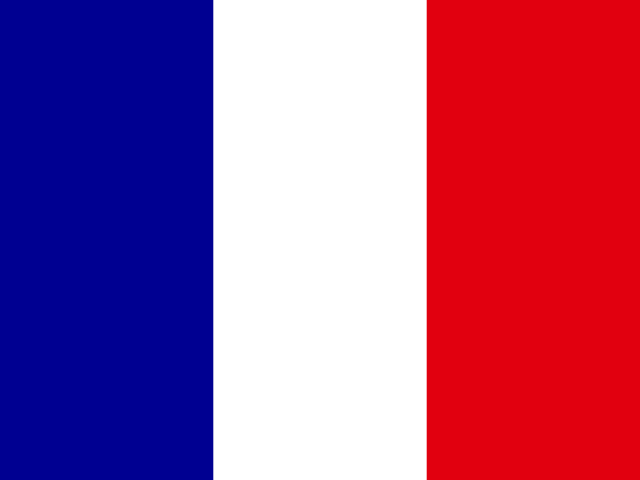 French
 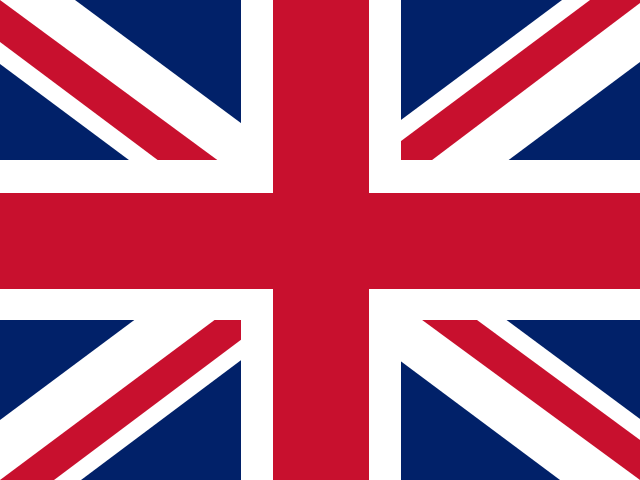 English
 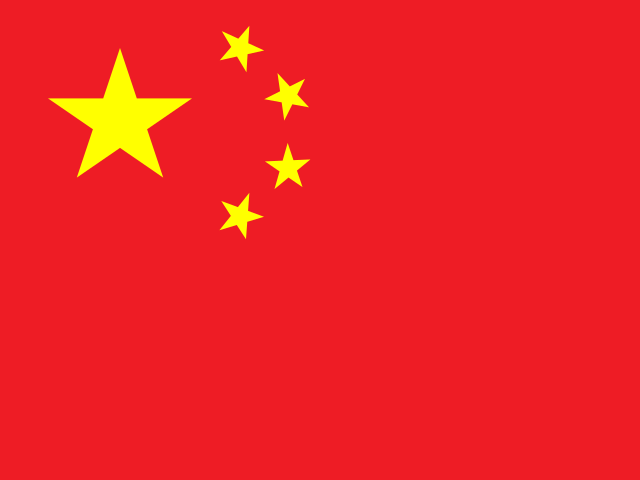 Chinese
 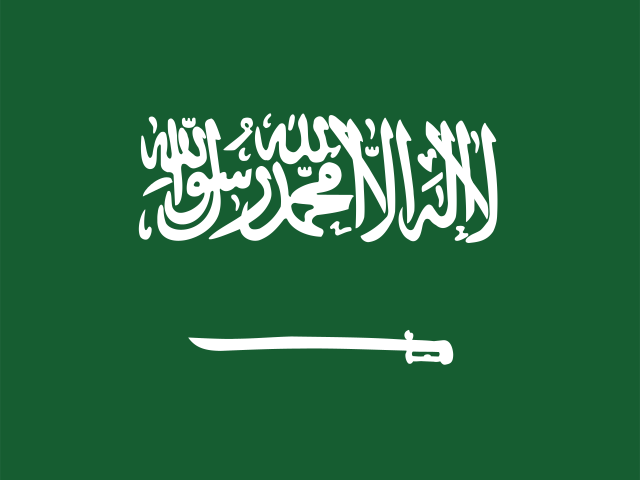 Arabic