
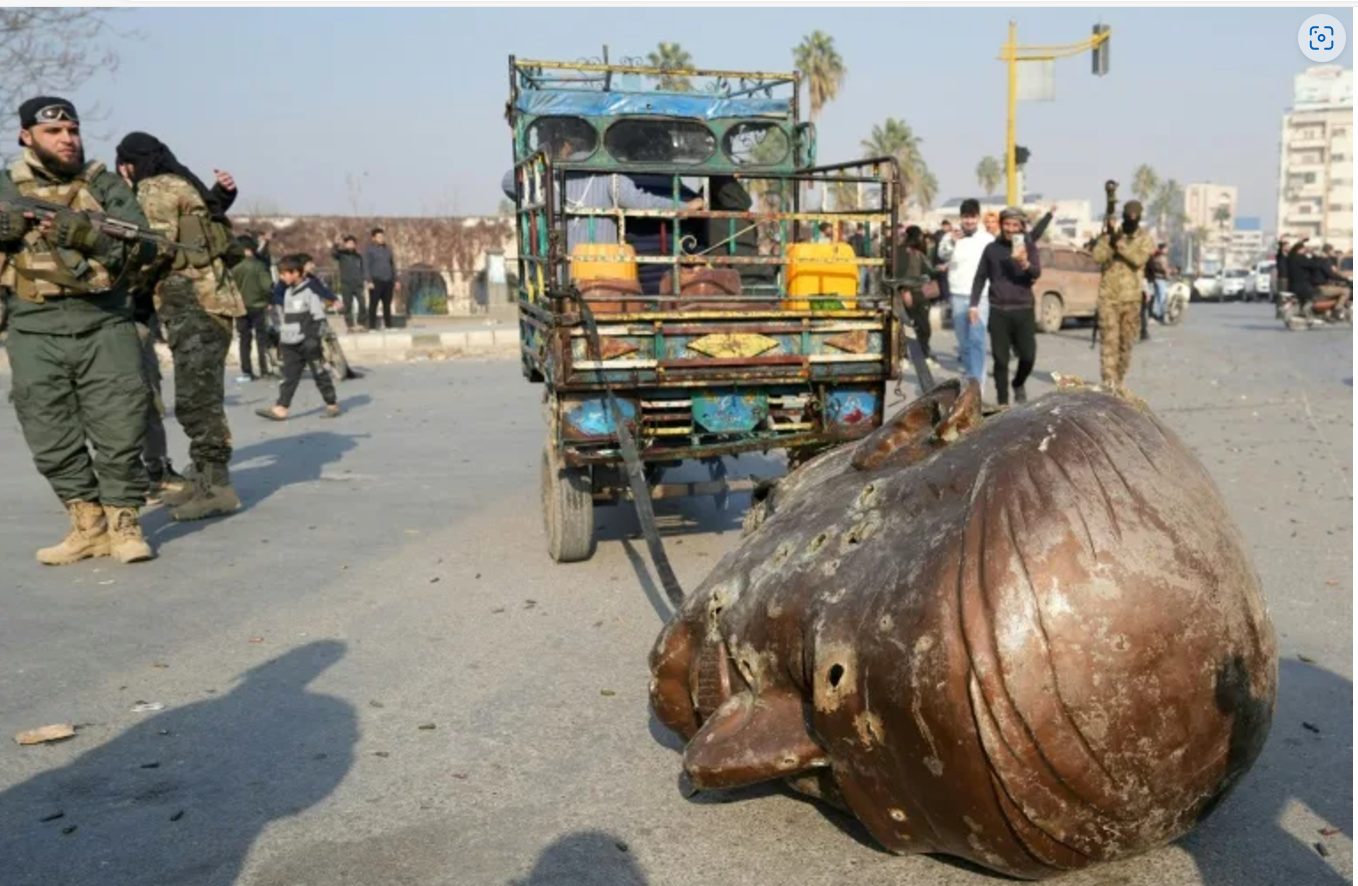
Aside from a few brief reports, mostly poorly documented or content with regurgitating wire service dispatches, the mainstream Western media have eclipsed this objectively dramatic and worrying news: the regime of Bashar al-Assad in Syria has collapsed. In the streets of Damascus, the columns of those modestly referred to by the international community as «the rebels» are marching victoriously while all the effigies of the Assad clan are being pulled down and the fallen dictator's palace is given over to looting, as broadcast overflight footage on TF1's evening news showed this Sunday.
What lessons can be learned from this new upheaval in the Levant? What lessons for the region, but above all with regard to our own policies and positioning in this respect?
The Kremlin, which had deserted the regional front to refocus its forces in Ukraine, did not come to the rescue of its old ally. Bashar al-Assad has fled, very likely taking his wife and children with him. Obviously far from being a great democrat, let alone a humanist, ruling with an iron fist, it is customary to call the figure a ruthless dictator, and that is a fact. As a worthy heir to his father Hafez, whose original family name was not el-Assad («the lion») but al-Hawch («the wild beast»). According to the Roman adage *nomen omen*, the name is a destiny, and the Assad family – the Assad clan, according to journalists – had certainly earned theirs.
Whether one likes it until recently Syria was one of the last more or less stable countries in the region, despite internal squabbles and foreign incursions attempts (Editor's note: notably Turkish at the end of 2019). The very fragile ramparts of this stability collapsed in a week, under the pressure of a Caliph as arrogant as he is aggressive, whose «colourful» victories were widely shared on X and Telegram. Across almost the entire territory, the new masters of Syria are flying the black flag bearing the Shahada with one hand, and with the other pointing their index finger to the sky to thank Allah for granting them victory. These «rebels» against the former regime are effectively Islamists, and for good reason: their main DNA is none other than Hayat Tahrir al-Sham (Editor's note: Organisation for the Liberation of the Levant in Arabic), HTS in mainstream parlance, originally under the infamously known name of Al-Nusra Front, an Al-Qaeda offshoot in Syria.
Let us remember that al-Nusra, which was doing « good job », as Laurent Fabius bellowed.
The leader of this new recipe with an Islamist sauce, then, has just been propelled to «president» of Syria. An Islamist certainly, but a «pragmatic radical», according to AFP, which twists vocabulary left, right and centre. After serving five years in prison in Iraq before founding al-Nusra, preferring al-Qaeda to Daesh. Like all jihadists, Ahmed al-Sharaa had in his time adopted a war name composed, according to tradition, of his eldest son's first name and his region of origin, thus going underground: Abu Mohammed al-Jolani.
It is under this name that he is henceforth head of state, with whom, eventually, we shall have to «talk». Furthermore, Al-Jolani means «originally from the Golan», the Hebrew State having driven his family from the region. Here too, nomen omen: this weekend, and this time with great fanfare in the press, Israel was quick to welcome the fall of Bashar al-Assad, while immediately announcing the rupture of the Golan accords, signed in 1967.. Thus, according to many analysts, Tel Aviv now has a free hand to launch new conquest operations on Syrian territory, while the new Syrian president says he is ready to «fight to the death» for the Golan Heights. So, a new battlefield on the horizon, then.
In the wake of its grand outbursts of Christian faith, France is sniggering. Chief among them and leading the way is its President of the Republic, Emmanuel Macron, hailing the fall of the Syrian dictator on X. Perhaps he imagines that by freeing themselves from the yoke of the Assad clan, things will be better for Syrians under al-Jolani? This is to show a selective, or at the very least very short, memory regarding what became of post-Saddam Iraq, or indeed post-Gaddafi Libya.
Conclusion: across the globe, a decades-old regime can fall in a mere eight days, through the collision of a coalition of fanatics and an exhausted population, a resigned army and opportunistic public authorities.
On the Quai d'Orsay side, they haven't sent Jean-Noël Barrot to Damascus just yet. Let us hope the fall of the Barnier government will spare us from further absurdity.

 French
  English
  Chinese
  Arabic