
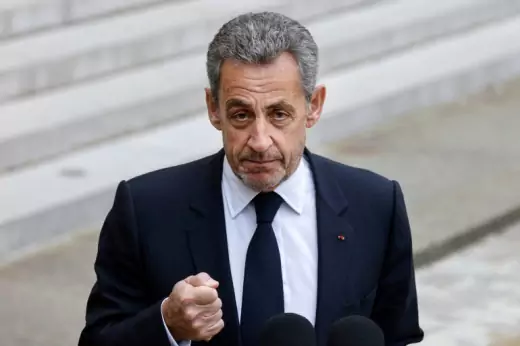
Episode 4 : THE TOTAL FLOP OF ROCK STAR SARKOZY'S COMEBACK
A false start
In the speech following his presidential defeat on 6th May 2012, Nicolas Sarkozy's tone is assuredly presidential, befitting the office he held. Nostalgia is already washing over his supporters. He is stepping down with dignity.
Unfortunately, the following years demonstrated that he had by no means given up on returning to active political life. Like Valéry Giscard d’Estaing, reconquering the Elysée never left his mind. But unlike the latter, he was prepared to force the issue, in the absence of a real window of opportunity.
Nicolas Sarkozy places conditions on it: that the French recall him, show their desire for it; that will not happen. That the French right clamour for his return; that will not happen. That UMP supporters demand his return; nothing there either. In reality, only some of the members and activists want him back.
A return to the dark ages
It is on this extremely fragile basis that Nicolas Sarkozy announced his return to political life, on 19 September 2014. Alain Juppé, for his part, announced his candidacy for the primaries on 20 August. A clash between two giants is therefore looming. Nicolas Sarkozy chooses, as his first step, the reconquest of the party. The fate of the right is sealed. The primary election of the right and centre is shaping up to be a free-for-all.
The battle for the UMP presidency took place in the autumn of 2014. Only party members (268,000, a drop of 50,000 compared to the same election in 2012) took part in the vote. Unsurprisingly, Nicolas Sarkozy was elected in the first round. Nevertheless, his result—slightly below 65%—and Bruno Le Maire’s impressive showing (over 29% of the vote) make it clear from the outset that Nicolas Sarkozy’s comeback was a hard-fought one, a far cry from the landslide victory he had hoped for. Figures from the Sarkozy era are back in the party. Nevertheless, a significant change is worth noting: Frédéric Lefebvre, the former political adviser, has become an opponent, and his replacement, Eric Challe, is at least a division below.
Personally, I cannot stay at the UMP. Having resigned from the civil service, I am resigning myself to asking for a mutual termination agreement without really knowing what the future holds. Indeed, as soon as Alain Juppé is a candidate, it is out of the question for the Chirac supporter that I am to make any other choice. I negotiate my mutual termination agreement with Frédéric Péchenard, the new Director General of the UMP. I know and like him. His predecessor will not leave a lasting impression on the party, to say the least. He will be dismissed in 5 minutes flat by Nicolas Sarkozy.
I shall therefore be taking part in this primary, but as a rival to Nicolas Sarkozy. Without any bitterness, but in the firm belief that it is high time for the French right to return to the Gaullist-Chiracian fundamentals.
Leader of a party in decay
The UMP, a brand associated with numerous victories, became «Les Républicains», an unnecessary name change. «Les Républicains» would suffer a long cycle of electoral defeats that has not yet ended.
But, unsurprisingly, Nicolas Sarkozy has no intention of truly getting involved in the internal life of the party and the construction of a new intellectual matrix. What he used to fancy and what he had applied himself to in 2004-2005 logically no longer motivates him.
However, his position as party leader – a role he held for most of the primaries – is open to question and gives it a certain advantage over its competitors. At least one major advantage: He has full control over the National Nomination Commission, which has been entrusted to one of his very close associates: Christian Estrosi. He thus has a means of pressure over future parliamentary candidates, who are forced to toe the line unless they are well established. Generally speaking, the network of LR elected officials is mobilised in his favour. Alain Juppé's campaign headquarters neglected the party. It was a grave mistake.
An attempt to re-run the 2007 campaign but without the asset of novelty
Nicolas Sarkozy is running his campaign at breakneck speed with the energy he is known for. The objective is to highlight the contrast with Alain Juppé, who is older and more nuanced. The idea is to pit the political animal against an ageing technocrat. Throughout this campaign, he never stopped laying into Alain Juppé, without the latter hitting back enough for my liking. In doing so, he will give François Fillon a leg up who will have come through the primary unscathed, and who will not hesitate to land some hard-hitting blows himself. Thus, on 28 August 2016, the former Prime Minister declared, «Can one imagine for a single moment General de Gaulle being placed under formal investigation?» It is for psychiatrists to analyse what then went on in the mind of the future winner of the primary... Indeed, to top it all off, Nicolas Sarkozy has been caught up in the ’Bygmalion affair«, which was manipulated from the start to bring down Copé.
Unsurprisingly, Nicolas Sarkozy will be being Nicolas Sarkozy throughout the campaign. The campaign themes from 2007 were dusted off and given a more hard-hitting edge in a further, unsuccessful attempt to thwart the rise of the FN. The novelty effect of 2007 no longer applies. Since Nicolas Sarkozy has a track record, some would say baggage, that considerably weakens the force and credibility of his words.
Sarkozy has not managed to erase the image from the start of his five-year term that sticks to him. the man from Fouquet's, the man from Bolloré's yacht... «La France pour la vie», which he published in January 2016, was intended to wipe the slate clean of these mistakes. But it is too late and the Sarkozy persona is firmly anchored in the minds of the French with his qualities… But above all his flaws. The permanent divisiveness. The «double portion of chips» in school canteens when pork is served will be the telltale sign of a populist and failed campaign.
The magic has worn off
The charm and fascination no longer work. As LR manager of the 9th In the constituency for French citizens living abroad (where I am about to stand as a candidate), I have been tasked with organising, at short notice, a rally for Nicolas Sarkozy (even though I am part of Alain Juppé’s campaign team). I am doing this out of respect for the man and because, unlike others, I do not think it is wise to neglect the party in a primary for the right and centre. Les Républicains abroad have been in a state of decline since Senator Frassa was appointed head of the Federation of French Citizens Living Abroad. It is a daunting task, but the hall is full. And I note that in a country that seems won over to him and where he remains in theory very popular, the atmosphere is freezing. A few polite applauses, no enthusiasm…
The three televised debates between the candidates in the primary do not allow him to score points. He does not surprise, nor does he stand out. He maintains a suicidal line right to the end: constantly taking up the themes of the FN while stigmatising it and denigrating the populists.
A quiet exit
It is an understatement to say that Nicolas Sarkozy’s poor result (20.61 per cent in the third round) comes as a shock. Il n’a, finalement, réussi à convaincre que le noyau dur des militants et des adhérents dans un corps électoral où ils sont largement minoritaires. Cela signifie la fin définitive, à son corps défendant, de la vie politique active. Mais pas de toute influence.
Il choisit de voler au secours de la victoire pour ce second tour de la primaire en apportant son soutien à François Fillon dont le score étonnement élevé ne laisse planer aucun doute sur l’issue du scrutin. Le choix peut paraître logique car l’intéressé fut son Premier ministre pendant cinq années. Néanmoins, les contentieux se sont accumulés entre les deux hommes et le camp Fillon n’a pas ménagé Nicolas Sarkozy, contrairement à celui d’Alain Juppé. C’est donc surtout un choix d’opportunité que fait Nicolas Sarkozy. L’horizon judiciaire semble bien chargé, mieux vaut être du côté du futur Président de la République que de celui qui sera le perdant malheureux de la Primaire.

 French
  English
  Chinese
  Arabic