
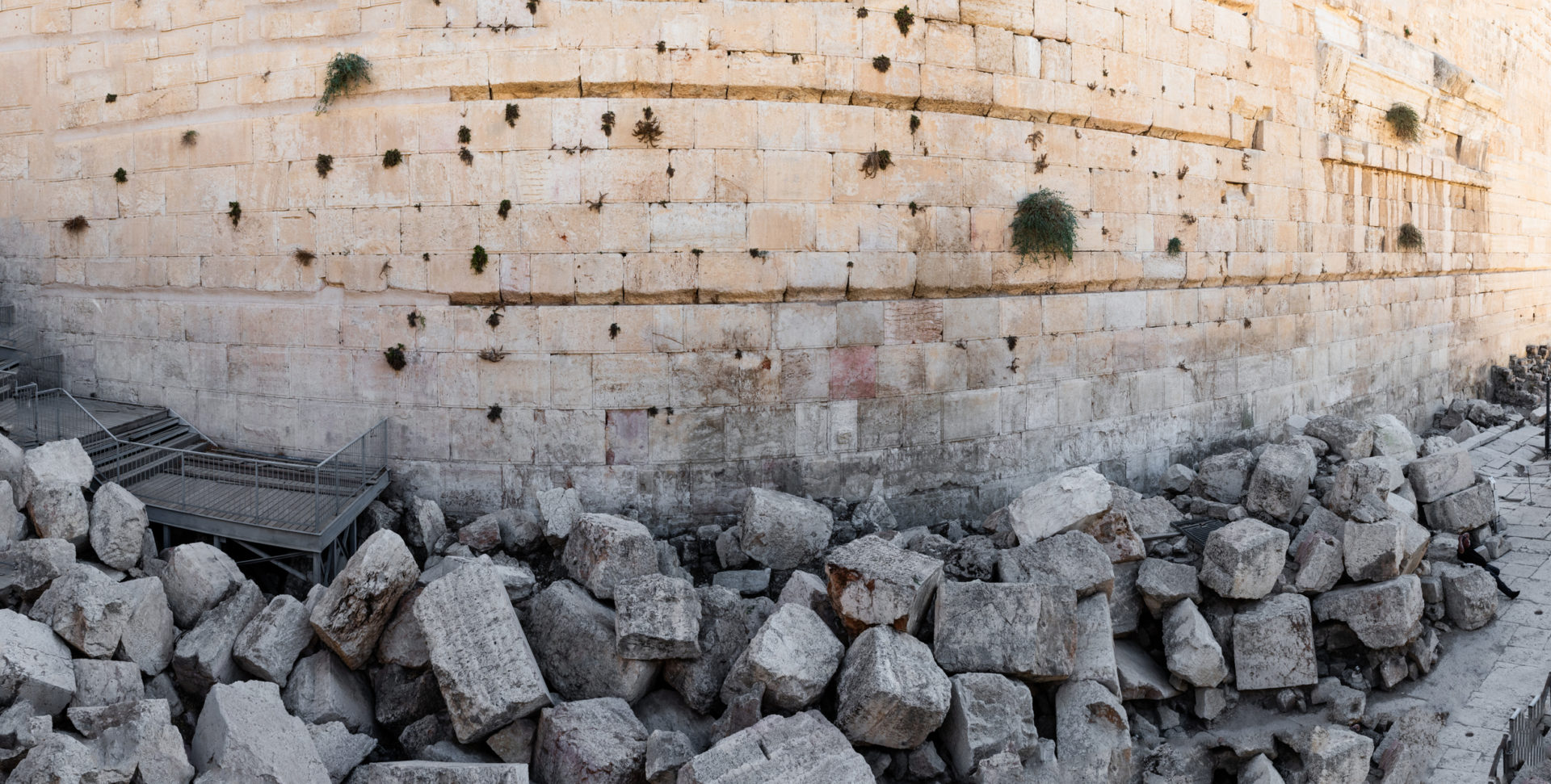
Crises of legitimacy, collective illusions and mutations of Judaism through the centuries
| This article offers a comparative analysis of three rupture events in the history of Judaism and the State of Israel: the destruction of the First Temple of Jerusalem by Nebuchadnezzar II (586 BCE), the destruction of the Second Temple by Titus (CE 70), and the systemic crisis triggered by the Hamas attack on 7 October 2023, referred to here analytically as the crisis of the «third temple». Five documented structural parallels are identified: the institutionalised illusion of security (kontzeptzia), deliberate strategic error, internal divisions as an aggravating factor, the marginalisation of clear-sighted voices, and the presence of a messianic current in power. The article then examines the documented erosion of Israel's international legitimacy and the possible trajectories of mutation in contemporary Judaism — in particular, the growing fracture between Jewish identity and the Israeli state referent. |
1. Introduction: the framework of the analogy
The history of Judaism is punctuated by foundational catastrophes which, paradoxically, did not annihilate the Jewish people but profoundly reconfigured them. The destruction of the First Temple (586 BCE) and the Second Temple (70 CE) constitute the two most studied rupture events in this history. While their comparison is well established in historical and theological literature [1, 2, 3], the idea of a «third temple»—in the metaphorical sense of a third moment of a break in legitimacy—has not, to our knowledge, been the subject of systematic academic analysis.
The present study makes no claim to factual equivalence between the situations. The destruction of the ancient Temples was physical, military and total; the post-2023 Israeli crisis has not resulted in a military defeat. We use the analogical framework in a precise and limited sense: to identify recurring structural mechanisms — patterns of decision-making, risk management, and internal and external dynamics — which, in both preceding cases, preceded and conditioned the collapse.
The question we are asking is not «Is Israel going to be destroyed?» but: «Can we recognise, in the current crisis, the cognitive and political structures that led to previous catastrophes?» And if so, what forms of mutation in contemporary Judaism might this fracture bring about?
2. The first two destructions
2.1 The destruction of the First Temple (586 BC)
Political and strategic context
The Kingdom of Judah has been a vassal of Babylon since the first deportation of 605 BC. King Jehoiachin is deported to Babylon in 597, and his successor Zedekiah remains under direct imperial tutelage. Zedekiah's decision to break the vassal treaty by seeking an alliance with Egypt constitutes the fatal strategic error: Egypt possesses neither the military might nor the political will to resist Babylon [6, 7]. The siege of Jerusalem lasts for eighteen months (589–586); the city falls in Ab 586, the Temple is burned, and the elite deported.
The belief in the invincibility of the Temple
A dominant fraction of the priestly and political elite adheres to what researchers have called the «theology of Zion» [8]: the conviction that YHWH cannot allow His earthly dwelling to be destroyed. This belief is not irrational within its own logical framework — it stems from a theology of the Covenant (berît) — but it constitutes a major cognitive bias: it renders decision-makers impervious to opposing signals.
«The word of the Lord came to me: What does it matter to you if the whole country is in flames? You will be saved.»
— Jeremiah 37:17 — words of the false prophets refuted by Jeremiah
The marginalised prophetic voice
The prophet Jeremiah occupies a position structurally analogous to that of a dissident strategist: he predicts destruction, interprets the Babylonian crisis as deserved divine punishment, and advises submission as the only viable way out. He is imprisoned, accused of defeatism and treason [9]. His lamentations (Eikha) constitute the most accurate document on the collective psychology of a society that refuses to hear what it does not want to hear.
2.2 The destruction of the Second Temple (70 AD)
Political context
Judea has been a Roman province since the conquest by Pompey (63 BC). The Great Revolt of AD 66 occurred against a backdrop of accumulated fiscal tensions, repeated symbolic humiliations and extreme political fragmentation [10, 11]. Vespasian and then his son Titus led the military reconquest; Jerusalem fell after a five-month siege in AD 70.
The internal civil war as an aggravating factor
Flavius Josephus, a direct witness, reports that the rival factions inside Jerusalem — the Zealots of John of Gischala, the followers of Simon bar Giora, and the Sicarii — waged a civil war within the very walls of the besieged city [12]. One of the most catastrophic decisions was the deliberate burning of the grain supplies to force the population to fight. Josephus estimates that this internal war was more deadly than the Roman siege itself.
The messianic current and strategic irrealism
The Zealot and Sicarii movements combined a political project with a messianic eschatology that made any realistic assessment of the balance of power impossible. During the siege, prophets announced imminent divine intervention [13]. The resistance of Masada (73 CE), celebrated in modern Israeli collective memory, illustrates this phenomenon: a militarily hopeless resistance transformed into a symbolic act of high identity value.
3. The five structural parallels
The comparative analysis of the two historical destructions makes it possible to identify five recurring structural patterns. It is these five patterns that we are going to examine in light of the post-2023 Israeli crisis.
Figure 2 — Matrix of structural parallels between the three crises
| 1st Temple (586 BC) | Second Temple (70 AD) | Israel post-2023 | |
| Illusion of structural security | Inviolable temple (false prophets) | Inviolable Temple (Zealots) | The Conception (Manageable Hamas) |
| Documented strategic error | Egypt Alliance (abandoned) | Uncoalition revolt | Hamas funding via Qatar |
| Internal divisions during the crisis | Pro-Babylon vs resistance fighters | 3 factions, internal civil war | Judicial reform, pre-7/10 crisis |
| marginalised lucid voices | Jeremiah (imprisoned) | Josephus (traitor) | Ayalon, Diskin (ignored) |
| Messianic movement in power | Zedekiah's nationalism | Zealots & Sicarii | Ben Gvir, Smotrich |
| Faulty external alliance | Egypt (retired) | Parties (absent) | USA – conditional support |
3.1 The illusion of structural security
In both historical cases, a deeply ingrained belief in the inviolable nature of the Temple renders decision-makers impervious to warning signals. This mechanism — which cognitive psychologists call confirmation bias or normalcy bias — is documented in the literature as one of the most recurrent factors in strategic failures [14, 15].
3.2 The deliberate strategic error
In both cases, the major error was not accidental but resulted from short-term political calculation: Zedekiah relied on Egypt to keep his throne; the leaders of the Great Revolt banked on divine intervention or Roman weariness. Both calculations deliberately ignored the structural constraints of the actual balance of power.
3.3 Internal divisions as an accelerator
In both cases, internal divisions — pro-Babylon parties versus nationalists in 586, rival factions in 70 — did not merely weaken the resistance. They profoundly absorbed the cognitive, military, and logistical resources that would have been necessary for a coherent response to the external threat.
3.4 The marginalisation of lucid voices
Jeremiah in 586, Josephus in 70: in both cases, the figure who speaks the unbearable truth is rejected as a traitor. This pattern is remarkable in its regularity: societies under existential pressure tend to ostracise those who challenge the dominant narrative rather than listen to them.
3.5 The messianic current in power
In both cases, an eschatological vision — the conviction that God or History will intervene on behalf of the chosen people — contaminates political decision-making. This current does not necessarily produce the irrational; it produces an alternative rationality in which ordinary empirical constraints are suspended in the name of a transcendent framework.
4. Israel post-7 October 2023: the «Third Temple»
4.1 The 7th of October 2023 as a rupture in the founding narrative
The State of Israel has built its narrative of legitimacy on two fundamental pillars since 1948: firstly, the definitive response to historical Jewish vulnerability (never again Auschwitz); secondly, the strategic and moral superiority of a technologically advanced army. 7 October 2023 shattered both pillars simultaneously.
The Hamas attack, which killed approximately 1,200 people and took 250 hostages, is the deadliest against Jews since the Holocaust. It demonstrated that the existence of an armed nation state does not guarantee Jewish security—refuting the most profound foundation of the Zionist narrative. It simultaneously revealed a massive failure in intelligence, strategic doctrine and alert protocols [16, 17].
4.2 La Kontzeptzia: the illusion of institutionalised security
The «Konzeptzia» — a Hebrew term denoting the dominant strategic doctrine — rested on four assumptions, all of which were disproved by 7 October [18]:
- Hamas is rationally deterrable by military threat and economic benefits.
- Hamas is structurally invested in maintaining the status quo in Gaza.
- The technological barrier constitutes sufficient protection.
- Field alerts could be ignored if they contradicted the Kontzeptzia.
This final point is of crucial analytical importance: the warnings were not lacking, they were institutionally rejected. This is the exact mechanism that Jérémie describes: not the absence of information, but its deliberate refusal.
4.3 The documented strategic error: funding Hamas
It is factually established, and documented in public statements by Prime Minister Netanyahu before the Knesset (2019) [19], that the Israeli government tolerated and facilitated the transfer of hundreds of millions of Qatari dollars to Hamas, with the explicit strategic objective of preventing the emergence of a unified Palestinian leadership that would have made the issue of a Palestinian state inevitable.
«Whoever wants to prevent the creation of a Palestinian state must support the strengthening of Hamas. That is what we have done.»
— Benjamin Netanyahu, Likud meeting, 2019 (cited in Haaretz, 8 October 2023) [19]
The logic of divide and rule — weakening the Palestinian Authority by strengthening Hamas — constitutes a strategic error of a magnitude comparable to Zedekiah’s alliance with Egypt: a cynical short-term calculation that creates the conditions for catastrophe.
4.4 Judicial reform: civil war before the war
In the months leading up to 7 October 2023, Israel was going through the most serious constitutional crisis in its history. The judicial reform aimed to subordinate the Supreme Court to Parliament, removing the government's primary check and balance. Weekly protests drew up to 200,000 people [20]. Thousands of elite reservists — pilots, cyber soldiers, commandos — had publicly announced their refusal to serve if the reform was adopted. The Shin Bet and the Mossad had warned the Prime Minister that this crisis was weakening social cohesion at the exact moment when the external threat was reaching its peak.
The parallel with the internal civil war in 70 AD is analytically robust: in both cases, the cognitive and institutional resources of the state are absorbed by an internal conflict at the precise moment when the external threat is most severe.
4.5 The Messianic current in power
For the first time in the history of the State of Israel, parties from the radical religious Zionist current (Dati Leumi) are exercising direct governmental power. Itamar Ben Gvir and Bezalel Smotrich adhere to an eschatological vision in which the State of Israel is reshit tzmichat geulateinu — «the beginning of our redemption» — and in which the annexation of the West Bank and the construction of the literal Third Temple constitute legitimate political objectives [21]. The messianic dimension of decision-making is therefore not an external analytical metaphor: it is claimed by the actors themselves.
4.6 The marginalised lucid voices
There is no shortage of contemporary equivalents to Jeremiah and Josephus. Ami Ayalon (former head of the Shin Bet), Yuval Diskin (ditto), Moshe Ya’alon (former Chief of General Staff), and Ehud Barak (former Prime Minister) warned that the policy of funding Hamas was a ticking time bomb, that the absence of a Palestinian political horizon was fueling radicalisation, and that the judicial reform was destroying the checks and balances necessary for coherent strategic decision-making [22]. Like Jeremiah, they were branded as defeatists by the incumbent government.
5. The erosion of international legitimacy
5.1 Empirical data
The parallel between the post-2023 legitimacy crisis and the symbolic destruction of a «third temple» rests on empirically documented data: the rapid and unprecedented erosion of international support for Israel in Western democracies.
Figure 3 — Erosion of international support for Israel (2000–2024). Sources: Gallup [4], YouGov [23], Ifop [24].
Several indicators converge. Annual Gallup polls show that American sympathy for Israel, after peaking at 64 % in 2018–2019, fell to 46 % in early 2024 — its lowest level since the creation of the State [4]. Support among American Democrats under 40 is now predominantly pro-Palestinian. Several historic allies — Norway, Ireland, Spain, Australia — formally recognised the Palestinian State in 2024. The International Criminal Court has issued arrest warrants for Israeli leaders [25].
5.2 The nature of destruction: narrative, not physical
The fundamental difference from the two previous destructions is decisive here: it is not a question of physical destruction or military defeat. Israel remains a functional state with one of the most powerful armies in the region and an undeclared nuclear arsenal. What is being destroyed is the narrative of legitimacy: the narrative according to which the State of Israel constitutes a morally and politically justified response to historical Jewish vulnerability.
This distinction is analytically crucial. It means that the parallel with ancient temples is not prophetic but structural: it does not predict the destruction of Israel, it identifies the conditions under which previous destructions occurred, and notes their presence in the current configuration. Political agency remains intact.
6. The rifts within contemporary Judaism
While both previous destructions produced profound mutations in Judaism, the current crisis is playing out on a different terrain: that of internal fractures within a deeply heterogeneous global Jewish community.
Figure 4 — Dual fracture: within Israeli society and Diaspora Jewish communities. Sources: IDI 2024 [26], Pew 2024 [27], AJC 2024 [28], JPR 2024 [29].
6.1 The internal fracture within Israel
Israeli society is today fractured along lines that intersect religious (secular/haredi/dati leumi), political (right/left) and ethnic divisions. Surveys by the Israeli Democracy Index [26] show considerable gaps between segments of the population regarding the government's responsibility for 7 October, the advisability of a ceasefire and trust in Netanyahu. The judicial reform crisis structured a divide between those who see the judiciary as a bulwark against authoritarian drift, and those who see it as a vestige of an elite imposing its values. This fracture preceded 7 October and has survived it.
6.2 The diasporic fracture
The Jewish diaspora - around 8 million people outside of Israel - is experiencing growing tensions. Organisations such as IfNotNow, Jewish Voice for Peace, and factions of J Street represent a current that refuses to equate support for Israel with support for its current government policies. This current is growing significantly among American Jews under the age of 40. Surveys by the American Jewish Committee [28] show that less than 40 % of American Jews support Israeli military policy in Gaza - a statistic that would have been unthinkable ten years ago.
6.3 The identity/state dissociation: an unprecedented mutation
What makes the current crisis different from the previous two is the potential emergence of a new identity configuration: a Jewishness that defines itself outside, or even in opposition to, the Israeli state reference point. During previous destructions, it was the Temple—an institution—that disappeared, and the people reorganised themselves around other supports (Torah, prayer, community). Here, it is the State itself that is becoming, for a growing fraction of Diaspora Jews, a problematic point of reference.
This dissociation — being Jewish without that implying support for the State of Israel — would constitute an unprecedented identity shift in the history of post-1948 Judaism. It is reminiscent of ancient Judaism's break with the Temple as a central point of reference, but it is occurring not as a result of an external military defeat, but as a result of an internal conflict of values.
7. Mutation trajectories
Based on the previous analysis, five non-exclusive mutation trajectories can be distinguished, which can combine or oppose one another.
Figure 5 — Tree of possible mutations: historical models and contemporary trajectories.
7.1 Radicalised religious Zionism: towards the literal third temple
The first trajectory is that of messianic escalation: a radicalisation of the Ben Gvir–Smotrich current pushing towards the formal annexation of the West Bank, or even towards attempts to modify the status quo of the Esplanade of the Mosques. This trajectory is politically represented in the government, has an electoral base of around 20 % of the Israeli electorate [26], and is supported by American evangelical networks. It leads to regional escalation and accelerated international isolation.
7.2 Post-Zionist Judaism: identity without a state
The second trajectory is that of a diasporic Judaism which is redefining itself by dissociating Jewish identity from the Israeli state referent. This current recalls what the philosopher Simon Rawidowicz called «the ever-dying people»: an identity that survives through ruptures by reinventing itself. It finds intellectual expression in thinkers such as Judith Butler or Omri Boehm [30], who propose a deterritorialised Jewish universalism.
7.3 The Yavneh moment: internal reform of the state
The third trajectory is that of the reformist bifurcation: an Israeli political coalition that learns the lessons of the catastrophe, carries out a constitutional overhaul, and engages in a serious diplomatic process towards a two-state solution. This trajectory corresponds to the «Yavneh moment»: after the fall of the Second Temple in 70 CE, Rabbi Yohanan ben Zakkai refounded Judaism in Yavneh on entirely new foundations, without a Temple, without sacrifices. Refoundation after catastrophe is possible — on condition of a break with the current coalition.
7.4 The decline in legitimacy: lasting diplomatic isolation
The fourth trajectory is that of a progressive but cumulative decline in Israel's international legitimacy, without a military catastrophe: erosion of diplomatic support, progressive economic sanctions, marginalisation in multilateral institutions. This trajectory does not destroy the state, but profoundly alters its positioning within the international system.
7.5 The fragmentation of global Judaism
The fifth trajectory is transversal: a growing fragmentation of world Judaism into increasingly distant streams—orthodoxy/haredi, American liberal Judaism, radical religious Zionism—to the point where the term «Judaism» would denote identity realities so diverse that it would lose its coherence as a unit of analysis. This fragmentation is already underway and documented in several comparative studies [31].
8. Discussion: limitations of the parallel
8.1 The three major differences
Any historical analogy must be evaluated in the light of its limitations. In this case, three major differences deserve to be highlighted.
Power asymmetry. Judah in 586 and Judaea in 70 were entities politically and militarily subordinate to empires whose power was beyond comparison. Israel in 2024 is one of the most significant military powers in the region, enjoys strategic American support and, according to most estimates, possesses a nuclear arsenal. Political agency is of an entirely different nature.
The absence of military defeat. Both previous destructions involved total military defeat, deportation or forced dispersion. The current situation — as grave as it is — does not approach this threshold.
The complexity of the actors. Comparison inevitably simplifies configurations of a much greater complexity. The internal dynamics of Palestinian society, the role of Iran, American policy, Sino-American geopolitical competition — none of these elements has an equivalent in the configurations of 586 or 70.
8.2 Analytical robustness
Despite these limitations, the five structural parallels identified withstand critical examination. They do not concern comparable events but rather mechanisms: patterns of information processing, risk management, and identity dynamics under pressure. These mechanisms are documented in the literature on strategic failures [14, 15, 32] and are not specific to Jewish history — which, paradoxically, reinforces their analytical scope.
9. Conclusion
The thesis of this article can be formulated in three distinct propositions.
Firstly, the five structural parallels between the post-7 October 2023 Israeli crisis and the two destructions of the ancient Temple are analytically robust and empirically documented. The illusion of institutionalised security (kontzeptzia), the strategic error of funding Hamas, pre-existing internal divisions, the marginalisation of clear-sighted voices, and the messianic current in power constitute a pattern of strategic behaviour which, in both previous cases, preceded and conditioned the catastrophe.
Secondly, the parallel has a limited and precise scope: it does not predict the destruction of Israel but identifies structural conditions of vulnerability. Political agency remains intact. The bifurcation between the identified mutation trajectories — messianic escalation, internal reform, gradual decline, diasporic fragmentation — is not determined.
Thirdly, the most original dimension of the current crisis is the endogenous nature of the ongoing transformation: it is not an external conqueror that is destroying the Temple, but a fracture of values within global Judaism, a growing dissociation between Jewish identity and the Israeli state reference. If historical comparison teaches anything, it is that transformations born of catastrophes have, in both previous cases, produced more resilient forms of civilisation. What the next transformation will be — if transformation there is — depends on the political and intellectual choices that are made in the coming years.
References
[1] Bright, J. (1981). A History of Israel (3rd edn). Westminster Press.
[2] Schäfer, P. (2003). The History of the Jews in the Greco-Roman World. Routledge.
[3] Goodman, M. (2007). Rome and Jerusalem: The Clash of Ancient Civilizations. Allen Lane.
[4] Gallup (2024). Americans’ Sympathies for Israel in Middle East Situation. Gallup Annual Survey.
[5] ICM Research / YouGov UK (2024). Attitudes towards the Israel-Gaza conflict.
[6] Malamat, A. (1968). The Last Kings of Judah and the Fall of Jerusalem. Israel Exploration Journal, 18(3).
[7] Lipschits, O. (2005). The Fall and Rise of Jerusalem. Eisenbrauns.
[8] Roberts, J.J.M. (2002). The Davidic Origin of the Zion Tradition. Journal of Biblical Literature, 91(3).
[9] Holladay, W. (1986). Jeremiah 1–2: A Commentary. Fortress Press.
[10] Hengel, M. (1989). The Zealots. T&T Clark.
[11] Horsley, R.A. (1987). Jesus and the Spiral of Violence. Harper & Row.
[12] Josephus, F. The Jewish War. Books IV–VI.
[13] Gray, R. (1993). Prophetic Figures in Late Second Temple Jewish Palestine. Oxford University Press.
[14] Janis, I.L. (1982). Groupthink. Houghton Mifflin.
[15] Kahneman, D. (2011). Thinking, Fast and Slow. Farrar, Straus and Giroux.
[16] State Comptroller of Israel (2024). Preliminary Report on the Events of October 7, 2023.
[17] Haaretz Editorial Board (2024, 7 October). One Year On: What Failed and Who Is Responsible.
[18] Bergman, R. & Mazzetti, M. (2024). The Unpublished Hamas Blueprint for October 7. The New York Times.
[19] Ravid, B. (2023, 8 October). Netanyahu’s Hamas Policy. Haaretz.
[20] Israeli Democracy Index (2024). Israel Democracy Institute. https://en.idi.org.il/
[21] Feige, M. (2009). Settling in the Hearts: Jewish Fundamentalism in the Occupied Territories. Wayne State UP.
[22] Barak, E. (2023, 4 March). Netanyahu Is Leading Israel Toward Apartheid. Time Magazine.
[23] YouGov (2024). International opinion on the Israel-Gaza war. Monthly tracker 2024.
[24] Ifop / Fondation Jean Jaurès (2024). The French and the Israeli-Palestinian conflict. March 2024.
[25] International Criminal Court (2024). Situation in the State of Palestine. Press release, 20 May 2024.
[26] Atmor, N. & Krayot, H. (2024). Israeli Democracy Index 2024. Israel Democracy Institute.
[27] Pew Research Center (2024). Israeli Public Opinion on the War in Gaza. October 2024.
[28] American Jewish Committee (2024). American Jewish Attitudes Toward Israel and the War in Gaza. AJC Survey 2024.
[29] JPR (2024). British Jewish Attitudes Towards Israel and the Gaza Conflict. JPR Policy Paper.
[30] Boehm, O. (2021). Haifa Republic: A Democratic Future for Israel. New York Review Books.
[31] Cohen, S. & Kelman, A.Y. (2010). Beyond Distancing. Andrea and Charles Bronfman Philanthropies.
[32] Betts, R.K. (2007). Enemies of Intelligence. Columbia University Press.
© Michael J.P. LAURENT — geopolitics.fr — March 2025
Reproduction authorised subject to acknowledgement of the source.

 French
  English
  Chinese
  Arabic