
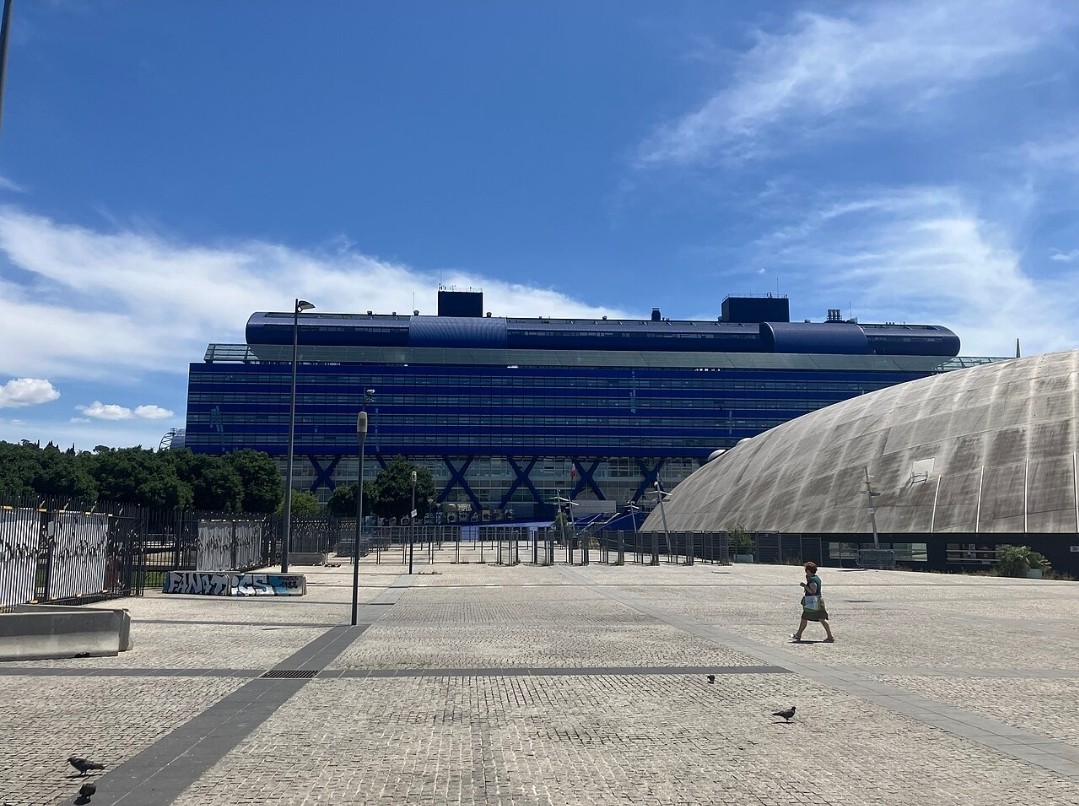
It was before a very sparse Assembly that Martine Vassal had the budget for the Bouches-du-Rhône Department adopted this Tuesday, 14th April.
Indeed, several mayors were conspicuous by their absence, contenting themselves with delegations of power. A few «figures» from the CD13 right wing cried off, such as Laure-Agnès Caradec (who was Martine Vassal's campaign manager for the municipal elections) as well as Sabine Bernasconi, Thierry Santelli, Sylvain di Giovanni and Professor Frédéric Collart.
A brief look back at 2025, which marked the 10th anniversary of the Vassal Presidency of the Department.
The government welcomed an increase in revenue The most significant increase comes from transfer duty products + 25%, following the buoyancy of the property market. These transfer duties, commonly known as solicitor's fees, vary according to the state of the property market. The institution therefore has no control over its independent revenues which are separate from its public policies.
Regarding charges, the Department has cut back on the solidarity budget, which is the very heart of its responsibilities. This latter budget saw growth of +0.8% compared to 1.6% the previous year, which is lower than inflation.
The 2026 budget: the desire to set things right following the highly critical report by the Regional Chamber of Accounts and very (too) optimistic assumptions
In its report dated 15 December 2025, the Regional Audit Office revealed particularly serious dysfunctions:
«The debt trajectory, which has doubled since 2018, is primarily attributable to the very significant level reached by capital grants paid to municipalities, representing nearly 900 million euros (€m) of expenditure between 2018 and 2023.
The change observed over the period is attributable to the high level of its investments, which are heavily focused on equipment grants paid to third parties; an above-average amount of these accounts for 55 % of the debt it carries, representing more than one billion euros.
The report highlights that equipment grants are not the priority of the departmental institution and that it was only by virtue of a very broad interpretation of its remit that it was able to heavily subsidise certain municipalities, without taking account of their wealth, and with no concern for equalisation. In reality, this amounted to distribution rather than redistribution.
https://www.ccomptes.fr/fr/publications/departement-des-bouches-du-rhone-2
The sudden fall in aid to local councils, for what reasons?
This repetitive policy, sustained over a long period, cannot be the result of chance. Everyone knows that Martine Vassal was seeking to anticipate her defeat in the municipal elections by positioning herself for the Senate elections of September 2026. However, mayors, deputy mayors, municipal councillors... are precisely the «grand electors» for the senatorial election.
While the defeat certainly took place, its cataclysmic scale came as a surprise and dashed any hope the President of CD13 had of heading a list, regardless of its political colour, whether Renaissance or LR. The surprise entry of Renaud Muselier and the tenacity of Valérie Boyer (outgoing senator) only further thwarted the hope of vassalisation.
Therefore, it is no longer politically necessary to shower local authorities with subsidies. Furthermore, the sharp cut in this significant budget is a signal sent to the Regional Chamber of Accounts and above all to the Court of Audit in order to prevent a possible judicial outcome [1]. A cut of €36m in aid to local authorities is therefore being made.
A debt repayment capacity that is improving but remains very low
The Department's debt repayment capacity was 19 years in 2024, and has been brought down to 12 years in 2025. As a reminder, this debt repayment capacity was 9.2 years in 2023. This is one of the lowest debt repayment capacities, if not the lowest, of all French departments.
This summer, the credit rating agency FITCH downgraded the Department from AA to A+. The Department of Seine-Saint-Denis, which experiences greater social difficulties than the Bouches-du-Rhône, maintained its A+. CD93 had a debt payback capacity of 12 years in 2024, whereas CD13 was at 19 years.
Increase in operating expenditure and very (too) optimistic assumptions for 2026
Operating expenditure is forecast to rise by 3.6% in 2026, which is significantly higher than inflation, which is expected to reach 1.9%.
Furthermore, the assumptions regarding a 6.4% increase in indirect taxation appear to be very optimistic. This is particularly true of the assumption of a 9.8% increase in transfer duties.Finally, the Department is counting on additional revenue of 22 million euros, which would stem from the institution’s potential eligibility for the «rescue fund for departments in difficulty». What a sad admission it would be if this were to come to pass![2]
It is safe to assume that many budget adjustments will take place during the year...
[1] Marc Jolibois, head of private office at the Department (and Martine Vassal's partner in private life) was interviewed on 10 July 2025 by a financial magistrate from the Court of Auditors – Revelation by Marc Endeweld in Le Nouvel Observateur dated 29 January 2026
[2] The government is increasing the rescue fund for financially struggling départements from 300 to 600 million euros in the 2026 budget.

 French
  English
  Chinese
  Arabic