
Erwan Davoux is a specialist in international relations. A graduate of the IEP in Paris and the INALCO, he was a former chargé de mission at the Presidency of the Republic (Francophonie, Arab World), and has advised several right-wing political figures internationally.
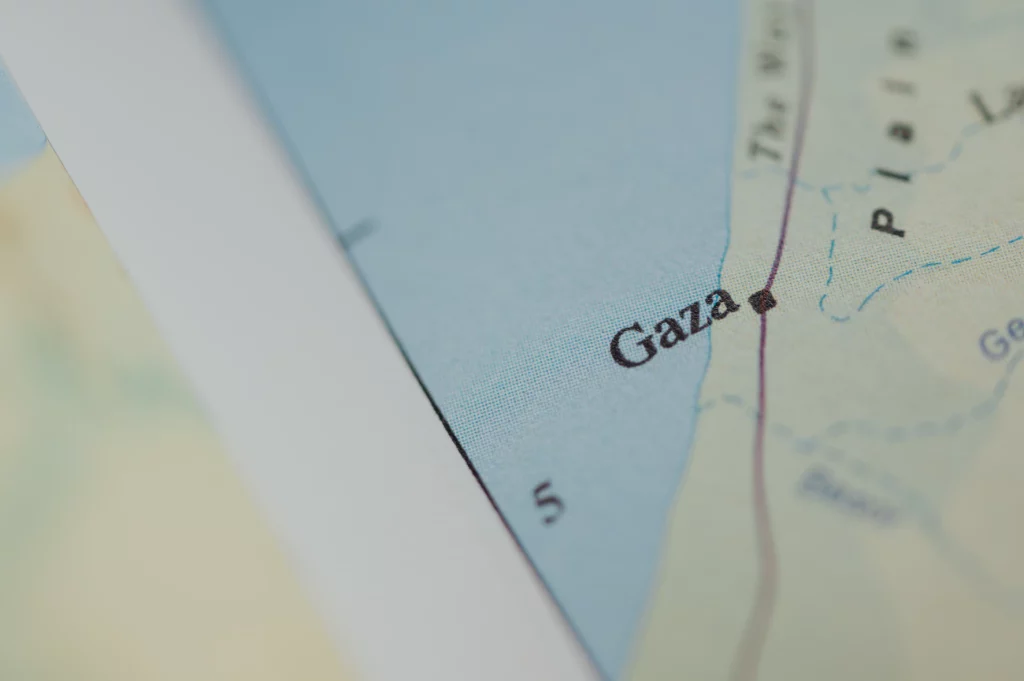
The time has come not to talk about decline but rather about «declassification»[1] even the disappearance of France in the major affairs of the world. The attack launched by Hamas against Israel illustrated, once again, France’s relegation in the Middle East. Our country plays no tangible role in resolving the crisis because it has not been involved in this issue for several years. Its only policy has been to uphold a de facto situation, the right of the strongest.
Compassionate statements, constant changes in strategy that, quite logically, prompted an unusual and justified reaction from most of our ambassadors stationed in the region, the approval given to small diplomatic initiatives taken by others: in short, the role of a middle-ranking European power that no longer has any hold on world affairs. Emmanuel Macron arrived late in the Middle East. Benjamin Netanyahu announced the arrival of the French President and the Dutch Prime Minister in a single tweet. The French president made a big mistake by mentioning an anti-Hamas coalition modeled on the anti-Daesh coalition. His proposal for a second tour following the Dubai COP was a resounding failure: no one saw any interest in it. He returned to Jordan on December 22. The President made it a point to point out that this time King Abdallah II was coming to receive him at the airport. But what else?
Staying with humanitarian aid cannot replace a policy of influence and pressure. On the contrary, humanitarian aid alone only serves to support the strongest in their ruthless policies while deceiving themselves.
Under Jacques Chirac, France's role was essential in resolving the crises in the Middle East
- During the «Raisins of Anger» operation carried out by Israel in Lebanon (April 1996), the French President had decided to send his forces immediately. Minister of Foreign Affairs on the ground with the mission «to obtain an end to the fighting and to seek arrangements that guarantee the security of the populations on both sides of the Lebanese border». Despite US opposition, France will play a major role in bringing the crisis to an end and will be associated with the monitoring of the «ceasefire”.
- During the Israeli-Lebanese conflict in the summer of 2006, it was again with the help of France that Resolution 1701 was adopted. United Nations Security Council (11 August 2006) which will put a temporary end to the conflict.
- In 2002-2003, France’s diplomatic action, supported by a large majority of the international community (and notably Germany), managed to outlaw the war desired by the United States in Iraq and Jacques Chirac’s prescient vision of the global destabilization of the region that would inevitably follow: an Iranian power expanding without counterweight, an escalation of violence between Sunnis and Shiites…
In the Maghreb, the impatient wait for the post-Macron era
Let us remember that Jacques Chirac was loved and respected in each of the three countries. Morocco, Algeria, and Tunisia (with the first Nicolas Sarkozy managed to maintain an excellent partnership) are impatiently waiting for the Macron era to be over. Emmanuel Macron is achieving the special feat of being confused with all three countries simultaneously, even though he had made a trip to Morocco three weeks after taking office and made establishing a strong and peaceful relationship with Algeria a priority. Today, Morocco, Algeria, and Tunisia are impatiently waiting for the Macron era to be over. The few signs of thawing must be interpreted for what they are: protocol-related for Morocco, which has chosen other diplomatic options, a slow-paced competition with Algeria that will yield nothing tangible before the end of the five-year term. The state visit of President Tebboune to France is becoming a farce and keeps being postponed. A certain amateurism in the preparation for the trip is noticeable.
France has made significant progress in Lebanon
President Macron’s gestures after the dramatic explosion that occurred in the port of Beirut on August 4, 2020 were of no effect. The French President, who thought of himself as the great liberator who would be at the forefront of a new political pact in that country, in reality achieved no tangible result and demonstrated his ignorance of the customs and traditions of this country, which is so close to France. The country, a privileged victim of the security chaos that surrounds it, continues to sink deeper into crisis. Jacques Chirac’s France was a reliable alliance to ensure the stability and sovereignty of Lebanon.
How did we get to this particularly rapid and marked diplomatic defeat in the Arab world or France’s voice is no longer heard and, what’s worse, expected?
François Hollande and Emmanuel Macron have killed France’s Arab policy, the fact is. Associating François Hollande and Emmanuel Macron may seem strange given that the men are so different. Emmanuel Macron is a brilliant mind, poorly advised, and with few strong convictions. François Hollande is an ideologue who has led a partisan foreign policy.
Nevertheless, in this area, Emmanuel Macron was only a continuation of François Hollande’s disastrous failure.
What factors specific to the two men came into play?
Inexperience does not forgive in foreign policy
We cite, first of all, the total lack of experience that is theirs in the international sphere when they come to power. However, foreign policy is not invented on the fly. It is not enough to swallow notes, publish agreed communiqués, and attend international summits to have an impact on world affairs. It requires a long apprenticeship that is acquired through travel abroad (François Hollande had, for example, never been to China before assuming power), which allows one to develop networks, to become intimately familiar with one’s counterparts, to absorb a sensitivity, to tame foreign cultures, and thus to be able, through a bold, forward-thinking foreign policy that inspires sympathy, to enable France to solve the square of the circle: How can a medium-sized country with a population on a global scale weigh on world affairs? The answer lies in adopting a grand foreign policy. It is the famous phrase of General de Gaulle: «It is because we are no longer a great power that we need great politics; because if we do not have great politics, just as we are no longer a great power, we will be nothing.«
Inexperience, Atlanticism and military bias
Other factors also played a role in the continuity between the two men: it is the same diplomats who are generally in charge., Marked by their partisan attachment to the PS, more specifically to its Atlanticist faction and always imbued with the ideology of neo-conservatism, close to Jean-Yves Le Drian (and for some to Laurent Fabius) and belonging to the «Leopold Sedar Senghor» promotion of the National School of Administration, that of the President. A promotion that is synonymous with a career accelerator, sometimes for the better, often for the worse. Experience is a considerable asset in the diplomatic sphere; Emmanuel Macron often tends to forget it. These diplomats have in common their military bias, the conviction that the resolution of crises is necessarily and primarily military. Politics is only second-rate. Their alliance with the United States is in reality a betrayal that manifested itself in a striking way when Hollande and Le Drian showed themselves ready to strike Syria in August 2013, because the famous «red line», the use of chemical weapons by the Syrian regime, had been crossed. Before Barack Obama told them that their position was of little importance.
Partisan diplomacy
François Hollande's other flaw was that he viewed foreign policy only through prejudices, in the light of the socialist international. He was an influential member of this party. This partisan bias led him to make several mistakes:
- The marked support in Tunisia for the Troika (2011-2014), which was crushed by the Islamists, because its friend Mustapha Ben Jaffar, a member of the Socialist International, was part of it.
- An ideological imbalance in the Maghreb involving the display of a claimed Algerian priority. But that would not have withstood the dubious jokes that are the trademark of François Hollande. On the matter of Manuel Valls’s trip to Algeria, he declared at the CRIF dinner in December 2013: «Manuel Valls returned safely; that’s already a lot.» A few laughs, a moment of self-satisfaction, but a diplomatic credibility ruined.
- In the Middle East, François Hollande simply ended the traditionally strong French influence in this region. His totally unbalanced position on July 9, 2014, in the context of the Israeli-Palestinian conflict, will be remembered despite the many retractions he will try to make. Indeed, during Israel’s response to the Hamas rocket fire, which was deemed «disproportionate,» he had no words for the very many Palestinian civilian casualties (1,500) and contented himself with showing strong support for the Jewish state. Again, the pro-Israeli bias inherited from the old alliance between the PS and the Labour Party played a role. Obviously, François Hollande did not realize that the Labour Party had disappeared and that this concession was made to a man as uncommendable as Benjamin Netanyahu. French policy based on respect for international law was abandoned.
The «at the same time,» catastrophic in foreign policy
Emmanuel Macron will not have been able to set out objectives and prioritize them in foreign policy. He will continue to display positions that he will very quickly contradict, according to his fluctuating intuition or that of his last visitor. From the «blank check» given to Netanyahu to «avenge» the 7th of October 2003 to the exhortation made to Israel, on the BBC a few days later, to «stop» the bombings because «de facto today civilians are being bombed. These babies, these women, these elderly people are being bombed and killed,» there is «no justification.» From the celebration of the «Hanouka» festival at the Elysée Palace, necessarily interpreted as support for Israel in this particular period, to the favorable vote on the Security Council Resolution calling for an immediate «ceasefire» in Gaza, it has been less than 48 hours. A guiding thread is being sought in vain. One act does not cancel out another. It simply ruins credibility.
Unless one is a Machiavelli and handles it with infinite precision, which is far from the case, «at the same time» proves calamitous in foreign policy.
The result is this: in a few years, France’s influence in the Arab world has collapsed. And at the same time, France is not a privileged partner for and by Israel. The collapse is complete and the prospect of a revival is far away; it is easier to break a bond of trust and ruin an influence than to restore it. Since France is no longer a great power, it is not in terms of power relations that it will regain control over the region; it is by restoring trust, by being faithful to its history and values, that it will regain control over the region. When one is a member of the Security Council, upholding international law and humanitarian law must be a guiding principle and not a variable to be adjusted.
[1] «The French relegation» is the title of the excellent book by Christian Chesnot and Georges Malbrunot.

 French
  English
  Chinese
  Arabic