
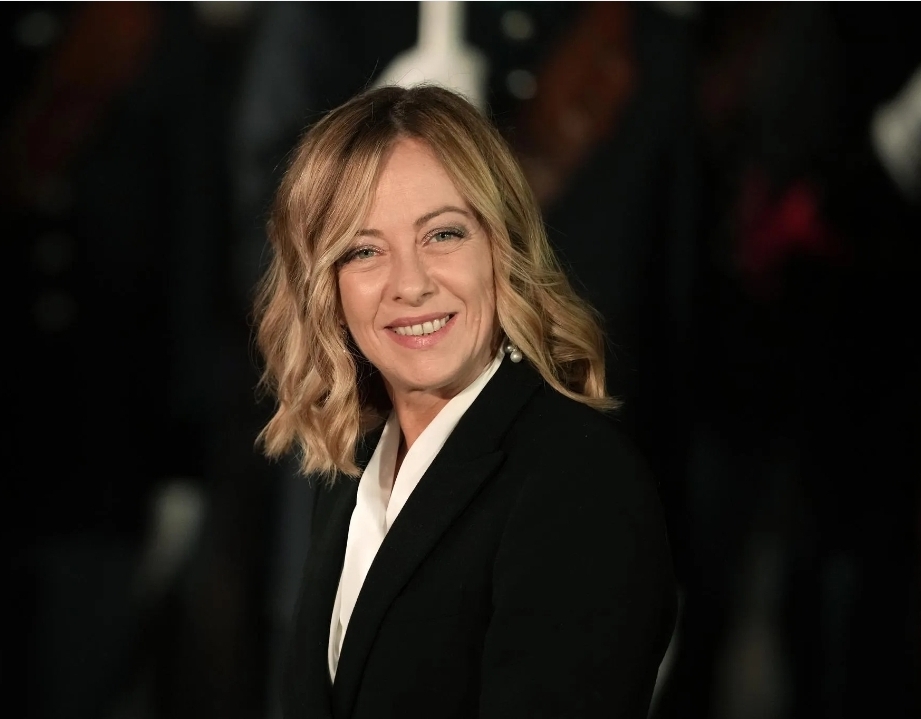
From bogeyman to recognised politics, an extraordinary rise
Born on 15 January 1977 in Rome, Giorgia Meloni entered politics at the age of 15 within the Italian Social Movement, the heir to the National Fascist Party. She continued her path in National Alliance, became Minister for Youth under Berlusconi, and then in 2012 founded Brothers of Italy, a national-conservative party which she has chaired since 2014. In 2022, she led this long-marginalised party to electoral victory, becoming the first woman to head a government in Italy.
In the beginning, fears were numerous in Europe: far-right in government, Italy on the brink of financial ruin, overt sovereignty. Yet, she quickly entrusted sensitive portfolios to moderate figures, adopted an austerity policy compatible with Brussels« demands, and secured access to funds from the European recovery plan. Within the space of a few months, she was deemed »serious and reasonable" by her Western partners. This is the first metamorphosis.
The transatlantic honeymoon, a calculated gamble, a foretold deadlock
When Donald Trump returns to the White House in January 2025, Meloni positions herself as his privileged interlocutor in Europe. She is the only European leader to attend his inauguration, and has since presented herself as a transatlantic bridge between Washington and Brussels. Trump describes her as a friend and a great leader. Her political memoir Io Sono Giorgia is republished in English with a preface by the US president.
However, for Mario Del Pero, professor of international history at Sciences Po Paris, questioned by France 24, the split was structurally inevitable: it was becoming politically unsustainable for Meloni to be associated with Trump, whose popularity had collapsed in Europe and in Italy. The initial choice to place herself in Washington's orbit was a rational calculation, to obtain leverage to influence European negotiations, but it carried a systemic risk that Meloni was slow to measure: Trump is not a partner, he demands vassalage.
A 2026 Statista poll showed that Meloni's approval rating had dropped to 39 %, with a record 55 % disapproval rating. Analyses conducted after the defeat in the March 2026 referendum on judicial reform confirmed that a significant portion of the backlash was directly linked to her perceived closeness to Trump. The political signal was unequivocal.
The triple decoupling of April 2026, sovereignty as a necessity
The turning point arrives in April 2026, on three simultaneous fronts.
First disagreement: Iran
Italy refuses to support the American war against Tehran and bans American bombers from landing at an air base in Sicily.
Second split: Israel
Rome decides not to renew the defence memorandum with Tel Aviv, which was automatically extended every five years.
Third and decisive fracture: the pope
Trump takes a swipe at Pope Leo XIV, and Meloni chooses her side. «I find President Trump's words regarding the Holy Father unacceptable,» she declares. Trump's reply is not long in coming in the columns of the Corriere della Sera: «I thought she had courage, but I was wrong.».
The breakup triggers an unexpected sequence
The Italian press is talking of rediscovered national unity, and Meloni's main opponent, Democratic Party leader Elly Schlein, is coming to her defence in Parliament: «No foreign head of state can attack, threaten or disrespect our country.» Trump had achieved the feat of making the Italian left applaud Meloni.
Geopolitically, the mechanics are clear: the war in Iran, combined with the traditional anti-war sentiment of the Italian electorate found on both the left and the right, has forced Meloni not only to distance herself from Trump, but to criticise him publicly at every opportunity. This is not an ideological conversion. It is political survival elevated to a doctrine.
The erasing of the Orbán model, why the hard right can no longer be pro-Trump in Europe
To understand the speed of Meloni's U-turn, one must look at Budapest. Viktor Orbán's defeat in the Hungarian elections served as a wake-up call for the entire European national-populist right. Meloni learned her lesson: getting too close to Trump is now counterproductive, as his hegemonistic ambition clashes head-on with the national sovereignties that this right claims to defend. The contradiction was insurmountable. One cannot be a sovereignist and a vassal.
The deterioration of the Meloni-Trump relationship is not merely personal or rhetorical: it signals the collapse of fragile common ground between a Europe seeking partnerships and a United States now demanding unconditional loyalty.
The European quartet: Meloni changes orbit
Meloni, Macron, Merz and Starmer now form a sort of geopolitical quartet
United by shared necessity. If Meloni was once a transatlantic bridge, she is now helping to build something quite different alongside her European counterparts.
Gathered in Paris in April 2026 for a conference bringing together 49 countries, these four leaders accelerated plans for a defensive and neutral mission designed to secure navigation in the Strait of Hormuz, outside the US framework. The image is a powerful one: Europe, with Rome in the picture, is asserting an autonomous capacity for action in a major strategic zone.
Meloni, defending herself against being under Trump's influence
She told Parliament: «I am neither blindly for Europe nor for the United States. I am in Europe because Italy is in Europe.» Since the foundation of Brothers of Italy in 2012, she has placed close ties with Washington at the heart of her foreign policy, but Trump's heavy-handed methods with his long-standing allies have unsettled Atlanticists and forced Europe to review its geopolitical options.
This repositioning reveals something deeper than an electoral tactic: it points towards a vision of Italy as a sovereign power in its own right, neither a satellite of Washington nor a province of Brussels.
The Mattei Doctrine, the Mediterranean as a space of power
The true geopolitical marker of the Meloni mandate is not the break with Trump. It is the reformulation of a long-term Mediterranean and African ambition
It is embodied by the Mattei Plan.
While France has long monopolised the position of leading European power in the Mediterranean, the progressive erosion of its influence is paving the way for a redistribution of regional roles, encouraging a return of Italy to centre stage.
The name chosen is not accidental. ENI, controlled by the Ministry of Economy, represents a jewel of Italian state capitalism which has always cultivated privileged relations with hydrocarbon-supplying countries, inheriting the policy of Enrico Mattei in the 1950s, when the founder of ENI offered more favourable contracts to producer countries than those practised by the «seven sisters», the major Western oil groups of the era.
The Meloni government's Mattei Plan aims to link European energy security to the southern shore of the Mediterranean
The plan pursues several convergent objectives
First, to strengthen Rome's position within the European Union, reduce French influence in the Mediterranean space and reassure the United States by seeking regional partners capable of managing energy and security issues.
With a 5.5 billion euro commitment over five years and 14 African countries targeted, energy occupies a central place in the scheme. ENI, a long-standing player, is already very active in Libya, Egypt, Algeria, Nigeria and Mozambique, supplying a major share of Italy's gas, particularly since the energy crisis linked to the war in Ukraine.
This strategy goes beyond the migration policy hastily attributed to it. It outlines an Italy that aspires to become Southern Europe's energy hub, the main interlocutor for the French-speaking African continent—whose French influence is declining—and the key player in the central Mediterranean. It is the old dream of «neo-Atlanticism» à la Fanfani, revisited for the 21st century.
Italy as a middle power, the limits of a project
Meloni’s trajectory illustrates a structural tension that all mid-sized countries experience: they are too large to submit without resisting, too small to impose alone. Her heart was on America's side, but her head told her that Italy is in Europe and that its economy is intertwined with Germany's.
Domestically, the Meloni coalition has just made history as the second-longest-serving government in republican Italy
Fratelli d’Italia is holding steady at 30 % in the polls. However, the defeat in the March 2026 referendum revealed that the opposition, if it puts forward clear ideas on common ground, can mobilise a majority. One year ahead of the 2027 general election, Meloni is navigating a turbulent patch: referendum defeat, persistent energy crisis, war on Europe's doorstep.
What remains established, on the other hand, is a lasting transformation of the Italian posture on the international stage
Meloni’s Italy is no longer the weak link in Southern Europe nor the compliant partner to whoever is willing to listen. It is playing its own tune, sometimes dissonant, often calculated, that of a country which has rediscovered that geography is a destiny, and the Mediterranean, a heritage to defend.
There is a profound irony in the trajectory of Giorgia Meloni. She came to power bearing the banner of an inward-looking, identity-based nationalism, and she governs by practising a realistic and multilateral state diplomacy, more the heir to De Gasperi than to Mussolini. She was celebrated by the global hard right as one of their own, and today she is one of the figures who most clearly reaffirms the primacy of national sovereignty in the face of imperialisms of every kind, including that of Washington.
The geopolitical lesson is simple, and cruel for Trumpism
You cannot be both the champion of nations and the overlord demanding their allegiance. Meloni understood this before many others. She drew the consequences, at the cost of a spectacular break. She has not emerged unscathed from the last three years, but she has emerged on her feet, and in an international system undergoing accelerated recomposition, that is already a first-rate achievement.

 French
  English
  Chinese
  Arabic