
Essay on Responsibility, Judgement and Artificial Intelligence
An old question, in a new light
Some time ago, I published an article entitled: «Is AI an author, an editor or a mirror?»
I was asking a question there that seemed to me more important than the one that keeps coming up: «Was this text written by a human or by a machine?»
In my view, the real question lay elsewhere: who writes, certainly, but above all Who actually takes responsibility for the thought expressed in a text?
I also recalled there that this question was not born with AI.
For a long time, writing has raised questions of authorship, rewriting, correction, influence, and even style as supposed proof of intelligence.
AI therefore does not bring to light an entirely new problem. It simply makes an old confusion more visible: that between produce a text and produce a thought.
Because AI can rephrase, structure, correct, suggest and sometimes even contradict. But it cannot answer from an idea. It cannot explain it as a lived experience, nor take responsibility for it as an intellectual stance.
This responsibility remains with the author.
When the debate goes round in circles
Since then, I have been reading numerous articles on AI every day. I understand that the subject fascinates as much as it worries. It touches on writing, creation, work, intelligence, instead of the human.
But by dint of reading these articles, another problem became apparent to me.
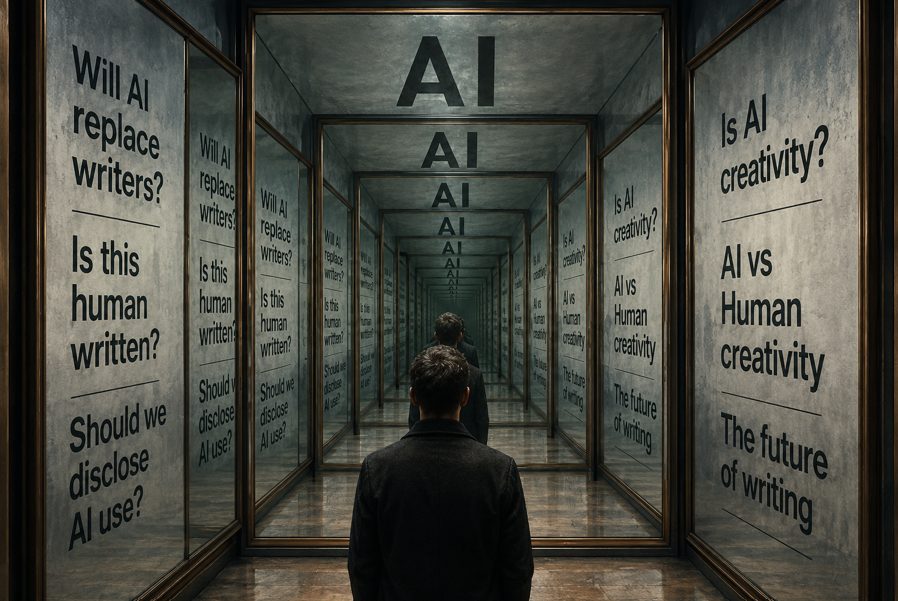
It's not just AI that repeats.
This is also our way of debating AI.
The same questions keep coming up over and over again:
- Will AI replace writers?
- Is it still possible to tell the difference between a text written by a human and one generated by a machine?
- Should we admit that we use ChatGPT?
- Is AI-assisted text still authentic?
These are legitimate questions. But all too often, they are phrased as though nobody had ever raised them before.
The problem is not that we talk too much about AI.
The difficulty arises when the debate becomes poor, when it contents itself with repeating the same oppositions:
- man versus machine; ;
- authenticity versus assistance ;
- creativity versus automation.
Responsibility cannot be delegated
At times, you could almost believe you were still hearing the echoes of an imaginary world shaped by several decades of science fiction. Since Terminator, the idea of an intelligent machine escaping its creator has become a familiar trope in our culture. Of course, cinema alone is not responsible for our current concerns, but it has helped to establish a portrayal of artificial intelligence as a potential threat, even before it made a visible appearance in our daily lives.
If artificial intelligence is to worry us, it is perhaps not primarily for its ability to produce texts, to reformulate ideas or to imitate certain forms of human creation. The most serious issues are already appearing elsewhere: in military and security applications, where AI systems participate in information analysis, target identification and the acceleration of decision-making.
Do you remember when computers first started being used in businesses? Back then, you’d often hear people say: «It's a computer error.» Yet, a computer merely processes the data and instructions that we provide it with.
This old formula already revealed a tendency to transfer to the machine a responsibility that remains human.
Besides, this mechanism is not new. More than twenty years ago, the wars in Iraq were already popularising expressions like «surgical strikes» or «collateral damage». Today, as artificial intelligence contributes to the identification of targets and accelerates the military decision-making chain, the vocabulary has changed little. The machines are evolving. The euphemisms remain.
Since 2023, the conflicts in Gaza, Lebanon and more recently in Iran have made this reality even more visible. The more technical systems interpose themselves between the decision and its consequences, the more responsibility seems to dissolve.
Yet the question remains open.
Who is the author of a massacre?
The algorithm that recommends a target? The analyst who validates it? The command that orders it? The pilot who executes it? Or the political power that decides?
The multiplication of intermediaries does not eliminate human responsibility. It only allows each of us to claim an ever smaller part of it.
War crimes without perpetrators do not exist.
When man imitates the machine
But let's return to the civil sphere. Because unfortunately that’s where it is which today focuses much of the public debate.
The old opposition between the power of discourse and the truth of discourse It also manifests itself in certain reactions to AI.
I even recently read, elsewhere on the web, the text of a writing professor who denounced a form of unfair competition exercised by AI.
This complaint bothered me, not because it was entirely illegitimate, but because it seemed to grant AI what it does not exactly possess: the ability to produce thought.
AI does not therefore create a new philosophical problem. It re-raises an old Socratic question. Should a text be judged by its eloquence or by the truth it conveys?
If we come to believe that a machine is competing with us in the field of thought itself, then the problem may not be the power of AI.
The problem is that we have stopped fully inhabiting our own thinking, This is certainly even more serious than not being able to read anymore.
Because if reading doesn’t improve our ability to reason, then what’s the point?
Montaigne already preferred A well-made head to a well-filled head. His warning has undoubtedly never been more relevant. For our minds no longer risk being cluttered with knowledge alone, but are now overwhelmed by generated texts. faster than some will be able to understand its meaning.
As AI becomes more prevalent in our daily lives, the number of positions is increasing.
In some people, it becomes almost a compulsive reflex.
We are already seeing a symptom of this: instead of asking ourselves whether a text is true, just, or enlightening, we go through it diagonally, searching for clues that will help us find out who — or what — wrote it.
Yet, an erroneous reasoning does not become more just because it is human.
Perhaps this is the real paradox: at the very moment when AI is accused of producing repetitive texts, part of human writing about AI becomes repetitive itself.
This essay could have been titled: « The real problem is not that AI is writing. It’s that humans are repeating themselves.»
I could also have called him: «When humans write about AI as machines.»
Or, even more provocative: AI! AI! AI!
Like a loop: by repeatedly asking the same questions about AI without really delving into them, the debate sometimes ends up resembling more of a sound than a thought.
But let's be clear.
I’m not saying that we shouldn’t continue to write about AI. On the contrary. But writing on a subject that is already saturated requires bringing a new angle, a distinction, an idea, or something that justifies a new perspective.
Who feeds whom?
One could then open another question: who fed the machine?
Because AI did not emerge from nowhere. It was trained by billions of texts, conversations, data, and human interactions, especially through the Internet and communication technologies.
In this sense, it is human intelligence. who instructed Artificial intelligence.
But maybe what worries the human being is not only that the machine imitates him, but that the student ends up surpassing the master. Blade Runner This concern had already been addressed: the creature becomes a disturbing mirror, revealing less of what it is than what its creator no longer understands about himself.
However, it is necessary to add an essential nuance: Having knowledge does not yet mean being self-aware.
Knowing is not living. And living is not just about accumulating experiences; it is also about letting them transform you and then responding to what you become.
It may not be what an intelligence knows that defines it, but what it is capable of assuming.
AI can process, recompose, and reconstruct forms derived from human experience, but she does not yet possess this experience as a consciousness.
Of course, we can extrapolate. Science fiction has been exploring these questions for a long time.
But it may not be the most urgent debate.
It is disconcerting to be perplexed by what we ourselves have conceived.
This perplexity should perhaps lead us to greater humility.
Let’s instead strive for more constructive, in-depth discussions that can teach us something about AI., but also on ourselves: on certain aspects of the human mind, on our way of thinking, of transmitting, of imitating, of creating and of believing.
And perhaps it will remind us that we ourselves are the result of a greater intelligence, which manifests itself everywhere, from the infinitely great to the infinitely small.
Perhaps artificial intelligence does not require us to first ask ourselves what it becomes, but what we are becoming ourselves.
And perhaps this detour brings us back to an older question: that of the intelligence at work in the real world.

 French
 English
 Chinese
 Arabic