
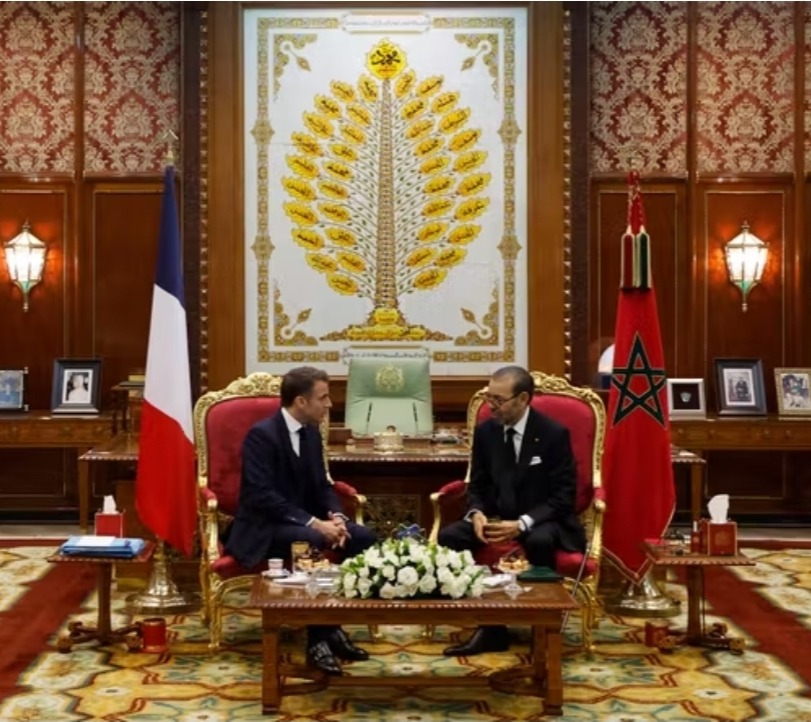
It will have taken several years for this trip to take shape. On 20 May in Rabat, the French and Moroccan Foreign Ministers formalised the preparation of a state visit by Mohammed VI to France, accompanied by the signing of an unprecedented bilateral treaty. The last visit of this level dates back to March 2000, a few months after the Moroccan sovereign's accession to the throne.
Long discussed then deferred, this visit comes after a phase of gradual warming in Franco-Moroccan relations. Far from having been lost, this time has allowed the two capitals to methodically rebuild a relationship weakened by several years of diplomatic tensions.
The time for reconciliation
Between 2021 and 2023, Paris and Rabat went through a period of tension rarely seen for several decades. The Pegasus affair, widely reported by the international press, had fuelled a climate of mistrust between the two partners. At the same time, the reduction in the number of visas granted to Moroccan nationals had caused deep incomprehension in Morocco, further chilling the bilateral relationship.
The rapprochement took place gradually, through discreet diplomatic exchanges, repeated ministerial contacts and a shared desire to restore trust. But it was primarily in the summer of 2024 that a major political turning point occurred. In a letter addressed to King Mohammed VI, Emmanuel Macron clarified the French position on Western Sahara by asserting that the territory's future lies within the framework of Moroccan sovereignty.
This gesture, long awaited by Rabat, opens a new phase in relations between the two countries. A few weeks later, Emmanuel Macron is received in Morocco in a particularly solemn format, while a visit by the Moroccan sovereign to France begins to be prepared.
A foundational treaty
The significance of this sequence goes far beyond a diplomatic symbol. The treaty currently being prepared between Paris and Rabat aims to structure Franco-Moroccan relations for the coming decades. For Morocco, this will be the first treaty of its kind concluded with a European country. For France, it will be the first strategic agreement of this level signed with a non-European partner.
Discussions are focusing on key sectors: defence, security, the energy transition, industry, aeronautics, and economic cooperation. A High Joint Commission is due to meet in Rabat to outline the main areas before the royal visit.
This development reflects a shared desire to move beyond the traditional historical relationship to build a partnership more focused on contemporary strategic issues.
A regional reshuffle
This Franco-Moroccan rapprochement is also part of a broader restructuring of regional balances in the Maghreb and in Africa. By clarifying its position on Western Sahara, Paris has embarked on an important diplomatic repositioning in the region, provoking critical reactions from the Algerian side.
At the same time, Morocco has significantly strengthened its economic and diplomatic position on the African continent, becoming a central player in trade between Europe and West Africa. For France, faced with a decline in its influence in the Sahel in recent years, Rabat now appears as an essential partner in its African and Mediterranean strategy.
Rabat’s diplomatic gains
For the Moroccan kingdom, this visit is part of a diplomatic strategy pursued consistently for several years regarding the Western Sahara issue. After the United States, followed by Spain and Germany, French support represents a significant diplomatic breakthrough for Rabat on the international stage.
The prospect of concluding a strategic treaty with a permanent member of the United Nations Security Council further reinforces this dynamic. In this context, the return of King Mohammed VI to the forefront of the international diplomatic scene appears as an important political moment for the kingdom.
A signal sent to Europe
Beyond the bilateral relationship, this rapprochement between Paris and Rabat also sends a broader message to European partners. At a time when major powers are stepping up their initiatives for influence on the African continent, France is seeking to redefine its regional presence through more structured and more balanced partnerships.
Morocco, whose African ambitions continue to grow, is establishing itself from this perspective as a leading interlocutor.
Therefore, Mohammed VI's visit to Paris will not merely represent the return of a diplomatic sequence that has been suspended for several years. It could mark the opening of a new strategic cycle between the two countries, based on converging interests and a shared desire to redefine their partnership within a rapidly changing international environment.

 French
  English
  Chinese
  Arabic