
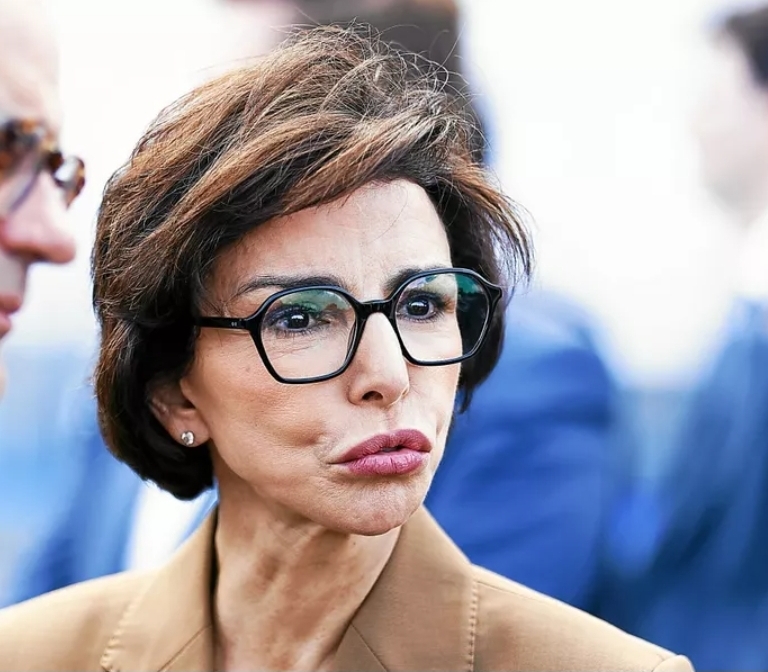
It took creating an entire website to catalog them. WikiDati.fr lists twelve of them. Twelve separate dossiers, prosecuted by different jurisdictions, revealed by independent journalistic investigations. They were conducted over several years by «Libération», «Blast», «Le Monde», «Franceinfo» and even «Complément d’enquête». On Tuesday, May 12, 2026, a thirteenth branch has just emerged, under the sign of the alleged surveillance of a lawyer from the Paris bar.
Rachida Dati is no longer a minister. The Paris City Hall missed her out for the second consecutive time. But her judicial agenda, on the other hand, remains constant. Behind the official trajectory, the daughter of immigrant workers, lawyer, Minister of Justice under Nicolas Sarkozy, and Minister of Culture, another biography emerges: that of a politician whose accumulated judicial files paint a disconcerting portrait.
The founding case: Renault, Ghosn, and the 900,000 euros
It all officially began with a convention signed in 2009 between Rachida Dati and Carlos Ghosn, then the all-powerful boss of the Renault-Nissan alliance. The stated purpose: legal advice and assistance in international development. The fees are high for a former recognized minister. The reality described by investigators from the National Financial Prosecutor’s Office is radically different.
Behind the lawyer’s facade, they suspect lobbying by the European Parliament in favor of an automobile manufacturer whose interests were directly affected by the eurodeputized’s votes. Because while European parliamentarians have the right to practice the profession of lawyer, they are formally prohibited from lobbying. This is the entire line of disagreement between Rachida Dati’s version and that of the investigators.
Renault's new management disputes the reality of the work
For three years, the payments kept coming in. The new management of Renault-Nissan launched an internal audit after Ghosn’s spectacular fall in 2018. It believes that the actual amount of work invoiced has never been proven. The final bill exceeds 900,000 euros. A minority shareholder of Renault, Danièle Coutaz, represented by her lawyer Jean-Paul Baduel, filed a complaint in 2019. The National Financial Prosecutor’s Office opened an investigation. Two years later, in 2021, Rachida Dati was charged with corruption and passive bribery.
During her hearings, Dati consistently defended her version: she was the driving force behind the opening of the large automobile factory in Tangier, Morocco; helped find a favorable legal framework; facilitated the group’s establishment in the Maghreb and the Middle East. Several testimonies collected by Radio France contradict this version. A Renault-Nissan lawyer, quoted by Franceinfo, succinctly summarizes the situation: «In 2010, everything was already in place.»
In July 2025, the judges order the referral to criminal justice. The trial is set for September 16-28, 2026, at the judicial tribunal in Paris. Carlos Ghosn, who has been living in Lebanon since his spectacular escape in 2019, will be tried in his absence. For Rachida Dati, this will be the first substantive judicial confrontation over the case that triggered everything.
The double hat: MEP by day, big-business lawyer by night
The Renault-Ghosn affair is not an isolated case. It is part of a pattern that, as the investigations progress, seems to have been systematic over the ten years in the European Parliament.
«Libération reveals that starting in September 2010, Rachida Dati also became a lawyer for the Orange group. The remuneration is substantial, spread over several years. The problem is the same as in the Renault case: a member of the European Parliament cannot lobby. However, the interests of Orange, a telecommunications operator directly exposed to European regulations, were precisely within the scope of the texts voted in Parliament.
Lobbying in favor of fossil fuels?
But the story doesn’t end there. An investigation conducted jointly by «Complément d’enquête» and Le «Nouvel Obs» and published in June 2025 reveals payments received through a Parisian firm corresponding to payments made by GDF Suez during the same period. The timing is particularly troubling. Indeed, during these years, Rachida Dati adopted positions in the European Parliament deemed favorable to the gas sector. She signed a tribune in «Les Échos» calling for the cessation of subsidies for renewable energy. The plea corresponded point by point to the interests of a group like GDF Suez.
When asked about this aspect, she claimed that GDF Suez had «never been her client.» Two elements undermine this version: mentions found in the notebook of her parliamentary assistant and invoices seized during subsequent searches. For «Transparency International France,» the common thread of all these cases is identifiable. Behind the various structures, Renault-Nissan, Orange, and GDF Suez each appear to follow the same logic of interests. The logic of fossil fuels and large industrial groups seeking to influence European decisions, through a lawmaker suspected of using the powers of her mandate to favor them.
Azerbaijan and caviar diplomacy
This may be the most difficult to pull off, and one of the least publicized until the recent raids. Rachida Dati is described by « Libération » as the face of Baku’s lobbying in France. She sits on a group that « Le Monde » calls the main instrument of « caviar diplomacy». This strategy of influencing the authorities among European elected officials consists of buying political influence in Western Europe. The goal: to counter criticism of democracy and human rights in this oil-rich country in the Caucasus.
The concrete manifestations of these links are numerous. She congratulates President Ilham Aliyev on re-elections that international observers view with evident skepticism. His agendas, seized during searches as part of a separate procedure, reveal contacts with SOCAR, the country’s national oil company. The links between his political positioning on energy issues and Azerbaijani oil interests feed the investigators’ suspicions.
A judicial investigation into this aspect will be opened in the autumn of 2025. The dimension is particularly sensitive. Indeed, it touches on the question of foreign influence on French and European democratic institutions. A subject that, since the Qatargate, has become a priority for specialized prosecutors.
Qatar and the shadow of the Qatargate
The Qatari component was added to the overall package in 2024, in a particularly sensitive context. When «Blast» publishes working documents written by Rachida Dati’s parliamentary assistants, it appears that some of them deal with topics directly related to Qatar. They seem to have been written with a view to a minister of the Doha government in mind. Indeed, these documents do not resemble internal working notes. They have the appearance of briefings intended for an external recipient of the parliamentary institution.
The timing is particularly sensitive. Europe is currently dealing with the Qatargate scandal, the alleged corruption case at the European Parliament that broke in 2022. It led to the arrest of several Europarliamentarians and associates, including the Vice-President of the Parliament, Eva Kaili. In this context, parliamentary documents apparently transmitted to the Qatari government are particularly resonant.
The National Financial Prosecutor’s Office opens an investigation, then a judicial investigation. In December 2025, the investigators step up the pace: they search Rachida Dati’s home and her offices. This is a sign that the investigations are no longer at the exploratory stage but that concrete elements now justify coercive actions.
The jewels, Henri Proglio and the declaration of assets
In the spring of 2025, Libération reveals a more internal affair whose legal implications are serious. A collection of high-value jewelry was not mentioned in Dati’s asset declaration to the High Authority for the Transparency of Public Life. The pieces identified by the newspaper bear prestigious signatures of Cartier, Bulgari, and Chopard.
A few months later, « Blast » takes the investigation further and lists about thirty undeclared items. The estimated value could exceed several hundred thousand euros. But there is another detail that draws attention: the purchase invoices for these jewels are not in the name of Rachida Dati, but in the name of Henri Proglio, her former CEO at EDF, her partner. The question of whether these assets constitute a benefit in kind that should have been declared to the transparency authorities arises with urgency.
When asked, Rachida Dati brushed off the accusations: she has nothing to regulate, she has never been found in violation of the law. The Paris prosecutor’s office, however, considers the matter serious enough to open a preliminary investigation, entrusted to the Financial and Anti-Corruption Brigade. This is a less extensive procedure than a judicial inquiry. But it means that the facts are deemed worthy of a thorough investigation.
The « barbouzeries of PSG » and the clandestine surveillance of a lawyer
The thirteenth case, the most recent, is arguably the most politically spectacular. Its origins are a vast judicial file called the «barbouzeries» scandal surrounding Paris Saint-Germain. Former officials of the Parisian club, police officers, and the Franco-Algerian lobbyist Tayeb Benabderrahmane are suspected. This central figure in the case is described as being close to Rachida Dati. His links with the entourage of PSG president Nasser Al-Khelaïfi are at the heart of the investigation.
It was while investigating this sprawling case that police officers made a surprising discovery. Investigations had been conducted, clandestinely, into an Air France shareholder who had filed a complaint against Rachida Dati and her lawyer. Specifically: consultations of Air France listings, questioning of files by police officers. If these were indeed carried out for surveillance purposes, they would constitute a serious infringement on individual freedom and privacy.
The alleged victims are Jean-Paul Baduel and his partner Danièle Coutaz, who dared to file a complaint against Rachida Dati in 2019 in the Renault-Ghosn case. Baduel had himself filed a complaint in late 2022 regarding this «secret investigation» targeting them. «There are malicious intentions behind this investigation against me and my wife,» he declared on May 12, 2026. He welcomed Dati’s placement under the witness-assisted status. «It’s a good start,» the lawyer added modestly.
«Witness assisted»
The judicial hearing took place discreetly. Initially scheduled for March (during the municipal campaign), it was finally held on Thursday, 7 May 2026, at the Paris judicial tribunal. Rachida Dati was heard as an assisted witness. At this stage of the proceedings, she is not being prosecuted in this aspect. She contests all the charges.
A second component, called «Air France files,» concerns the circulation of confidential documents between the corridors of power and certain newsrooms. Again, two separate summonses were sent to him: one to the PJ police officers, another to the investigating judges themselves.
The Benabderrahmane network and residence permits
Alongside the PSG affair, elements consulted by « Le Monde » in early 2026 reveal another dimension of the links between Rachida Dati and Tayeb Benabderrahmane. According to these reports, she intervened repeatedly between 2018 and 2021 to support applications for residence permits for relatives of the lobbyist, including an Algerian investor. These interventions were nothing short of extraordinary: they would testify to a close relationship strong enough for the elected member of the 7th arrondissement of Paris to use her network in favor of the lobbyist’s entourage.
The burden of proof is particularly heavy here. Indeed, these interventions were confirmed to the investigators by Benabderrahmane himself, who therefore did not seek to protect Dati. But also by the political aide of the elected official in the 7th arrondissement. Two internal sources, therefore, which converge to describe facts that Rachida Dati disputes.
The 2024 appointment: a minister charged with a crime in the Ministry of Culture
We must return to a particular moment in this judicial biography that caused deep unease in the French public debate. In January 2024, while she has been under investigation for corruption and influence peddling for three years, Rachida Dati was appointed Minister of Culture in the Borne and then Attal governments.
This appointment was legally possible. But it raised a question of a nature not only moral but institutional as well. Can the Ministry of Culture, which oversees, among other things, public subsidies for the press, subsidies for the media, and support for creation, be entrusted to a minister who is simultaneously the subject of investigations for corruption? The question raised concerned the credibility of the institutions themselves and the separation of powers.
She left the government without the trial scheduled for autumn 2026 having taken place. Her ministerial agenda has lightened. Her judicial agenda, on the other hand, has continued to fill up.
The strategy of procedural-based procedures
Faced with the accumulation of revelations, Rachida Dati chose the path of legal action. This is a well-documented legal strategy, which lawyers call strategic law suits against public participation (SLAPP). Not to win, but to discourage, exhaust, and intimidate journalists, activists, and witnesses who might speak out.
When Aurélie Filippetti, former Minister of Culture, publicly mentions these Azerbaijani connections, Rachida Dati sues her for defamation. The outcome is striking: Dati will be convicted, paying two thousand euros to Filippetti for abuse of process. Dati sued «Le Canard Enchaîné» for defamation and lost as well. She attempted to have «WikiDati.fr» closed by contacting the site’s hosting company directly, without success. Dati publicly criticized the judges who are investigating the case, attacks that the president of the criminal court denounced as «discrediting the judicial authority.».
For Transparency International France, this strategy «undermines trust in the judicial system and constitutes another damaging attack on the foundations of the rule of law». The organization sees this not as a defense of a politician unjustly attacked but as a means of neutralizing civil society and the press.
What this sequence reveals is also the asymmetry of the means. An investigative newspaper, an association, a militant – all of them can find themselves embroiled in lengthy, costly, exhausting procedures, even when they are right on the substance. The threat of trial is sometimes enough to dissuade them from publishing, from testifying, from denouncing. This is precisely the effect sought.
What this dossier says about France and Europe
The Dati affair, viewed as a whole, goes far beyond the personality of the former minister. It highlights several glaring flaws in the functioning of the institutions.
The first is the control of European mandates.
For ten years, a French MEP was able, according to the accusations, to combine paid private activities with votes on texts directly related to her alleged clients. Without the existing control mechanisms triggering any alert. The European Parliament has rules on conflicts of interest, but they are largely based on self-declaration and the good faith of elected officials. In France, the HATVP could only belatedly identify omissions in her statements. The specialized prosecutors, on the other hand, were only alerted following complaints from private individuals. There are no automatic detection mechanisms.
The second dead end is that of foreign influence
The Azerbaijani and Qatari cases illustrate how authoritarian states or oil-rich regimes can try to buy their way into the very heart of European institutions. The Qatargate showed that the problem was structural, not individual. The Dati case illustrates it again, from a different angle.
The third is the appointment of elected officials who have been charged with executive functions.
France is one of the few democratic countries that has no automatic rule preventing a minister under investigation from remaining in office. The debate on this point has existed for decades, without any reform having been implemented.
The September 2026 trial: a test for French justice
The planned criminal trial from September 16 to 28, 2026, will be a test. Not only for Rachida Dati but for the ability of the French justice to deal thoroughly with cases involving money, politics, and foreign influence at the highest level. The media pressure will be intense. Rachida Dati’s defense, provided notably by Messrs Olivier Pardo (Netanyahu’s lawyer before the International Criminal Court) and Olivier Baratelli. It will undoubtedly mobilize all available means to challenge the charges.
Carlos Ghosn, however, will be tried in his absence from Beirut. The former head of Renault-Nissan, who has presented himself as a victim of a political-judicial conspiracy since his spectacular escape from Japan in 2019, has not shown any intention of returning to France. His absence deprives the trial of a key player, but it does not prevent it from taking place.
For now, everything is fine
In the meantime, until this major judicial hearing takes place, the woman continues to claim to be the victim of an unprecedented judicial and media onslaught. She contests every case, every revelation, every summons. Her line of defense is consistent: she is a political figure targeted because she is disruptive; because she is a woman; because she is of immigrant origin; because she embodies a certain idea of republican virtue that her opponents would not tolerate.
His lawyers do not comment. His entourage does not respond to requests from journalists. And the files, meanwhile, continue to pile up.

 French
  English
  Chinese
  Arabic