
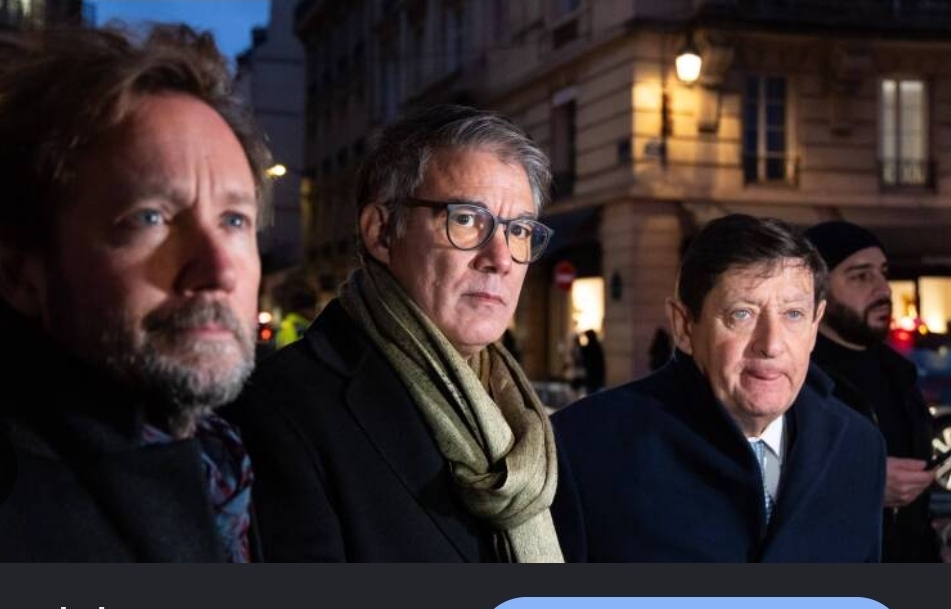
However, Vallaud is not leaving the PS: he is keeping his membership card and the presidency of the parliamentary group. He is only stepping down from the governing bodies, thereby maintaining his institutional legitimacy while positioning himself as an internal opponent, free to criticise the party line without being bound by collective responsibility.
In a letter addressed to Olivier Faure, Senator Alexandre Ouizille, representative of the faction, denounces a «botched collegiality», a «brutalisation of the functioning» of the bodies and a «strategy of isolation and stagnation». The leadership of the PS responded laconically: «You cannot build anything lasting by brutalising your partners.»
The heart of the conflict: primary or internal selection?
Behind the personal dispute, there is a deep disagreement over the left's strategy for the 2027 presidential election. Olivier Faure defends an open primary of the left and the Greens, a broad consultative process to designate a common candidate. Vallaud categorically rejects this option. He argues for a Socialist-first designation — the PS must appoint its own leader before any coalition — followed by the construction of an alliance around a clear programmatic foundation, with Raphaël Glucksmann and Yannick Jadot, without depending on a mechanism that would advantage figures with high external notoriety. His position can be summed up by a formula: «My only concern is that in the end, there is a single non-Mélenchonist left-wing candidate.»
This divergence is not insignificant. The question of the primary is above all a question of the balance of power. For the PS, agreeing to an open primary means risking having its identity absorbed by a dynamic it cannot control. Faure sees it as a tool to avoid the fatal dispersion of left-wing votes in the first round. Vallaud sees it as a mechanism likely to further weaken an already fragile party.
The LFI variable: the real ideological divide
The question of La France insoumise constitutes the real symbolic turning point between the two men. A section of the Socialists, led by Vallaud, believes that too close an alliance with LFI blurs the social-democratic identity of the PS and costs it votes in medium-sized towns where it is seeking to establish a foothold. During the recent municipal elections, Vallaud's camp had already denounced the leadership's ambiguities regarding local alliances with the Insoumis.
Faure, on the other hand, has opted for the broadest possible alliance, continuing his strategy from the 2024 legislative elections. His calculation is simple: to avoid a fresh dispersion of left-wing votes in the first round, which would repeat the scenario of 2002 or 2022, where multiple left-wing candidates cancelled each other out. Vallaud, meanwhile, is arguing for an identifiable social-democratic line, less LFI, more Glucksmann, capable of attracting a centre-left electorate that currently feels orphaned. This is not merely a dispute among strategists: it is a disagreement over the very identity of the Socialist Party.
Faure weakened, but still in office
Institutionally, Faure remains First Secretary, but his authority is considerably weakened. Re-elected at the Nancy congress in June 2025 with only 51.15 % of the votes cast, he was already leading a divided party. The departure of the Vallaud faction places him in the position of a de facto minority: he keeps the title, but without a real majority in the bodies he chairs.
Several figures from the PS seized the opportunity to openly call for his resignation. Karim Bouamrane, mayor of Saint-Ouen, stated that Faure was henceforth in a minority and that his roadmap for the presidential election was obsolete. Stéphane Le Foll recalled that he was the only one in 2021 to demand a debate in a party that had not debated for a long time. These statements outline the contours of a rebellion that goes beyond the Vallaud faction alone.
An identity crisis as much as an organisational crisis
Beyond the socialist dispute, this episode reveals a structural tension on the French left since 2022: how to rebuild a block capable of governing in a fragmented landscape between LFI, the PS, Place publique and the greens? The Vallaud-Faure fracture is not an accident; it is the resurgence of an unresolved debate over the identity of the non-insoumise left.
On the wider chessboard, several players are already positioning themselves. Glucksmann is refusing any primary and is fine-tuning his own roadmap. Circles close to François Hollande have launched Young People with Hollande, a signal that the former president is not ruling out a comeback. Faced with this confetti-like left, in the words of a party official, Jean-Luc Mélenchon remains the only one to have a solid and structured candidacy. The next key date is internal: a vote on the party's manifesto is scheduled between now and June 2026. That is where the true balance of power post-Vallaud will be measured.

 French
  English
  Chinese
  Arabic